The Mishna in Rosh Hashana (16a) lists Shavuos as one of the 4 times in the year that we are judged. The gemara in Megilla (31b) takes this very seriously. The gemara there comments that before the Yom Hadin we read the קללות. The gemara says I understand that we read the קללות in כי תבא before Rosh Hashana but what about the קללות in בחוקתי? The gemara answers that they are read before Shavuos.
On Shavuos we are judged for פירות האילן, fruits. The gemara in Rosh Hashana (16a) comments that therefore we bring the שתי הלחם on Shavuos. The obvious question is what do the שתי הלחם have to do with פירות האילן? The שתי הלחם are made with wheat which is not a fruit. Rashi there answers the question by saying that the Gemara is going with R' Yehuda's opinion that the fruit of the עץ הדעת was a חטה (wheat). However, this just shifts the question, after all wheat has not been a fruit for over 5000 years?
R' Goldvicht explained as follows. He said that fruits and wheat represent 2 ways that Hashem can deal with a person.
Fruits grow in a way that requires very little work. You plant the tree once and you forever have fruits. There is very little work in maintenance of the tree, the fruits grow every year, and you can just pick a fruit and eat it.
Wheat (really bread) on the other hand requires a tremendous amount of work. You first have to plow, then plant, then harvest, then do all the other melachos (winnowing, threshing, sifting, grinding, etc.). You can't just pick it and eat it. The next year you have to repeat the whole process.
Fruits represent the way the world was before the חטא, even wheat was a fruit. Food was easily obtained with little or no work and therefore man would have time to fully devote himself to serving Hashem.
Wheat or bread represents the world after the חטא. We live in a world of בזעת אפך תאכל לחם. It is a very difficult process to make that essential staple of life, bread. We have to work hard just to feed ourselves.
On Shavuos we are judged on פירות האילן, meaning we are judged how is Hashem going to relate to us, is he going to relate to us like before the חטא or after the חטא. Is our food going to be easy to obtain or is it going to be difficult. This is why we specifically bring the שתי הלחם, we want to remind Hashem that wheat was once a fruit as well. We hope to return to the days of before the חטא and have our food provided to us so that we can better serve him.
Hopefully we will all be זוכה in the din on פירות האילן this Shavuos and therefore be זוכה to have פרנסה ברוח ולא בצמצום and to be able to focus our energies on עבודת hashem and not on putting bread on the table.
Tuesday, May 30, 2006


Sunday, May 28, 2006
Making early Shabbos this week
This week Friday is Shavuos. Can you and maybe should you make early Shabbos?
There is absolutley no problem with making early Shabbos. In fact, the Mishna Berura in Siman 527 Sif Katan 3 writes that the minhag was to make early Shabbos specifically on this Friday. The reason is as follows.
The Gemara in Pesachim (46a) has a machlokes Rabba and R' Chisda, is there an issur d'oraysa if you cook on Yom Tov for a weekday. Rabba says no and R' Chisda says yes. Rabba says no because of ho'eel, since guests can come and eat the food it falls under the heter of ochel nefesh. R' Chisda disagrees. Rabba asks R' Chisda according to you how do we cook on Yom Tov for Shabbos? R' Chisda answers that tzorchei shabbos naasim, b'ytom tov, that you are allowed to prepare from Shabbos to Yom Tov.
There is a big nafka mina between the 2 opinions. What happens if you finish cooking very late in the day right before Shabbos? According to Rabba you are in trouble, the heter of ho'eel does not apply as there was not time for guests to come and eat the food on Yom Tov while according to R' Chisda there is no problem as you are allowed to prepare from Yom Tov to Shabbos.
It is not clear who we pasken like, Rabba or R' Chisda. Based on this the Mishna Berura writes that we should be choshesh for Rabba's opinion and finish cooking early in the day. Therefore the Mishna Berura writes the minhag was to make early shabbos.
The question is how does the minhag help. There are 2 possibilities:
1. It is a pyschological thing. If you make early shabbos then you will prepare earlier in the day.
2. It is a din.
There is a a big nafka mina, many people will finish their preparation 2 minutes before candle lighting whenever it is, therefore if early shabbos is because of 1 you gain nothing as people will finish cooking 2 minutes before lighting candles for early shabbos.
What is pshat that it is a din? The answer may be as follows. When you make early shabbos, you are turning a day of chol into Shabbos, you are adding kedusha. However, when that day is also Yom Tov, you cannot take away the kedushas Yom Tov, you can only add kedusha. Therefore, that time period of early shabbos has both kedushas. If this is true, if you finish cooking before early shabbos, then there is still time for ho'eel to kick in, until Yom Tov is actually over. Any food eaten before shkia will be a kiyum of simchas Yom Tov as well and therefore the heter of ochel nefesh would apply as well as the sevara of ho'eel.
To sum up, this Friday you should try to finish any cooking early in the day to be yotze Rabba's opinion and it is a good idea to make early Shabbos.
Sunday, May 21, 2006
Split between UTJ and Aguda
UTJ wants to join the coalition and accept the 500 shekel a month increase for families with 4+ kids. Aguda disagrees and wants everything restored, otherwise they won't join. Why is there this split? One theory is that the Chassidic Rebbes like the Gerer Rebbe have Chasidim coming to them all the time (every day) and fully understand the dire financial straits their Chasidim are in. They are close to their Chasidim and therefore understand what they are going through. On the other hand, R' Elyashiv and the other Roshei Yeshiva don't really meet with the average Kollel guy and therefore don't feel his pain. People don;t cvome to R' Elyashiv and complain that they can't pay their bills. Therefore, their opinion is a more theoretical one while the Rebbes are responding to their Chasidim.
Wednesday, May 17, 2006
The extremists win again - Montreal visit cancelled
The planned visit by R' Steinman and the Gerrer Rebbe to Montreal has been cancelled due to fears of protests by Satmar, etc. This is being reported all over the press (Haaretz Hasidic protest in Montreal scares off UTJ rabbis' visit, the Jerusalem Post Orthodox in US to protest rabbi's visit, etc.)
What exactly are they protesting?
They are protesting against R' Steinman, a 93 year old Rosh Yeshiva whose whole life is Torah.
His strong support for the Tal Law and the Nahal Haredi [a special army unit for haredi soldiers] made him a lot of enemies," said a source in Degel Hatorah, the Lithuanian faction of United Torah Judaism.
"The zealots express themselves in an unbridled way," added the source. "But their basic argument is accepted by a lot of people in the haredi community."
Unfortunately, the cancellation just gives more power to the extremists. The trip was cancelled to avoid a chillul hashem, however, all this publicity has created a chillul hashem in any case and exposed the huge problem in Charedi society today, no one is willing to take on the extremists. Basically, everyone is cowed by Satmar, Eidah Chareidis, etc. This phenomenon explains why it is so difficult to change anything in Charedi society and how it is so easy to ban books.
Tuesday, May 16, 2006
Another Olmert mistake - a Health Minister who smokes
It is pretty sad that in 2006 a smoker could be appointed Health Minister in Israel, what kind of message does that send?
Olmert has made more mistakes in his first 2 months then anyone could have expected, the smoking Health Minister is just the last of many.
Let us take a look at some of his mistakes.
1. He gave away the store to Amir Peretz. 7 ministers for a party that got just 19 seats is ridiculous.
2. He abolished Deputy Ministers without asking anyone.
3. He caved in to Shas by foregoing the child support cuts when everyone knew that Shas was desperate to get in to the government.
4. He further caved in to UTJ by offering them 400 shekel for the 4th child. Even the pro-disengagement left has started wondering about him. Here is a quote from today's Haaretz (No staying power) written by a left wing journalist who is very pro-disengagement:
But Olmert surrenders easily. He has no principles, he is easily pressured, and he has no staying power.
And if this is the case, how will it be possible to trust him when he conducts the fateful negotiations on the country's borders?
5. He ended up with a government of only 4 parties and 25 ministers
6. He managed to upset almost everyone about the ministry they got and put the wrong people in the different ministries. 2 examples: 1. Shaul Mofaz is pining away for the Defense Ministry when people are being killed on the roads (11 people this week, has anyone heard from Mofaz?) and the infrastructure is crumbling. 2. The Health Minister smokes. What kind of message does that send?
7. The rebellion has already started (i.e. the vote on the budget) and he has done nothing to stop it.
...
There is no way this government is going to last. The big question will be what will happen to Kadima?
The Gedolim trip - the facts - Updated
A lot has been made in the blogosphere about the trip by R' Steinman and the Gerrer Rebbe. I would like to clear up some the misconceptions that people have.
1. They flew first class to London on El Al. It is this flight that they requested that they not be served by female flight attendants.
2. El Al flies mostly 767's to London and therefore the number of first class seats is very limited.
3. The flight to London is relatively short about 4.5 hours.
4. Online, you can get a first class seat from Tel Aviv To London for $3100. If you buy 10 seats you get a pretty big discount and therefore the cost is nowhere near what was speculated.
5. They stopped in London to avoid problems with davening due to the trip to LA.
6. They flew British Air from London to LA. On this flight they did not request that there be no female flight attendants.
Rebbe of Gur and Rabbi Shteineman Cancel Canada Visit
A planned visit to Quebec by the Rebbe of the Gur Chassidic sect, Rabbi Yaakov Aryeh Alter, and Rabbi Aharon Leib Shteineman, both leading figures in the Hareidi-religious community in Israel, has been cancelled. The reason for the sudden cancellation is reportedly the plans by members of the Satmar Chassidic sect in Montreal to hold public demonstrations against the visiting rabbis.
Satmar Chassidim in Montreal have obtained a police permit for a protest scheduled for the day of the two Israeli rabbis' planned arrival in town. The spark for the Satmar opposition to the two Hareidi-religious rabbis is Rabbi Shteineman's support for the Tal Law and for the IDF's Nachal Hareidi unit, both of which signal formalized integration of Hareidi citizens into larger Israeli society.
The Rebbe of Gur, seeking to avoid the public disgrace of open conflict in the Jewish community, elected to cancel the visit, despite pleas from local rabbis that such a tactic would strengthen the extremist minority in the French Canadian city.
It is very sad that they had to cancel because of Satmar, what is the Jewish world coming to?
1. They flew first class to London on El Al. It is this flight that they requested that they not be served by female flight attendants.
2. El Al flies mostly 767's to London and therefore the number of first class seats is very limited.
3. The flight to London is relatively short about 4.5 hours.
4. Online, you can get a first class seat from Tel Aviv To London for $3100. If you buy 10 seats you get a pretty big discount and therefore the cost is nowhere near what was speculated.
5. They stopped in London to avoid problems with davening due to the trip to LA.
6. They flew British Air from London to LA. On this flight they did not request that there be no female flight attendants.
Update
Rebbe of Gur and Rabbi Shteineman Cancel Canada Visit
A planned visit to Quebec by the Rebbe of the Gur Chassidic sect, Rabbi Yaakov Aryeh Alter, and Rabbi Aharon Leib Shteineman, both leading figures in the Hareidi-religious community in Israel, has been cancelled. The reason for the sudden cancellation is reportedly the plans by members of the Satmar Chassidic sect in Montreal to hold public demonstrations against the visiting rabbis.
Satmar Chassidim in Montreal have obtained a police permit for a protest scheduled for the day of the two Israeli rabbis' planned arrival in town. The spark for the Satmar opposition to the two Hareidi-religious rabbis is Rabbi Shteineman's support for the Tal Law and for the IDF's Nachal Hareidi unit, both of which signal formalized integration of Hareidi citizens into larger Israeli society.
The Rebbe of Gur, seeking to avoid the public disgrace of open conflict in the Jewish community, elected to cancel the visit, despite pleas from local rabbis that such a tactic would strengthen the extremist minority in the French Canadian city.
It is very sad that they had to cancel because of Satmar, what is the Jewish world coming to?
Thursday, May 11, 2006
Charedi, the Government, and Money
Given the state of coalition negotiations between UTJ and Kadima, this post The Charedi view of the government and money from last year is still very relevant.
R' Elyashiv's הסכמה to the Artscroll Gemaras
Artscroll just came out with a travel version of their Gemaras in hebrew and they are really pushing it here in Israel. They have distributed softcover copies with the haskamos and the first 2 dapim in all the shuls around where I live. This morning, I looked at it and read the haskama that R' Elyashiv gave them. There are 2 interesting points:
1. It was basically a negative הסכמה. He writes that עת לעשות לה' הפרו תורתיך, since translations of the gemara have come out in both English and Hebrew (I assume he is referring to Steinsaltz) that אין רוח חכמים נוחה הימנו, he understands the need to publish one that is based on the "Torah true" mesora. It is clear that he would not have supported such a project לכתחילה
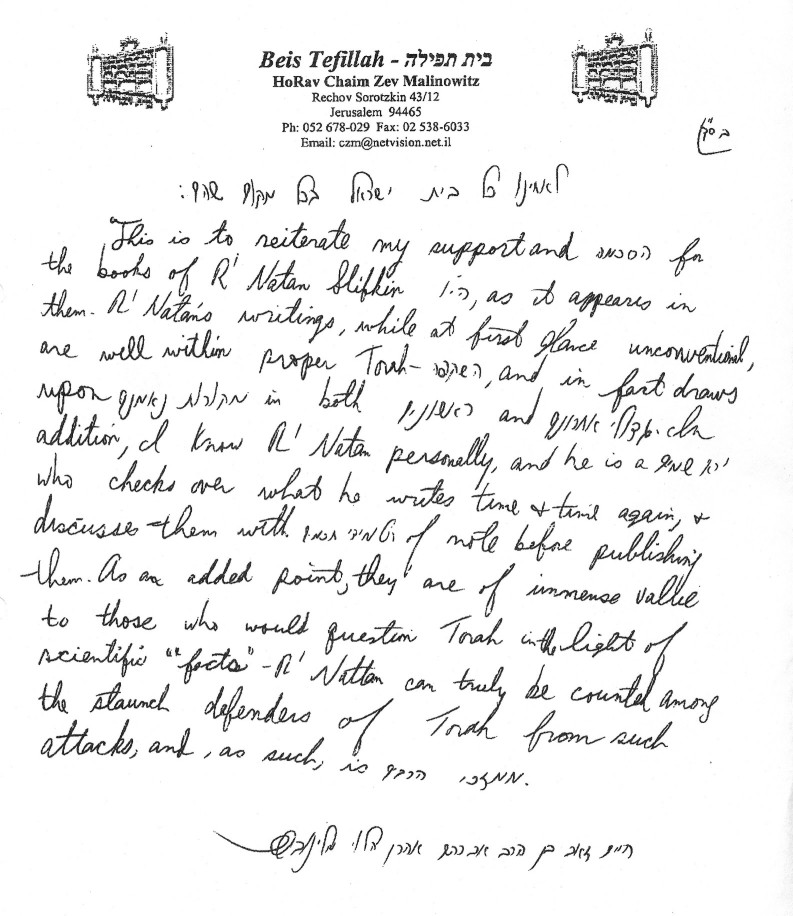
2. Listed as one of the editors is R' Chaim Malinowitz (who I believe is the overall general editor) who not only gave a haskama to R' Slifkins books, but wrote a letter after the controversy broke out reiterating his support (you can see the letter here). Not only that, the Artscroll Gemara in Pesachim quotes the shita of R' Avraham ben Harambam when explaining the Gemaras dealing with astronomy. It is obvious that R' Elyashiv was not מעיין in all the gemaras, but this is something that he called kefira and said that we are not allowed to say.
Wednesday, May 10, 2006
Missing a day of Sefira
We all know the din that if you miss a day of sefira you can no longer count with a Beracha (this is the shita of the Behag). However, if you remember during the day you count without a beracha and then can continue counting with a beracha. L'halacha the acharonim say we do this because of a s'fek s'feka. However, the Behag himself who held that you are not יוצא during the day said this. The obvious question is that if you are not יוצא (you don't make a beracha) why can you continue the next night with a beracha?
RYBS explained as follows (Mesora volume 3). The Behag said that if you miss a day you can no longer count with a beracha because of a lack of תמימות. What does this mean? RYBS explained that תמימות means continuity. If you are counting you cannot skip a number, you can't count 1,2,3,4,6.
Based on this we can understand why the Behag says to count during the day without a beracha. Although you are not יוצא the mitzva, you did count the day. Therefore, that night when you get up to count you have the continuity of the count.
He brought a number of proofs to this, I will mention 1 of them.
R' Hai Gaon (quoted by the Mishna Berura) says that if you forgot a day, the next night before you count you should first say that yesterday was so and so. The obvious question is why? Yesterday is over, what good does it to to say today that yesterday was 6? The answer is that R' Hai held like the Behag, that counting needs continuity, Therefore if you mention that yesterday was so and so you can then continue to count today, as you have the continuity.
Based on this, a child who becomes Bar Mitzva during sefira would certainly be able to counting as even if we consider that what he did as a minor was not a real מעשה מצוה it doesn't matter, he certainly did count. Therefore, just like someone who counts during the day can continue even though they were not מקיים the mitzva, so too a the Bar Mitzva boy can continue counting with a beracha.
Sunday, May 07, 2006
UTJ and the new government
UTJ is not part of the government today, but everyone seems to think that they will join eventually. In fact, today I heard the following theory (on Radio Kol Chai, a Charedi radio station) which makes a lot of sense. In many ways UTJ is happy about joining the government after it was already created. This gives them an alibi for their voters. When Olmert comes to do the disengagement and people ask UTJ how they can be in the government, or when the voters ask how come the child payments aren't restored, etc., they have an alibi, they didn't create the government, Shas did. They only joined to save what they could after the government existed. Olmert had a government without them anyway so they are not to blame.
Now, Meretz is providing them with another alibi. They will say they joined because it was either them or Meretz so they had no choice but to try to minimize the damage and save what they could.
In short, I would be very surprised if UTJ does not end up in the government.
One last point, there is no way that this government will last more then 2 years at best.
Are you allowed to give a non-religious Jew food to eat?
The issue is as follows. In last week's parsha (קדושים), we have the issur of לפני עור. When you give a non-religious Jew food he is going to eat it without saying a beracha, thereby violating an issur d'rabbanan. Given this, the question comes up, maybe it should be a violation of לפני עור to give him the food.
The gemara in Avoda Zara (6b) learns out from the pasuk of לפני עור that you are not allowed to give a Nazir wine. The gemara concludes that this is only in a case of תרי עברא דנהרא (literally 2 sides of the river), meaning he cannot do the issur without you, but in a case of חד עברא דנהרא (literally 1 side of the river), where he could do the issur without you (he could ask his neighbor for wine) it is permitted. Tosafos paskens like this, that whenever he can do the aveira without you it is permitted and there is no לפני עור. The Ran there comments that although there is no prohibition of לפני עור, it is still prohibited m'drabbanan because of מסייע לעוברי עבירה, you are helping him do an aveira.
The Shulchan Aruch in Yoreh Deah Siman קנ"א paskens like the Ran, that even if he can do the issur without you it is prohibited. The Rama there comments that י"א like Tosafos that it is permitted וכן נוהגים. However, many of the acharonim disagree with the Rama (Magen Avraham, Shach, Gra) and pasken like the Ran because Tosafos in other places assumes that there is an issur d'rabbanan in such a situation.
The Shach as explained by the דגול מרבבה has a very important קולא. The Shach says that there is no machlokes between Tosafos and the Ran. Tosafos is talking about a case where he is doing the aveira במזיד and therefore there is no issur of helping him do an aveira while the Ran is talking about a case of שוגג and therefore there is an issur d'rabbanan to help him.
It comes out according to the Shach that whenever the person is doing the aveira במזיד and/or there is no way for you to stop him, it is mutar to give him the issur if he could do the issur without you.
רעק"א takes a different tack regarding לפני עור. In Yoreh Deah Siman קפ"א סע' ו the Shulchan Aruch writes that it is prohibited for a woman to cut off the payists of a man according to some opinions. רעק"א comments that according to everyone there would be an issur of לפני עור on the woman. He then states the follwing chiddush. If the man could cut his own payists and is going to do it, the woman can cut them for him and will not violate לפני עור. He explains as follows. If the man cuts his own payists, he violates 2 issurim, מקיף and ניקף. If the woman cuts them, he only violates the issur of ניקף and not מקיף. Meaning, that if the woman cuts them she is saving him from an additional aveira and therefore there is no issur לפני עור as her action is saving him from an additional aveira.
It comes out according to רעק"א that if your action reduces the total number or severity of aveiros committed then there is no issur of לפני עור.
R' Moshe (יורה דעה סימן ע"ב) discusses the following case. A religious caterer asked him if he is allowed to cater an affair where there will be mixed dancing. Is there a problem of לפני עור?
R' Moshe answered that it is allowed for 2 reasons:
1. We pasken like the Shach as explained by the דגול מרבבה and therefore in this case where they are doing it במזיד (and they would not listen to you) it would be permitted.
2. This is not לפני עור. The classic case of לפני עור is where you give someone or help someone do an aveira. Here your action is perfectly mutar both for you and the other person. You don't have to worry that he will use it for an aveira. If that was the case then R' Moshe asks how can you sell anything to a non-religious Jew? If you sell him a pot, he will use it for non-kosher food or בשר וחלב. Yet, no one thinks that there is an issur of לפני עור there. The reason is because since your action is perfectly mutar for both you and him there is no לפני עור.
Based on the above we can answer our original question. It is permitted to give a non-religious Jew food for the following reasons:
1. רעק"א - RSZA (Minchas Shlomo Siman ל"ה) was asked this question and was matir for the following reason. He explained that if you don't give him food he will be insulted and he will violate a bigger aveira, לא תשנא את אחיך. Therefore based on רעק"א reasoning (you action saves him from a bigger aveira) it would be permitted.
2. It seems that we pasken like the Shach (at least by issurim d'rabbanan) and therefore here where he is a מזיד it would be mutar. R' Moshe relies on the Shach as does R' Shternbuch.
3. R' Moshe's sevara applies here as well. You are giving him food which he is allowed to eat. You don't have to worry that he will do an aveira with it.
To sum up, there are a number of reasons why the issur of לפני עור would not apply in many of our interctions with non-religious Jews. Each case needs to be looked at individually to see if the reasons apply.
Wednesday, May 03, 2006
Does the psak of Beis Din affect reality?
The Wolf has a post where he claims that Psak does not affect reality. I commented there and would like to expand on what I wrote.
There is a gemara which is quoted l'halacha which supports the idea that the psak of Beis Din affects reality. The Gemara in Nidda 45a states that a girl under 3 who loses her virginity, the virginity (hymen) will grow back. The Yerushalmi (Kesubos 1:2) comments that even if when she had relations she was over 3 but then the Beis Din made a leap year which in doing so made her at the time that she had relations under 3, it will grow back. The Yerushalmi bases this on a pasuk in Tehilim. The Pnei Moshe explains the Yerushalmi and states: אף הטבע מסכמת עליהן. Even nature agress with the psak. This is explicit that the psak changes reality. Before Beis Din declared a leap year her virginity would not have grown back, now that they declared a leap year it will grow back. This Yerushalmi is quoted l'halacha in the Rama Even Haezer Siman 20 sif 1 (relating to this halacha of a girl under 3, see the Gra there) as well as by the Acharonim in Orach Chaim Siman 55 sif 9 (relating to a boy who becomes Bar Mitzva in a leap year, again see the Gra there). We see clearly that the Beis Din declaring a leap year changes reality. If they hadn't she would not be a virgin (the hymen would not grow back), since they did she is a virgin (it does grow back).
One of the mefarshim on the Yerushalmi (Kesubos 1:2) brings another example that psak affects reality from the Tosefta in Rosh Hashana (1:10). The Tosefta assumes that the מן did not fall on Yom Tov. The Tosefta says that how long the מן that fell on erev Rosh Hashana lasted depended on the psak of Beis Din. If Beis Din made the 30th Rosh Hashana, then the מן lasted 2 days (the 29th and Rosh Hashana). However, if Beis Din made Rosh Hashana on the 31st, then the מן had to last a third day (29,30 because it didn't fall because it could have been Yom Tov, and Rosh Hashana). Again, we see that the psak of Beis Din affected the reality of when the מן rotted away.
The Ran in his Derashos in Derasha 11 seems to disagree with this. The Ran asks why is psak given to חכמים and not נביאים? He gives the following example. What happens if the חכם makes a mistake in pask and he allows you to eat non-kosher food. The Ran states that you will be harmed because non-kosher is poison. Therefore he says, why wasn't psak given to Neviim who would not make mistakes (see the derasha for his answer). We see clearly from the Ran that the psak that the food is kosher does not affect the reality that non-kosher food is poison.
The resolution of the contradiction may be as follows. The Ran is discussing a case where the חכם made a mistake and paskened against reality. The 2 examples above are where the Beis Din paskened correctly and as a result of their psak reality changed. When the psak is in error reality doesn't change.
It comes out that a psak of Beis Din which contradicts reality (and therefore is wrong) does not cause reality to change, however, a correct psak whose outcome is that reality needs to change does change reality.
Monday, May 01, 2006
The Satmar succession battle
NY Magazine has a long article about the succession battle in Satmar. The only thing I can say is what a chillul hashem. The reader comes away with terribly negative picture of the leadership, the process and the people.
Sunday, April 30, 2006
Not eating chametz that was sold to a גוי
This has become a very popular chumra in Israel in the past few years. In fact, for the past few years the major bakeries accomodated this chumra. Flour used in baking is washed before used which makes it into chametz. Therefore, the major bakeries (Angel's, Berman's, etc.) would use only unwashed flour right after Pesach until they received flour that was ground after Pesach. This year both Angel's and Berman's decided not to do this, they felt that it was too much work (the flour was hard to use and didn't bake well) and therefore after Pesach they used regular flour. This caused an uproar in certain segments of the Charedi community, there was a big article about this in the Mishpacha magazine this past week how it is terrible that this year we went backwards in terms of chumras.
Interestingly enough, the Badatz Eidah Chareidis (who gives the hashgocho on the bakeries) has no problem with this. They hold that the sale of the chametz to a גוי(which they arranged) is perfectly valid and therefore there is no reason to be machmir.
This is one thing that we can all learn from the Eidah Chareidis. they have their shitos and they hold from them. They don't care if other people are machmir, if their poskim hold it is mutar, it is mutar and they offer no apologies. The same thing applies in shemittah. They pasken that non-Jewish produce has no kedushas sheviis, while many in the Yeshivish community are machmir like the Chazon Ish that the produce has kedushas sheviis. Again, they follow their mesora with no apologies.
The serious MO community needs to take a lesson from them and follow their rabbanim בין לקולא בין לחומרא and not be influenced by the chumra of the day attitude in some parts of the Charedi community. If the MO poskim like RHS, RMW, etc. are matir then don't apologize, follow the poskim with pride.
Thursday, April 27, 2006
The Ramban in this week's parsha (תזריע) ...
quotes Chazal (Gemara in Nidda) as follows:
איש מזריע בו לובן שממנו גידים ועצמות ... אשא מזרעת אודם שממנו עור בשר ודם
The man provides the white from which the bones and sinews grow ... the woman provides the red from which the skin, meat, and blood come
The Ramban then quotes the Greek philosophers who disagree with Chazal
ועל דעת חכמי הפלוספי היונים כל גוף העובר מדם האשה אין בו לאיש אלא ... שהוא נותן צורה
And the Greek philosphers say that the all of the body of the child comes from the blood of the women the only thing that comes from the man is the tzura (whatever that means)
The Ramban clearly and unequivocally records the opinion of the Greek philosophers who argue on a scientific opinion of Chazal.
This is the same Ramban who is the foundation of much of Jewish thought today and who was a great mystic/kabbalist.
Tuesday, April 25, 2006
Shaving this Friday
For those people who don't shave during Sefira, this Friday is an opportunity to shave. Because it is both Rosh Chodesh and Erev Shabbos, the Mishna Berura (סימן תצ"ג ס"ק ה) writes that since there is additional simcha of both Shabbos and Rosh Chodesh, even those who are noheg not to shave from Pesach until Lag Baomer are allowed to shave on this Erev Shabbos which is also Rosh Chodesh.
In previous years I have always forgotten and when I came to shul Friday night and saw the shaven faces I kicked myself. This year I don't plan on forgetting and am going to trim my beard nicely (it doesn't seem worth the effort to shave it all off).
In previous years I have always forgotten and when I came to shul Friday night and saw the shaven faces I kicked myself. This year I don't plan on forgetting and am going to trim my beard nicely (it doesn't seem worth the effort to shave it all off).
Monday, April 24, 2006
Why don't we say שהחיינו on the mitzva of ספירת העומר?
The בעל המאור in Pesachim gives a cryptic answer, he states that it is only זכר למקדש and therefore there is no שהחיינו. This is difficult because we find that we do say שהחיינו on מצות דרבנן. The Brisker Rav explains the בעל המאור as follows.
There are different types of מצות דרבנן
1. A new mitzvah like Channuka
2. A mitzva that used to be min hatorah that no longer applies min hatorah. The Chachamim tell us to do the same exact mitzva m'drabbanan, for example, מרור nowadays
3. A new mitzva זכר למקדש
The Brisker Rav claims that according to the Baal Hamaor, ספירת העומר is category 3, it is a new mitzva זכר למקדש. He brings a number of interesting proofs.
The gemara in Menachos comments that some of the Amoraim only counted days and not week, because it is only זכר למקדש. If it was in category 2 we would say that the mitzva needs to be done exactly as it was done min hatorah. However, if it is a new mitzva זכר למקדש we can say that they only instituted days and not weeks and understand the opinion of these Amoraim.
After counting we say הרחמן הוא יחזיר וכו. We don't say this after we eat maror or after we shake a Lulav (after the first day of Succos which is only מדרבנן). The reason is because we are being מקיים the same mitzva only מדרבנן. However, ספירת העומר is a new mitzva specifically instituted זכר למקדש and therefore we mention that we hope that the Avoda in the Beis Hamkidash is restored becuase that is the whle purpose of the mitzva.
If ספירת העומר is a new mitzva זכר למקדש we can also understand why we don't say שהחיינו, we are not happy that we are doing this mitzva, rather it reminds us that we don't have a Beis Hamikdash.
We should keep this idea in mind during sefira as we prepare for Kabbalas Hatorah, the lack of a Beis Hamikdash should be bother us and hopefully we will all be able to celebrate Pesach Sheni in the Beis Hamikdash.
The largest government ever in Israel 27+ ministers
It is pretty clear from all reports that the new government will have 27+ ministers (7 out of 19 Labor MK's are going to be Ministers!). This is another symptom of a failing system, 27+ ministers in the government with at least 4 of them being Ministers without Portfolio is a very overblown government. In addition, there are a whole host of Deputy Ministers. Remember, this is out of only 120 members of Parliament, meaning that over 1/4 of the MK's are ministers or Deputy Ministers.
Not only does this cost a fortune, it is creates a very inefficient unwieldy government where it is very hard to get anything done. The ministries have turned into money machines where every ministry gets a budget that the minister has control over.
If we look around the world we can compare Israel to other democracies
Given the small population and size of Israel in comparison to most of these other countries, we can see that 27 ministers is way out of line.
This is more proof that the system in Israel is completely broken and needs to be fixed badly. I offered a suggestion a while back The electoral system in Israel is broken ... on some possible reforms. It is clear that something needs to be done, unfortunately, given the current makeup of the government I am very pessimistic that anything will be done.
Not only does this cost a fortune, it is creates a very inefficient unwieldy government where it is very hard to get anything done. The ministries have turned into money machines where every ministry gets a budget that the minister has control over.
If we look around the world we can compare Israel to other democracies
- Australia - 16 Ministers
- Denmark - 20 Ministers
- Finland - 17 Ministers
- France - 16 Ministers
- Germany - 15 Ministers
- Japan - 17 Ministers
- Norway - 18 Ministers
- Sweden - 10 Ministers
- United Kingdom - 22 Ministers
- United States - 15 Ministers
Given the small population and size of Israel in comparison to most of these other countries, we can see that 27 ministers is way out of line.
This is more proof that the system in Israel is completely broken and needs to be fixed badly. I offered a suggestion a while back The electoral system in Israel is broken ... on some possible reforms. It is clear that something needs to be done, unfortunately, given the current makeup of the government I am very pessimistic that anything will be done.
Sunday, April 23, 2006
מים אחרונים nowadays
At the end of last week's parsha (שמיני) the pasuk says והתקדשתם והייתם קדושים. The gemara in berachos coments on this that והייתם קדושים refers to מים אחרונים.
In some circles today מים אחרונים has fallen out of favor. I would like to explain the reason for this.
The Gemara in Chullin (105a) requires מים אחרונים before benching because of the concern of מלח סדומית that may remain on the hands from the meal, potentially causing blindness through contact with the eye. Tosafot (both in Berachos and in Chullin) comment that the minhag in their day was not to wash מים אחרונים. They justify the minhag by saying that we no longer have מלח סדומית and therefore there is no need. Many Rishonim disagree with Tosafos based on the gemara in Berachos that links מים אחרונים to Kedusha.
The Tur and Shulchan Aruch quote the opinion that requires מים אחרונים, Tosafos's opinion is quoted as a יש אומרים. The Gra vehemently rejected the opinion of Tosofos as did the Kabbalists.
The Mishna Berura (כדרכו) is machmir that one should wash מים אחרונים.
Rav Yaakov Emden (Mor U-ketzia 181) writes that people during Talmudic times would eat without cutlery, thus necessitating hand washing before benching. Now that people do not eat directly with their hands, no obligation of מים אחרונים exists, even according to the Kabbala.
Both R' Shternbuch (Teshuvos V'Hanhagos) and R' Wosner hold that women do not need to wash מים אחרונים. They hold that chiyuv today is a chumra based on kabbala and only men accepted upon themselveves chumra's based on kabbala.
In short, the basis for not washing מים אחרונים nowadays is:
1. Tosafos which is quotes as a יש אומרים in Shulchan Aruch
2. R' Yaakov Emden that nowadays we use cutlery and therefore there is no chiyuv according to everyone
3. According to R' Wosner and R' Shternbuch nowadays it is only a chumra based on kabbala
Psak in the name of R' Elyashiv: Valis is innocent
Update
I finally saw the pashkevilli and it did not say what the JPost article said. Nowhere is there a psak that he is innocent, rather it just says that everyone should help the family to prove that he is innocent.
Below is the actual קול קורא

End of Update
For those of you who have not followed the news in Israel, Yisrael Valis, a 19-year-old father is accused of violently killing his infant son. He was arrested before Pesach and is sitting in jail.
I cannot comment on the facts of the case other then what I have heard in the media.
Today I heard on the radio and saw online Halachic decree: Valis is innocent that R' Elyashiv paskened that he is innocent.
I don't understand this for many reasons.
1. This is not something that can be paskened on, he either did it or he did not. There is nothing to pasken.
2. There was no trial, no witnesses etc. brought before R' Elyashiv, the psak is based on what the "askanim" told him.
IMHO, this is a tremendous chillul hashem when these kind of "psakim" are reported. It makes halacha and psak into a joke.
The day he was arrested I heard an interview with Yehuda Meshi Zahav, the founder of Zaka, who is no stranger to being arrested. He said that while he does not know the specifics of this particular case, terrible things happen in the Charedi world (which he personally has knowledeg of through Zaka) and that the Charedi world need to stop trying to hide everything under the rug.
Sunday, April 09, 2006
Eating on Pesach
The mitzvah's of Pesach all revolve around eating, eating, matzah, korban pesach etc.
In fact, Matzah is the only time that we eat a cheftza shel mitzva nowadays. On succos while we have a mitzva to eat in the succah, the mitzva is on the person, the food is not a cheftza shel mitzva. By matzah, the matzah becomes a cheftzah shel mitzva.
Likewise, Korban Pesach is unique amnog korbanos. It is the only korban where there is a chiyuv on the person to eat the meat. Every other korban just has an issur that it shouldn't become נותר, there is no specific chiyuv on you to eat the meat.
The reason for all this is that Pesach is the birth of the Jewish people. Hashem wanted to teach the Jewish people a critical lesson that the purpose of life is to be mekadesh the gashmiyus. A person is supposed to take physical acts and turn them into spiritual acts. This is what eating Matzah and Korban Pesach do. It turns a physical act of eating into a sublime spiritual act. This was a crucial lesson that need to be imparted to the Jewish people before Matan Torah. Eveyrthing depends on a person's kavana, with the right kavan the most physical act can be sanctified.
How is Kiddush Pesach night different then other nights?
I would like to point out a number of differences.
On Friday night the Gemara in Berachos states that a person can daven early as well as make Kiddush early (before nightfall). This is generally assumed to be because when you are mekabel shabbos early it turns day into Shabbos.
What about on Pesach night?
The Gemara in Pesachim comments based on a Pasuk that the Korban Pesach needs to be eaten at night. The Rishonim add on, that likewise the other mitzvos (Matzah and Maror) which need to be eaten with the Pesach need to be at night as well. The Shulchan Aruch adds on that you can't make Kiddush until night either. Why not? The Magen Avraham explains that Kiddush is the first of the 4 cups and just like the other Mitzvos need to be done at night , so too the 4 cups because כעין דאורייתא תקנו. The Taz ofers a cryptic suggestion. RYBS explained the Taz as follows. Kiddush is part of Magid, it is the beginning of the telling of the story of yetzias Mitzrayim and therefore as part of Sippur Yetzias Mitzrayim it needs to be at night.
There is a general dispute whether you can ever use grape juice for Kiddush, we will not get into that. Assuming that in general you can, what about Pesach night? The gemara in pesachim comments that if you drink יין חי, you are יוצא the 4 cups, but you are not יוצא חרות. What is יין חי? It is undiluted wine. The wine in the time of Chazal was basically undrinkable without diluting it.
Based on the fact that the gemara said that יין חי is not יוצא חרות a number of poskim say the same applies to grape juice. Since it is not alchoholic it is also not a sign of freedom. Others disagree and say that there is no comparison. יין חי is undrinkable wine, no one drinks it. Grape juice is drunk and enjoyed by many and therefore you would be יוצא חרות if you enjoy it.
Bottom line is if you can drink wine it is better to drink wine.
On Friday night you need to drink a cheekful of wine which is a a majority of a reviis. What about Pesach night? On Friday night, there is no chiyuv to drink wine per se, rather since you are making a beracha on a cup of wine you need to drink from it. On Pesach night there is a chiyuv not only to make kiddush but drink 4 cups of wine. Kiddush is one of those, and therefore you need to drink either the whole cup or at least a majority of the cup.
I. When can you make Kiddush?
On Friday night the Gemara in Berachos states that a person can daven early as well as make Kiddush early (before nightfall). This is generally assumed to be because when you are mekabel shabbos early it turns day into Shabbos.
What about on Pesach night?
The Gemara in Pesachim comments based on a Pasuk that the Korban Pesach needs to be eaten at night. The Rishonim add on, that likewise the other mitzvos (Matzah and Maror) which need to be eaten with the Pesach need to be at night as well. The Shulchan Aruch adds on that you can't make Kiddush until night either. Why not? The Magen Avraham explains that Kiddush is the first of the 4 cups and just like the other Mitzvos need to be done at night , so too the 4 cups because כעין דאורייתא תקנו. The Taz ofers a cryptic suggestion. RYBS explained the Taz as follows. Kiddush is part of Magid, it is the beginning of the telling of the story of yetzias Mitzrayim and therefore as part of Sippur Yetzias Mitzrayim it needs to be at night.
II. Can you use grape juice?
There is a general dispute whether you can ever use grape juice for Kiddush, we will not get into that. Assuming that in general you can, what about Pesach night? The gemara in pesachim comments that if you drink יין חי, you are יוצא the 4 cups, but you are not יוצא חרות. What is יין חי? It is undiluted wine. The wine in the time of Chazal was basically undrinkable without diluting it.
Based on the fact that the gemara said that יין חי is not יוצא חרות a number of poskim say the same applies to grape juice. Since it is not alchoholic it is also not a sign of freedom. Others disagree and say that there is no comparison. יין חי is undrinkable wine, no one drinks it. Grape juice is drunk and enjoyed by many and therefore you would be יוצא חרות if you enjoy it.
Bottom line is if you can drink wine it is better to drink wine.
III. How much do you need to drink?
On Friday night you need to drink a cheekful of wine which is a a majority of a reviis. What about Pesach night? On Friday night, there is no chiyuv to drink wine per se, rather since you are making a beracha on a cup of wine you need to drink from it. On Pesach night there is a chiyuv not only to make kiddush but drink 4 cups of wine. Kiddush is one of those, and therefore you need to drink either the whole cup or at least a majority of the cup.
Thursday, April 06, 2006
Early Shabbos Primer
With the changing of the clock both in Israel and in America many people will once again start making early Shabbos. Here are 2 posts from last year which explain many of the relevant halachik issues. Early Shabbos Primer and Early Shabbos primer continued
A very relevant interpretation of the רשע in the Haggada
I posted this last year, I think this is worth repeating.
The Beis Halevi explains the רשע's question as follows. He says that the רשע is asking why do we need to do the mitzvos nowadays. Who wants to bring an animal sacrifice in 2005? The רשע understands why the Jews in Egypt brought it, but we have grown up, who needs all these anachronistic miztvos? The answer given is "בעבור זה עשה ה לי בצאתי ממצרים". The Beis Halevi asks this is strange answer? I would have expected something like, because hashem took us out of Egypt we do these mitzvos. He explains this as follows. We see from many sources that the Torah preceded the creation of the world. We think in terms of cause and effect. Because we left Egypt we have Pesach and all the mitzvos. However, this is incorrect. The mitzvos existed before the world was created. The events unfolded the way they did because they had to, so that the mitzvos in the torah would make sense. Based on this we understand the answer, "בעבור זה" because of this, the Torah, עשה ה לי, Hashem made the events of יציאת מצרים happen. This answers the רשע, that the mitzvos preceded the events and are not anachronistic at all. The Mitzvos are not based on the events, rather the events are based on the mitzvos, and therefore the mitzvos are timeless.
The Beis Halevi explains the רשע's question as follows. He says that the רשע is asking why do we need to do the mitzvos nowadays. Who wants to bring an animal sacrifice in 2005? The רשע understands why the Jews in Egypt brought it, but we have grown up, who needs all these anachronistic miztvos? The answer given is "בעבור זה עשה ה לי בצאתי ממצרים". The Beis Halevi asks this is strange answer? I would have expected something like, because hashem took us out of Egypt we do these mitzvos. He explains this as follows. We see from many sources that the Torah preceded the creation of the world. We think in terms of cause and effect. Because we left Egypt we have Pesach and all the mitzvos. However, this is incorrect. The mitzvos existed before the world was created. The events unfolded the way they did because they had to, so that the mitzvos in the torah would make sense. Based on this we understand the answer, "בעבור זה" because of this, the Torah, עשה ה לי, Hashem made the events of יציאת מצרים happen. This answers the רשע, that the mitzvos preceded the events and are not anachronistic at all. The Mitzvos are not based on the events, rather the events are based on the mitzvos, and therefore the mitzvos are timeless.
Wednesday, April 05, 2006
The next government of Israel
It is now pretty clear who is going to be in the next government.
The basis of the coalition will be:
Kadima - 29
Labor - 19
Yisrael Beitenu - 11
Pensioners - 7
This adds up to 66 seats.
The big question is what about the Charedi parties, Shas and Yahadut Hatorah and why Lieberman?
Shas - There are a number of reasons why Olmert does not want Shas in the coalition:
1. Money - Labor and the pensioners have already blown up the budget, Shas will just make things worse with their economic demands
2. Ministries - Shas wants a number of key Ministries (including Misrad Hapnim), Lieberman will probably be cheaper
3. Disengagement - Shas is against disengagement and cannot afford to change it's mind. Shas's voters are right wing and are very against disengagement
Yahadut Hatorah has a good chance of being in the coalition without Shas for a number of reasons:
1. They only have 6 seats so their demands won't be that high
2. They don't want any ministries
3. They will go along with disengagement. They will tell the Charedi population that Olmert had a majority for disengagement anyway and therefore their being in the government is irrelevant and by being in the government they can get money for Torah, etc.
Olmert wants Lieberman for the following reasons:
1. Economically it doesn't cost him anything. Lieberman is like Netanyahu and therefore will not request more governement spending
2. Olmert believes that he can be persuaded to support disengagement in some way or another
Another interesting question is who will get which ministries. As of now it looks like the following:
Amir Peretz, Defense Minister - IMHO this is not a bad thing for the following reasons:
1. He will not be Finance Minister
2. It is a good thing to have a civilian Defense Minister
3. Good riddance to Mofaz
Yuli Tamir, Education Minister - I don't know much about her, but I know that Kadima's candidate Reichman was one of the founders of Shinui so she is better then him. In fact, good riddance to Reichman who thought he could parachute in to be Education Minister.
To sum up, I think that Shas is going to be the big loser here, either being left out of the government completely or getting in at a much reduced price.
Religion and the Jewish State: An Interview with Rav Aharon Lichtenstein
This is a fascinating interview in the YU Commentator which covers a lot of the major issues of the day.
Tuesday, April 04, 2006
US Taxes in Israel
Any American citizen with children living and working in Israel should file a US tax return and get money (in the form of the child tax credit) back from the US Government. This is perfectly legitimate, in fact, US citizens living anywhere in the world are obligated to file a tax return. For more on this see this post US Tax Day is good for the American Jews of Israel from last year.
Saturday, April 01, 2006
'אל פתח אהל מועד יקריב אותו לרצונו לפני ה
The pasuk uses a strange phrase, 'לרצונו לפני ה, The standard pshat is as Rashi comments that כופין אותו עד שיאמר רוצה אני, that every Jew really wants to do mitzvos and by forcing them we are just bringing out their true desire.
The Chasam Sofer explains the pasuk as follows. He says that the pasuk is teaching us an educational lesson. A person has to take his children אל פתח אהל מועד, send them to yeshiva, take them to shul, show them kedusha, even against their will, and then when they get older, Yiddishkeit will be לרצונו לפני ה for the child. The child will do mitzvos out of his own free will if when he is young we make sure to bring them אל פתח אהל מועד.
The Chasam Sofer explains the pasuk as follows. He says that the pasuk is teaching us an educational lesson. A person has to take his children אל פתח אהל מועד, send them to yeshiva, take them to shul, show them kedusha, even against their will, and then when they get older, Yiddishkeit will be לרצונו לפני ה for the child. The child will do mitzvos out of his own free will if when he is young we make sure to bring them אל פתח אהל מועד.
Economic ramifications of the election
I am not a big fan of Harretz (to put it mildly), but on economic issues they are ok. Their analysis is the same as mine, the election results are bad for the economy.
Two percent? It should have been 10 percent!
Make no mistake: Financially, the election results are somewhere between bad and very bad
...
1. A fragmented coalition: The combination of Kadima, the Labor Party and the Pensioners Party (Gil) gives the coalition 55 seats. Thus, a fourth coalition member will be necessary to give the coalition a majority. Meretz, with four seats, will not be enough. Therefore, we can assume there will be no choice other than to add one or more of the religious parties
...
Pensioners:
...
The party is composed of experienced former union leaders, and large Histadrut unions to boot. As we know, the Histadrut labor federation is vehemently opposed to pension reforms carried out by the previous government. We can assume the subject of turning the clock back on these reforms will come up in coalition negotiations.
...
Labor: The Labor Party, the second-largest in the coalition, is expected to demand a senior portfolio. Finance is the most natural choice, assuming that the Foreign Ministry does not interest Amir Peretz. Peretz as finance minister again means a retreat from pension reform, and also a possibility of backtracking on capital market reform - the Bachar reforms.
It will certainly mean a rise in the minimum wage. And don't forget the remaining privatizations: Mekorot, the Israel Electric Corporation, the Israel Military Industries and the Israel Aircraft Industries. These will all fall by the wayside, as will any prospect of government reform, both local and national, and probably education reform as well. All of these reforms demand a greater level of job market flexibility.
Structural paralysis, with everything it entails for the Israeli economy, which is in desperate need of continued reform, is the recipe Peretz is undoubtedly preparing for us. For the economy and the capital markets, this is very worrying news indeed.
Friday, March 31, 2006
Election results update
The numbers changed a little.
This changes things a bit as now Olmert in theory can make a coalition of
Kadima - 29
Labor - 20
Meretz - 5
Pensioners - 7
61 seats without any of the right wing parties.
This may lead to the right wing supporting Amir Peretz for PM.
The next few weeks will be very interesting
The winners
- Kadima 29 (up from 28)
- Likud 12 (up from 11)
- Meretz 5 (up from 4)
The losers:
- Shas 12 (down from 13)
- Lieberman 11 (down from 12)
- Raam-Tal 3 (down from 4)
This changes things a bit as now Olmert in theory can make a coalition of
Kadima - 29
Labor - 20
Meretz - 5
Pensioners - 7
61 seats without any of the right wing parties.
This may lead to the right wing supporting Amir Peretz for PM.
The next few weeks will be very interesting
Wednesday, March 29, 2006
An interesting coalition possibility ...
If Netanyahu is deposed or resigned. If that happens, Labor could make a government with the following parties:
Labor - 20
Yisrael Beitenu - 12
Shas - 13
Yahadut Hatorah - 6
Likud - 11
62 seats
This would allow the Likud and Labor to effectively kill Kadima. Kadima would not survive as an opposition party.
Labor - 20
Yisrael Beitenu - 12
Shas - 13
Yahadut Hatorah - 6
Likud - 11
62 seats
This would allow the Likud and Labor to effectively kill Kadima. Kadima would not survive as an opposition party.
Election results in Israel
Th election results had a number of pleasant surprises and not so pleasant surprises. Here is my analysis.
While Kadima ended up with the most seats, their position is quite weak. Kadima and Labor only have 48 seats, even if you add in the pensioners (who may have right wing views) that is only 55. They need one or more of the following parties to join, each one of whom has stated that they are against a unilateral pullout.
If you look at the Jewish vote, the right wing anti-pullout camp got 51 seats, the pullout camp got 52 (Kadima 28, Labor 20, Meretz 4). Given these numbers, to say that Olmert now has a mandate for his pullout plan is ridiculous.
In short, Kadima will not have an easy time forming a coalition to support a unilateral pullout.
The election results are a disaster for the economy. Below are the parties who will probably be in the government.
In short, Netanyahu was a very good finance minister, he accomplished a lot and got the economy moving again. I fear that many of his reforms will go by the wayside and the economy will go downhill again.
The big winners are:
In summary, althoug Olmert and Kadima won and will make the next government, they will have a hard time making any unilateral moves. IMHO, there is no way that this government lasts 4 years.
Diplomatic Front
While Kadima ended up with the most seats, their position is quite weak. Kadima and Labor only have 48 seats, even if you add in the pensioners (who may have right wing views) that is only 55. They need one or more of the following parties to join, each one of whom has stated that they are against a unilateral pullout.
- Shas - I don't think that Shas will support a pullot from Yehuda V'Shomron. I can't see R' Ovadya supporting evicting Jews from Hevron, Bet El, etc.
- Yahadut Hatorah - I don't think that they will support a pullot from Yehuda V'Shomron. I can't see them supporting evicting Jews from Hevron, Bet El, etc. although you never know with them.
- Yisrael Beitenu - Lieberman stated that he opposes unilateral pullouts. Labor does not want him in the government.
If you look at the Jewish vote, the right wing anti-pullout camp got 51 seats, the pullout camp got 52 (Kadima 28, Labor 20, Meretz 4). Given these numbers, to say that Olmert now has a mandate for his pullout plan is ridiculous.
In short, Kadima will not have an easy time forming a coalition to support a unilateral pullout.
Economic Front
The election results are a disaster for the economy. Below are the parties who will probably be in the government.
- Kadima - Hard to say what their economic outlook is, but in any case they will be forced by their coalition partners to adopt a more socialistic policy.
- Labor has only 8 seats less then Kadima and will have a tremendous influence on economic policy. Labor is led by the "King of Strikes" Amir Peretz, and has a socialist ideology.
- Shas - Their main plank was to restore the child allowance cuts. Although this will personally benefit me (I have a lot of children), it is a very bad idea for the economy. In general, Shas is for more government control and spending.
- Yahadut Hatorah - Very similar to Shas
- Pensioners - They also want the government to spend more money
- Yisrael Beitenu - I don't know, but in any case I don't think they will have much influence on economic policy.
In short, Netanyahu was a very good finance minister, he accomplished a lot and got the economy moving again. I fear that many of his reforms will go by the wayside and the economy will go downhill again.
Big Winners
The big winners are:
- Lieberman - He is now the leader of the right wing and will have a lot of influence
- Shas - With 13 seats they beat the pollsters expectations. Olmert needs them for the coalition and therefore they will have a lot of influence.
- The pensioners- This was definately the surprise of the election. with 7 seats they will get what they want.
Big Losers
- Netanyahu - With the Likud only getting 11 seats he is in big trouble. I hope that he stays and leads the Likud in opposition.
- Olmert - With only 28 seats and the need to take in a right wing party for his coalition, he is going to have trouble governing.
- Shaul Mofaz - Labor will probably get the defense ministry leaving Mofaz without a ministry. Makes me very hapy.
- Yossi Beilin - With Meretz only getting 4 seats, I think he is done. Good riddance.
- The pollsters - Again, all the pre-election polls were wrong. No poll was even close to 28 for Kadima and 11 for the Likud. The pollsters completely missed the Pensioners and predicted they would not even get in to the Knesset. Hopefully, people will learn something from this and the next election won't be so poll driven
In summary, althoug Olmert and Kadima won and will make the next government, they will have a hard time making any unilateral moves. IMHO, there is no way that this government lasts 4 years.
Monday, March 27, 2006
The upcoming election
Polling in Israel has become a joke. In Maariv today we haveהסקר האחרון: קדימה נחלשת, הימין מתחזק with the right wing up to 54 seats. On the other hand, YNet has very different results and so does Haaretz where the left is gaining strength. I really hope that the polls are proven wrong again and once and for all people stop believing the polls. The polls have really changed the election hopefully to Kadima's detriment that many Kadima supporters won't get out and vote because they will think that the lection is in the bag.
The best scenario that I see is the right wing (Likud, Yisrael Beitenu, Ichud Haleumi Mafdal, Shas, and Yahadut Hatorah) getting 61 seats. While this is not probably it is possible. Netanyahu (the best of the worst) would be Prime Minister. This would destroy Kadima.
Another alternative would be for Labor and Likud to form a coalition to block Kadima. This most probably won't happen because of Amir Peretz's hate of Netanyahu.
In any case, the Charedim are sitting pretty. Kadima, Labor and Meretz will probably not have 61 seats and therefore the Charedim will be needed to make a coalition. This is their dream, to be the make or break party for the coalition.
Thursday, March 23, 2006
Only in Israel: A party called מלחמה בבנקים
The platform is as the name suggests "War on the Banks".
Here are some more interesting parties:
The common denominator among all these parties is that they are narrow 1 issue parties. The only reason they exist is because of the election system in Israel where elections are nationwide using a proportional representation system. In a normal political system none of these parties would exist, rather they would be subsumed under one of the larger parties. There are 30!! parties running in the current election between 10 - 15 will get into the Knesset. There is no way that the next government (whoever leads it) will be stable given these numbers.
It is obvious that the political system in Israel needs to be changed to some kind of district based system. I an very skeptical of this getting done, no politician wants to vote himself out of a job.
Here are some more interesting parties:
- גיל - a party for retirees. The party platform is to protect the rights of retirees e.g AARP
- צדק לכל - The party platform is equal rights for men regarding family law
- לח"ם - Anti-corruption party
- עלה ירוק - Main platform, the legalization of marijuana
- עתיד אחד - Main platform, to bring all the Ethiopian Jews to Israel
- ציונות חדשה - Main platform, government reform
The common denominator among all these parties is that they are narrow 1 issue parties. The only reason they exist is because of the election system in Israel where elections are nationwide using a proportional representation system. In a normal political system none of these parties would exist, rather they would be subsumed under one of the larger parties. There are 30!! parties running in the current election between 10 - 15 will get into the Knesset. There is no way that the next government (whoever leads it) will be stable given these numbers.
It is obvious that the political system in Israel needs to be changed to some kind of district based system. I an very skeptical of this getting done, no politician wants to vote himself out of a job.
Wednesday, March 22, 2006
יהדות התורה campaign site
Even though the Gedolim have banned the internet, יהדות התורה has an internet campaign site where you can watch their campaign videos and listen to their jingles and get information.
Tuesday, March 21, 2006
Women's prayer groups
My last post sparked a debate about Women's Prayer Groups so I would like to devote a post towards it. This will not be a comprehensive treatise, I will only be discussing the 1 point raised in the previous post.
RHS and R' Bleich make the following argument (1 of many reasons that they have in opposing them). Everyone agrees that women are not chayav in tefilla betzibur. However, they state that if a woman decides she does want to go to daven outside of the house in an organized fashion she now has 2 choices, a regular minyan or a women's tefilla group. She needs to make a choice. The halacha is unequivocally clear that tefilla betzibur is the best way to daven. Therefore if a woman picks the womens tefilla group she is ignoring what the halacha states is the best option and instead doing what she feels serves her spirituality best. This is what the Beis Halevi thinks was the chet haegel. Nowadays we assume that most people in any case cannot have true kavana and therefore to abandon what chazal say is a tefilla that Hashem always listens to for tefilla beyachid is incorrect. When the MB quotes an opinion that a person can daven beyachid if he will have more kavana he brings down from the Pri Megadim that this is only for gedolei hador. I don't think that any of the women going to these prayer groups think that they are on that level.
RHS writes:
It is true that women are not obligated to pray with a minyan (it is also a matter of debate whether men are obligated to do so). However, when women get all dressed up on Shabbos and leave their homes to pray in an organized service, and they choose to go to a WPG instead of a minyan, they are choosing a sub-optimal mitzvah over an optimal mitzvah; they are actively rejecting the more complete fulfillment for the lesser. If they stayed home, they are opting to pray alone rather than put in the effort to go to shul. However, when they put in that effort but go to a WPG instead of a synagogue, they are making a statement that they prefer the lesser fulfillment over the greater. They are figuratively being ma'avir al ha-mitzvos, stepping over a mitzvah. That, I believe, is sufficient reason to label a WPG a distortion of Torah principles. If most of the attendees of a WPG are actively choosing it over a minyan, the WPG is an instrument of misguided Torah principles, a teacher of distorted values.
R' Bleich makes the same point:
Women who pray with a minyan have a guaranteed better reward for their prayers than women who pray with a Women's Prayer Group. If women are willing to take on the burden of leaving their homes and going to a place of prayer (i.e. they are willing to invest their money in an opportunity) and choose the lesser option of praying without a minyan (i.e. place their money in the opportunity that gives a lower return), they are making a foolish choice. Anyone who advises them to do so is giving bad advice, with all of the attendant implications.
...Assuredly, the guaranteed benefits of tefillah be-zibbur outweigh those of any possible subjective experience.
Those who support Women's Prayer Groups have have tried to deflect this opinion by IMHO bringing irrelevant sources. For example, a letter of the Gra is quoted where he advises the women of his family not to go to shul. IMHO this is completely irrelevant. There were many reasons for women not to go to shul including as Jerusalem's Sephardic Chief Rabbi Shalom Messas records, that most Moroccan Jewish women never attended synagogue even on Yom Kippur. As a result, few synagogues even had women's sections. Those women who did come to the synagogue rarely participated in the prayer service. R. Messas attributes this primarily to the women's illiteracy and lack of education.
These and other similar arguments have no bearing on our case where the woman is leaving her house and going to a public prayer service. In our case she needs to make a decision, she has already decided that she wants to do more then what is required. Does she follow the guidelines of Chazal who praised Tefilla Betzibur and saying devarim shebekedusha or does she follow her "spirituality" and give these all up for a subjective spiritual experience.
Thursday, March 16, 2006
Understanding the חטא העגל
The question is obvious, how could the Jewish people who had just seen all the ניסים and were mekabel the Torah turn to avoda zara so soon after?
The Beis Halevi explains as follows. Beni Yisrael really made the עגל l'shem shamayim. They were looking for a way to worship Hashem after they thought that Moshe Rabbenu was gone. They thought that they could make up their own way of worshipping Hashem and use the עגל as an intermediary/replacement for Moshe Rabbenu. They were not worshipping the עגל per se, rather they wanted to worship Hashem through the עגל. They wanted to invent a new way of worshipping Hashem not found in the Torah. This was exactly their sin. After Matan Torah, we are not allowed to create new ways to worship hashem. Even more then that. The Beis Halevi says, eveen if a person knows that doing x will do great things in shamayim, if it is prohibited by the Torah he cannot do it. This is contrast to pre matan torah where the Avos were allowed to be creative in their worship. One answer for how was Yaakov allowed to marry 2 sisters is that he knew that for him it was the right thing, that marrying 2 sisters is what he needed to do to carry out his mission. Since this was pre matan torah he was allowed to do that.
This Beis Halevi is very important for our times. What we need to do is serve Hashem not feel good or spiritual. Today, people want to feel good/spiritual. There is nothing with wrong with that, but it has to take a back seat to serving Hashem and keeping the Torah. There is absolutely no heter to violate even the smallest issur for any "spiritual" activity.
This is one of RHS's points against many of the innovations in certain MO circles. Instead of focusing on avodas hashem and what the Torah says the person needs to do, a focus is put on the person feeling spiritual (והמבין יבין).
Sunday, March 12, 2006
The responsibility of a Rebbe, learned out from מחיית עמלק
The gemara in Bava Barsa (21a-b) has the following story (my rough translation):
Yoav killed all the male Amelekites. Dovid Hamelech asked him why did you kill only the men? Yoav answered because the pasuk says "Timcheh Es Zachar (the males of) Amalek". Dovid answered, no, the word is read as "Zecher (the remembrance of)"! Yoav answered, I was taught 'Zachar'! They called Yoav's Rebbi, who said that he taught זכר (since the gemara has no nekduos we don't know if he answered zecher or zachar in fact this is a machlokes). Yoav drew his sword to kill him based on the pasuk "Arur Oseh Meleches Hash-m Remiyah". Some say, he killed him; others say, he did not
What did the Rebbe teach Yoav and why was he blamed? Tosafos (21a) as well as the Rashba understand that the Rebbe taught Yoav "zecher" correctly. If so, why was Yoav ready to kill him? What did the Rebbe do wrong? The answer is that the Rebbe needs to not only teach the students correctly but he needs to ensure that they actually know the material correctly. Since Yoav left the with the incorrect p'shat of zachar we blame the Rebbe.
The Maharsha disagrees and understands that Yoav's Rebbe taught him "zachar" and his sin was that he became a teacher without first learning enough to teach correctly.
According to the Rashba we see the tremendous responsibility that a Rebbe has. If a student leaves the class with the wrong p'shat even if the Rebbe explained it correctly, the Rebbe is blamed. The Rebbe needs to make sure that every student gets the correct p'shat.
Friday, March 10, 2006
Everyone saying the עשרת בני המן out loud
This is a common minhag whose source is not so clear. It can be explained based on the following.
The gemara in Brachos 21 states that if you come in late you are not allowed to start שמונה עשרה if you cannot finish by kedusha.
There is an interesting dispute relating to this halacha. What should you do if somehow you are in the middle of שמונה עשרה and the ש"ץ reaches kedusha. Rashi in Succa says that you should stop saying שמונה עשרה and listen to the ש"ץ and be יוצא שומע כעונה. Tosafos (in Brachos) has 2 questions on this:
1. If this is true then why aren't you allowed to start שמונה עשרה at any time, you aren't losing anything, you are יוצא קדושה through שומע כעונה anyway?
2. If you are יוצא why isn't it a הפסק ?
Tosafos answers 1 by saying that although you may be יוצא with שומע כעונה it is better to say the words (this needs explanation). Tosafos doesn't answer the second question.
We can explain the dispute based on the following. There are 2 ways to look at שומע כעונה:
1. Take the words literally, the halacha is saying that if you listen the halacha views it as if you said the words
2. You are יוצא with his דיבור meaning that you didn't say the words, however the halacha says that you are יוצא by someone else saying the words.
Tosafos would hold like 1, therefore it would be a הפסק because the halacha views it as if you said the words, so you said kedusha during שמונה עשרה. Rashi however holds like 2 and therefore there is no הפסק, you said nothing you are יוצא with his דיבור so it is ok even in the middle of שמונה עשרה.
This is the pshat here by the עשרת בני המן as well. The Rogatchover says that although the whole megilla you are יוצא with שומע כעונה you can't be יוצא the minhag of saying the names in 1 breath with שומע כעונה. Why not? It would seem that the Rogatchover holds like Tosafos, and therefore שומע כעונה makes it like you said the words but it can't add anything over and above that, so you said the words but not in 1 breath. However, according to rashi you are יוצא with his דיבור and his דיבור was good (in 1 breath) so just like he is יוצא with his דיבור you are as well.
The same question comes up as well by bircas cohanim. Can 1 kohen make the bracha and all the other cohanim will be יוצא with שומע כעונה? The Beis Halevi said no because bircas cohanim requires קול רם that everyone in the shul needs to hear you. It would seem that the explanation is the same as for the עשרת בני המן that שומע כעונה can't create קול רם.
Thursday, March 09, 2006
What is the nature of the mitzvah of משלוח מנות
There is an interesting dispute about this. The Manos Halevi explains that the mitzvah is to show friendship (the opposite of what Haman said מפוזר ומפורד). The Terumas Hadeshen says that the mitzvah is to make sure that everyone has enought food for the seuda.
The Acharonim point out a number of נ"מ based on this:
1. What if you send it to someone and they don't accept? According to teh Manos Halevi you were Yotze, you showed friendship, according to the Terumas Hadeshen you were not Yotze because the person did not get food.
2. What if you send it anonymously? Accordsing to the Manos Halevi you are not Yotze, you didn't show friendship, according to teh Terumas Hadeshen you are Yotze.
Tuesday, March 07, 2006
Pictures of the Gedolim in their youth
Have you ever wondered what gedolim looked like in their youth? If you think that they looked like yeshiva boys do today, you are in for a big surprise. Here is a site which is collecting pictures of the Gedolim in their youth. It is absolutely fascinating to see the way they looked and dressed (no black hats, no long payists behind the ears, stylish clothing, etc.).
I contributed some of the pictures (from the book Harav MiBrisk Volume 2 in Hebrew) so I will post 2 here (for the rest check out the link I posted above).
Below is a picture of R' Shach as a young man.

I contributed some of the pictures (from the book Harav MiBrisk Volume 2 in Hebrew) so I will post 2 here (for the rest check out the link I posted above).
Below is a picture of R' Shach as a young man.
Here is a picture of R' Aharon Leib Steinman as a young man (he is all the way on the right).
Monday, March 06, 2006
The Gedolim in Teaneck, what happened? - Updated
Was anyone there? Was it recorded? Can someone who was there provide a summary of what was said?
The reports that I am getting is that it was very uncontroversial, neither side brought up the real burning issues of the day. This is really too bad, a good opportunity was missed.
The reports that I am getting is that it was very uncontroversial, neither side brought up the real burning issues of the day. This is really too bad, a good opportunity was missed.
Sunday, March 05, 2006
Why is the construction of the Mishkan given so much detail in the Torah?
This question has bothered me for years. The Torah goes into tremendous detail about the construction of the mishkan not once but twice, once the command and once the actual building. The obvious question is what is this coming to tell us? Why does the Torah give so much detail here when most mitzvos get almost no detail. Just a few examples
1. tefillin has 1 vague pasuk from which we can understand little
2. The torah says don't do melacha on shabbos and never defines melacha (in Torah Shebicsav)
3. The torah says many times to shcecht but never explains what shechita is.
In short, most mitzvos have very little in teh Torah Shebicsav, most of teh mitzva is expounded in Torah Shebaal Peh, the contruction of teh mishkan on the other hand has tremendous detail in the Chumash.
What makes this even more troubling is that the construction of the mishkan was a horaas shaah. The mitzvah ledoros is to build the Beis Hamikdash, if so why does the Torah go into all this detail about building the mishkan?
I have not seen a good answer for this. Any answers would be appreciated.
I am back
I was traveling on business and didn't have much time to post. I am back and will be bakc to my regular posting schedule.
Wednesday, February 22, 2006
A very interesting upcoming event
On March 5th R' Feldman, R' Moshe Aharon Shechter, and R' Matisyahu Solomon, are going to be speaking in Teaneck on PERSPECTIVES ON TIMELESS ISSUES. I assume the Slifkin ban will be one of the topics of discussion. You can see the flyer here. I would really like to get a summary of this event so if anyone atends please let me know.
Thursday, February 16, 2006
Iran and Moshiach
I usually don't like posting about these kinds of topics but today I am making an exception. Someone sent the following to me:
The gemara in Yoma 10a, states:
Rabbi Yochanan said in the name of Rabbi Yehuda in the name of Rabbi Ilai: In the time to come, Rome will fall at the hands of Persia.
The Yalkut Shimoni states:
Rabbi Yitzchak said: The year that Melech HaMoshiach will be revealed, all the kings (leaders) of the nations will be struggling against each other. The leader of Persia (Iran) will contest with an Arab leader and the Arab leader will go to Aram (the Western Superpowers) to get council from them.
The leader of Persia will respond and destroy the entire world. All the nations of the world will be trembling and shaking and falling on their faces. They will be seized by pains like labor pains.
The Jewish people will be trembling and quaking and saying: "Where can we go? Where can we go?" And [Moshiach] will say to them: my children, do not fear! Everything I did I did only for you! Why are you frightened? Don't be afraid--the days of your redemption have arrived!
Rabbi Yonasan Eibshetz, writes in his sefer Yaaros Dvash:
At certain moment the time will come when Moshiach should have already arrived but the redemption has not yet come. The Moshiach will ask how it could be that the time for redemption has arrived and he still undergoes sufferings? The response that he will receive is that he must wait for nine months. Why? In order to wait for the fall of Persia (Iran) at the hands of Edom (the Christian West), and then the final redemption will come.
When we look at what is happening today with Iran and the West the parallels are remarkable.
Wednesday, February 15, 2006
כפה עליהם הר כגיגית Why?
I mentioned this idea recently offhand in a previous post ( How did the חרטומים turn blood into water?) and I bleive that it bears repeating.
The gemara in Shabbos comments that כפה עליהם הר כגיגת by Matan Torah. The obvious question is didn't they say נעשה ונשמע, meaning that they excepted the Torah willingly? The Meshech Chochma answers that the gemara is meant to be taken allegorically. The revelation when Bnei Yisrael left Egypt, krias yam suf, and matan torah was so great that it was as if Hashem forced them to accept the Torah. The revelation was so great that they could not say no, Hashem's presence in the world and Torah's importance were self understood like the sun is shining. They understood that if they did not accept the Torah the world would be destroyed, not as a threat but as a fact, as reality. In other words, their free choice was taken away by the tremendous revelation.
The gemara in Shabbos comments that כפה עליהם הר כגיגת by Matan Torah. The obvious question is didn't they say נעשה ונשמע, meaning that they excepted the Torah willingly? The Meshech Chochma answers that the gemara is meant to be taken allegorically. The revelation when Bnei Yisrael left Egypt, krias yam suf, and matan torah was so great that it was as if Hashem forced them to accept the Torah. The revelation was so great that they could not say no, Hashem's presence in the world and Torah's importance were self understood like the sun is shining. They understood that if they did not accept the Torah the world would be destroyed, not as a threat but as a fact, as reality. In other words, their free choice was taken away by the tremendous revelation.
Tuesday, February 14, 2006
Can the actions of a צדיק cause a mishap to occur?
The gemara in Kesubos 28b seems to say no. The gemara there is discussing testimony which allows a person to eat Teruma. The gemara brings a story with R' Elazar where he states that he gave testimony that allowed an עבד כנעני to be mistaken for a כהן. The gemara asks from the famous story in Chullin (7a-b) with R' Pinchas ben Yair that if Hashem doesn't let the animal of a צדיק cause a mishap קל וחומר a צדיק himself won't cause a mishap. Therefore the gemara corrects the story that the beis din was going to pasken that he was a כהן but didn't actually do so. We see from here that this principle applies in general to צדיקים.
However, Tosafos in a number of places in shas (Shabbos 12b, Gittin 7a and more) disagrees. Tosafos is bothered by a number of cases where we see that צדיקים did cause mishaps by their actions (for example in Shabbos 12b, R' Yishmael learned by the light of a candle and tilted the candle and violated an issur d'oraysa). Therefore R' Tam posits that this principle only applies to matters of food. Hashem will not cause the a צדיק to eat or violate an issur relating to food. However, this principle does not apply to other areas. R' Tam is therefore forced to change the girsa of the gemara in Kesubos and take out the line which refers to the principle. The Netziv suggests that the reason that this principle only applies to food is that non-kosher food is metamtem es halev.
The Ritva in Shabbos disagrees with R' Tam and answers the case in Shabbos by saying that R' Yishmael was punished for vioating the gezera d'rabbanan and the Ritva rejects R' Tam and claims that this principle applies in all cases.
In summary, there is a machlokes rishonim whether the principle that the actions of a צדיק do not cause a mishap applies to all cases and all kinds of mishaps or just to food related aveiras.
Sunday, February 12, 2006
Standing up for the Aseres Hadibros
I posted about this ( Standing up for the Aseres Hadibros) a while back. What I wrote then is very relevant this week when we read the Aseres Hadibros in Parshas Yisro.
Thursday, February 09, 2006
In the end a bit of unity
After months of bickering Degel Hatorah and Aguda agreed to run to together again. They expect to get 6 seats (1 more then last time) and they will rotate the 6th seat between Degal and Aguda. On a related front, the Dati Leumi parties also united and the NRP and the Ichud Haleumi will run together.
It will be interesting to see how things shake out. I believe that Olmert is starting to run into trouble with Amona, Hamas winning the PA election and his interview where he said that there will be more disengagements. I don't believe the polls and think that the election will be much closer then it appears now.
It will be interesting to see how things shake out. I believe that Olmert is starting to run into trouble with Amona, Hamas winning the PA election and his interview where he said that there will be more disengagements. I don't believe the polls and think that the election will be much closer then it appears now.
Sunday, February 05, 2006
A common misconception about קריעת ים סוף
Most people picture the sea splitting and Bnei Yisrael going through to the other side. However, both Tosafos (ערכין ט"ו) and the Rambam (אבות ה,ד) state that Bnei Yisrael actually went in a semicircle and ended up on the same side that they started from. This makes the נס even bigger, because the shevet on the outside had to go much further then the innermost shevet and therefore Hashem had to make sure that the innermost מצרים were slowed down so that they would not emerge before the outermost Jews.
The cartoons that shook the world
Here are the cartoons that the Muslim world is rioting about judge for yourselves:

I don't really get this one.

I don't really get this one.

This one seems quite funny to me

I don't really get this one.
I don't really get this one.
This one seems quite funny to me
Thursday, February 02, 2006
How many people are learning fulltime in Israel? The official numbers: UPDATED
Here are the current numbers for people learning full time in Israel according to the government (these are people who get money from the government):
Yeshiva students: 44,186 with 8,232 from chutz laaretz
Avreichim in kollel: 50,972
Exemptions from the army (Toraso Umnaso): 40,680
Hesder Yeshiva students: 6,850
All the numbers are from last weeks Mishpacha.
Haartez has an interesting article about the numbers. How did 20,000 yeshiva students disappear?
It is a mystery: In June 2001, approximately 81,000 students were enrolled in post-high school yeshivas and kollels. Four and a half years have passed since then. Between 20,000 and 25,000 new students have entered the yeshiva education system - more than 4,000 new students per year.
Nevertheless, the number of students enrolled in these yeshivas (for unmarried students age 18 and above) and kollels (which cater to avrechim, married students) now totals about 85,000, only 4,000 more than in mid-2001. Where did 20,000 yeshiva students go?
...
One of the explanations, of course, is that many fewer fictitious students are now listed in yeshiva rosters.
Yeshiva students: 44,186 with 8,232 from chutz laaretz
Avreichim in kollel: 50,972
Exemptions from the army (Toraso Umnaso): 40,680
Hesder Yeshiva students: 6,850
All the numbers are from last weeks Mishpacha.
Update
Haartez has an interesting article about the numbers. How did 20,000 yeshiva students disappear?
It is a mystery: In June 2001, approximately 81,000 students were enrolled in post-high school yeshivas and kollels. Four and a half years have passed since then. Between 20,000 and 25,000 new students have entered the yeshiva education system - more than 4,000 new students per year.
Nevertheless, the number of students enrolled in these yeshivas (for unmarried students age 18 and above) and kollels (which cater to avrechim, married students) now totals about 85,000, only 4,000 more than in mid-2001. Where did 20,000 yeshiva students go?
...
One of the explanations, of course, is that many fewer fictitious students are now listed in yeshiva rosters.
Some thoughts on Amona
It is clear to me that the timing of this was political. There are literaly thousands of illegal houses in Israel with orders of destruction, most of them built by Arabs. Yet, the government decided less then 2 months before the election to specifically destroy these houses in Amona. Olmert/Kadima thinks that this show of force will get them more votes especially from the left.
There is a tremendous campaign of vilification of the settlers by the left and the government. These are people who are motivated exclusively by a deep passion and love for Eretz Yisrael and who are willing to put their life on the line for it. The government is now making them out to be enemies of the state. This is the start of a war between the Jews and the Israelis.
I am against violence and do not justify the throwing of rocks, etc. at the police. In any case, throwing rocks harms the cause much then it helps. However, the violence used by the police was completely out of proportion and was out of control. It is 1 thing for 15 year olds to lose it and start throwing rocks. It is much worse when the police lose it and indiscriminately just beat everyone with the intention of causing injury.
The following illustrates the bankruptcy of the left in today's society. They are more worried about the horses getting hurt then 15 year old Jewish teenagers. 'Don't use horses for evacuation'
Tnu Lahayot Lihyot - Israel's main animal rights groups - protested against the use of horses in Amona's evacuation on Wednesday.
According to the organization, the horses that were recruited for the evacuation found themselves in a battlefield, susceptible to rocks being hurled at security forces by "dozens of law-violating settlers."
The group called upon Defense Minister Shaul Mofaz and Chief of General Staff Lt.-Gen. Dan Halutz to remove the animals from public discourse, and to refrain from using them for purposes that effectively place their lives in danger.
When a society puts the rights of animals ahead of human beings it is big trouble.
Monday, January 30, 2006
The mitzva of Kiddush Hachodesh
In this week's parsha (בא) we have the mitzva of Kiddush Hachodesh. A while back I explained how this mitzva works nowadays in the following post:
How does the Jewish calendar work today?
How does the Jewish calendar work today?
Sunday, January 29, 2006
The latest salvo in the Charedi culture wars - MP3 players
I just read in this past week's Mishpacha magazine that there was a
meeting of Roshei Yeshiva to discuss MP3 players. According to the
article these are very dangerous because they can hold tremendous
amounts of data, songs, etc. and who knows what kind of spiritually
dangerous material is on them.
The Charedi world is slowly turning into the Amish.
meeting of Roshei Yeshiva to discuss MP3 players. According to the
article these are very dangerous because they can hold tremendous
amounts of data, songs, etc. and who knows what kind of spiritually
dangerous material is on them.
The Charedi world is slowly turning into the Amish.
Thursday, January 26, 2006
Hamas wins the parliamentary elections
Believe it or not I believe that this is good for the Jews and Israel. The Palestinian mask has finally been removed. Since Oslo in 1993, the US, the Left in Israel, the EU, many misguided Jews in the US, and others, have believed or pretended to believe that the Palestinians were interested in co-existence with Israel and recognized Israel's right to exist. Now the illusion is shattered. Hamas openly declares that Israel has no right to exist and that their goal is an Islamic state in all of Palestine. At least now the enemy has declared himself and we can openly fight with him. It is much better to face an enemy who declares his hatred for you then an enemy who pretends to be your friend.
After reading some of the responses in the Israeli press and some of the responses by readers, I am amazed how blind and stupid the left is. There are still people saying, of course we will talk to Hamas, you make peace with enemies. I am sure that the Yossi Beilin's of the world would have wanted to talk peace with Hitler as well. Imagine, Hamas is saying we want to destroy you, you have no right to exist and yet these left wing idiots want to talk to them. What exactly do they think they are going to talk about? The flight arrangements back to Europe? Hamas means what it says, why is that so hard to understand? Professor Auman was so right , Peace Now is a very bad strategy to bring peace it brings war instead.
Update
After reading some of the responses in the Israeli press and some of the responses by readers, I am amazed how blind and stupid the left is. There are still people saying, of course we will talk to Hamas, you make peace with enemies. I am sure that the Yossi Beilin's of the world would have wanted to talk peace with Hitler as well. Imagine, Hamas is saying we want to destroy you, you have no right to exist and yet these left wing idiots want to talk to them. What exactly do they think they are going to talk about? The flight arrangements back to Europe? Hamas means what it says, why is that so hard to understand? Professor Auman was so right , Peace Now is a very bad strategy to bring peace it brings war instead.
Wednesday, January 25, 2006
Peace Now actually brings war
Nobel Prize winner Professor Auman said the following
The Arabs always said they have time, and that they can wait 10, 20 or 50 years until we disappear. But our problem is that we don't have time; we're rushing. We want 'peace now,' and so we go and destroy beautiful blossoming productive communities. We destroy the lives of tens of thousands of people on the altar of 'we have to do something.' The very act of running crazedly after the longed-for peace is precisely that which distances it from us.
Professor Auman knows what he is talking about as his Nobel Prize was for "enhancing our understanding of conflict and cooperation through game-theory analysis."
Tuesday, January 24, 2006
How did the חרטומים turn blood into water?
The answer would seem to be that magic really worked in those days. Now the question becomes why did it stop working?
The answer is that to enable free choice Hashem has to create balance in the world. In a world where there is נבואה there needs to be a counterbalancing force, otherwise belief in Hashem would be coerced. Therefore, magic worked.
We find this idea expressed in a number of other places as well.
The gemara in Shabbos comments that כפה עליהם הר כגיגת by matan torah. The obvious question is didn't they say נעשה ונשמע, meaning that they excepted the Torah willingly? The Meshech Chochma answers that the gemara is meant to be taken allegorically. The revelation when Bnei Yisrael left Egypt, krias yam suf, and matan torah was so great that it was as if Hashem forced them to accept the Torah. The revelation was so great that they could not say no, Hashem's presence in the world and Torah's importance were self understood like the sun is shining. They understood that if they did not accept the Torah the world would be destroyed, not as a threat but as a fact, as reality. In other words, their free choice was taken away by the tremendous revelation.
The Anshei Knesses Hagedola asked Hashem to be mevatel the yetzer hara for avoda zara at the beginning of the second beis hamikdash and Hashem agreed. However, as a consequence, נבואה ended as well. נבואה can not exist in the world without a counterbalancing force.
Likewise, magic cannot exist without a counterbalancing force like נבואה and miracles. Since we don't have these magic doesn't work as well.
This idea also explains how/why Hashem hardened Pharoah's heart. The revelation of the makos took away his free choice, the hardening of his heart restored that balance.
Thursday, January 19, 2006
The electoral system in Israel is broken ...
and needs to be scrapped. It just does not work for many reasons. Some of the things can be fixed but many cannot. Here are some of the problems:
I believe that Israel needs to make a large percentage of the Knesset seats district based. Create 90 districts (3/4 of the Knesset) and have 1 MK represent a district (and impose a residency requirement). The other 30 seats would be allocated based on the current system but with a much higher threshold like 10%. This would allow the large parties to have their leaders protected and be able to devote themselves to the larger picture while still enabling every one to have a representative. Alternatively, adopt the British system where every seat is district based. The advantages of this plan are:
The other alternative is a Presidention system like the US. I am against that for 1 simple reason. if you look around the world, presidential regimes often turn into dictatorships, the President ends up being much more powerful then the legislature and dominates. On the other hand, there has never been a parliamentary democracy that become a dictatorship, it simply can't happen because the Prime Minister is just an MK.
The bottom line is that the system in Israel is utterly broken and needs to be changed. Unfortunately, there are many people with vested interests in the current system which will make it very difficult to change. Sharon could have pulled it off (and wanted to change the system), I don't know if anyone else has the power or even the will.
- No one actually represents you in the Knesset. There is no one MK the average person can turn to if they have a problem. MK's are chosen in various different ways, but unless you are active in party politics you have no representation.
- The Knesset is based on a list based system. You vote for a party not for any specific people. Yet once in the Knesset an MK can do whatever he wants including taking his seat and creating a new party as Sharon and the Likud MK's did. That is a complete and utter perversion of the democratic process. None of them were elected, the Likud was elected and therefore the seat should not be theirs.
- There are too many small parties. Since elections are on a national basis, anyone who can get 2.5% of the vote (and in the past it was even less) is in the Knesset. This makes every government unstable and at the mercy of extortion by small 1 issue parties.
- MK's are chosen in various ways most of which are undemocratic. Kadima is clearly undemocratic, 1 man is deciding the list. But even the Labor party which has primaries is not really democratic for the following reasons:
- Various people are protected, for example, the 6th spot is reserved for a woman, the 9th spot for this person etc.
- A primary in which 90 people run and you have to pick among them is a bit silly. It is very hard for the average voter to rank 90 candidates, in fact to even know what all the 90 candidates stand for and therefore, the vote is not that relevant.
I believe that Israel needs to make a large percentage of the Knesset seats district based. Create 90 districts (3/4 of the Knesset) and have 1 MK represent a district (and impose a residency requirement). The other 30 seats would be allocated based on the current system but with a much higher threshold like 10%. This would allow the large parties to have their leaders protected and be able to devote themselves to the larger picture while still enabling every one to have a representative. Alternatively, adopt the British system where every seat is district based. The advantages of this plan are:
- Every person has a representative that they can turn to
- This would eliminate many of the smaller parties
- Anyone could run to be an MK from a district
- The MK's would need to be more responsive to the needs of people not from their group in society. Imagine a district with a sizable Charedi population (20%). Whoever would represnt that district would need to take the Charedim into account, their support could swing the election. We might actually get a chiloni represnting Charedi interests in the Knesset and vice versa. It would create a lot more understanding and a lot less posturing.
The other alternative is a Presidention system like the US. I am against that for 1 simple reason. if you look around the world, presidential regimes often turn into dictatorships, the President ends up being much more powerful then the legislature and dominates. On the other hand, there has never been a parliamentary democracy that become a dictatorship, it simply can't happen because the Prime Minister is just an MK.
The bottom line is that the system in Israel is utterly broken and needs to be changed. Unfortunately, there are many people with vested interests in the current system which will make it very difficult to change. Sharon could have pulled it off (and wanted to change the system), I don't know if anyone else has the power or even the will.
Tuesday, January 17, 2006
Freedom of Inquiry in Judaism
How free are we in our intellectual pursuits? Does the Torah limit us as to what we can study?
The UO world clearly holds yes, and therefore they ban books, internet, etc. Much of the MO world sets no limits. Interestingly enough this is a dispute between R' Parnes (when he wrote this he was at YU) and Drs. Lawrence Kaplan and Berger in the first 3 issues of the Torah Umadda Journal. They had a back and forth dispute where R' Parnes wrote an essay Torah Umadda and Freedom of Inquiry where he took the position that our inquiry must be limited and not touch on areas of kefira and minus. Dr's. Berger and Kaplan responded in an essay On Freedom of Inquiry in the Rambam and Today and disagreed. They stated To artificially limit serious fundamental inquiry where the person is properly prepared, even if such inquiry involves reading works of heresy is to stultify an individual's religious growth. R' Parnes summed up the dispute in Volume 3 Response and Closure [reply to Kaplan & Berger, and to Carmy]
R' Parnes expressed it best at the end of the article.
...Yet what is most important is that I have raised a halachick issue essentially no different then a a question in kashrut. In fact this is a question of kashrut in the sphere of intellectual activity. ... Of course there has been mention of the possibility that feedom of inquiry is not a halchic issue. ...Either way the matter cannot be swept under the carpet as a concession to the practicability and twetieth century living!
This is a genuine recurring unresolved issue that needs resolution ... If the matter is not dealt with in the classical manner of horaah Torah UMadda adherents may be left adrift in a sea of ambiguity and self doubt.
I have raised this critical issues to coax the advocates of Toprah Umadda to define it clearly to all of Jewry.
Unfortunately, to the best of my knowledge R' Parnes's pleas has not been answered.
Monday, January 16, 2006
A visit to a gadol
I recently had the privilege of visiting one of the Gedolim in his house in Bnei Brak. The visit reminded me of a famous story about the Chofetz Chaim. A wealthy man once visited the Chafetz Chaim. He was shocked that the Chofetz Chaim had no furniture in his house. The Chafetz Chaim explained as follows. He asked the rich man where is your furniture? The man answered at home in my house, now I am just travleing. The Chafetz Chaim answered I am also just traveling through this world to get to the next world, therefore I have no furniture here.
I felt like I was reliving this story. We walked into a dingy old apartment that you and I would never live in (in fact, we would call it a dump). The only furniture was a table, some chairs, and bookcases full of sefarim. It is clear that the gadol doesn't see things the way we do and has no problem living in this kind of apartment. After all, he has a chair a table and a bed (I am being serious).
This was very inspiring to me. I realized that this man was so far above me and that all his life was torah and only torah and the material things in this world did not concern him 1 bit. However, it scared me as well. Will there be anyone in the next generation willing to live like that, or are we all too spoiled? Who in our generation is willing to sacrifice for Torah like that?
Wednesday, January 11, 2006
אני יוסף העוד אבי חי What was Yosef asking?
Yehuda just finishes telling Yosef the whole story including that his father is alive, so what exactly was Yosef's question. In addition, Rashi quotes the medrash that this was a great תוכחה. What exactly was the תוכחה?
The Beis Halevi explains as follows. Yosef told his brothers you claim that you are so concerned about your fathers health, yet, I am Yosef is my father still alive? Meaning, he asked them if you really cared for your father how could you put him through the pain of of my disappearance. He exposed the hypocrisy of Yehuda's claim through Yehuda's own actions. Now we also understand why this is called a תוכחה as well.
The Beis Halevi says that this is what will happen as well when a person goes up to שמים after 120. Whatever excuses he gives for not doing mitzvos or aveiros will be shown to be hypocritical by his own actions. I will give 1 simple example. A person doesn't go to minyan on Sunday mornings, he claims that while he understands the importance of davening with a minyan he is just so tired he needs to sleep late. In שמים they will show him that whenever he had some other important event on Sunday morning he always managed to get up and therefore goign to a minyan was really not that important to him.
Sunday, January 08, 2006
Could Shlomo Hamelech have invented cars?
This sounds bizarre but this actually came up in a conversation.
Someone told me that his son came from home school and said that his Rebbe had told him the following. We shouldn't think that we are better nowadays because we have modern technology. In fact, the Rebbe said, Shlomo Hamelech was the wisest man who ever lived and he knew everything the scientists know and he could have created cars, phones, etc., anything that we have from modern technology. Why didn't he do it? He felt that a simple non-technological lifestyle was better.
I was stunned speechless. I could not respond. After this conversation I definately better understand the reaction to R' Slifkin's books and the Charedi attitude towards science and scientists.
Rabbi Sander Goldberg in his defense of R' Slifkin (THE SLIFKIN AFFAIR – ISSUES AND PERSPECTIVES) wrote essentially the same thing:
...most certainly if Chazal wanted to invest the time into scientific research, after a generation or two, they could have invented an atomic bomb. But it didn’t happen. First, they spent their time plying the depths of Dvar Hashem, but second, they saw no net advantage to man. Just the opposite, although we communicate and travel more easily nowadays, and have better medicine and air-conditioned homes and have mechanical slaves to do back-breaking work, the very same technology has been abused and utilized to murder millions of people, caused a segment of mankind to live in misery and has freed up time for mankind to get into all kinds of mischief. Accordingly, perhaps Chazal, privately, were skeptical of some accepted scientific “facts and theories” of their times. However, perhaps they did not want to even hint that those facts and theories would eventually be discarded; they felt it was healthier for the world to remain in the dark and not to develop technology at too rapid a pace
This is basically the thesis that I quoted above. Chazal could have invented everything we have today, but they felt that the benefits of modern technology were outweighed by the bad that would be done with it.
Someone told me that his son came from home school and said that his Rebbe had told him the following. We shouldn't think that we are better nowadays because we have modern technology. In fact, the Rebbe said, Shlomo Hamelech was the wisest man who ever lived and he knew everything the scientists know and he could have created cars, phones, etc., anything that we have from modern technology. Why didn't he do it? He felt that a simple non-technological lifestyle was better.
I was stunned speechless. I could not respond. After this conversation I definately better understand the reaction to R' Slifkin's books and the Charedi attitude towards science and scientists.
Update
Rabbi Sander Goldberg in his defense of R' Slifkin (THE SLIFKIN AFFAIR – ISSUES AND PERSPECTIVES) wrote essentially the same thing:
...most certainly if Chazal wanted to invest the time into scientific research, after a generation or two, they could have invented an atomic bomb. But it didn’t happen. First, they spent their time plying the depths of Dvar Hashem, but second, they saw no net advantage to man. Just the opposite, although we communicate and travel more easily nowadays, and have better medicine and air-conditioned homes and have mechanical slaves to do back-breaking work, the very same technology has been abused and utilized to murder millions of people, caused a segment of mankind to live in misery and has freed up time for mankind to get into all kinds of mischief. Accordingly, perhaps Chazal, privately, were skeptical of some accepted scientific “facts and theories” of their times. However, perhaps they did not want to even hint that those facts and theories would eventually be discarded; they felt it was healthier for the world to remain in the dark and not to develop technology at too rapid a pace
This is basically the thesis that I quoted above. Chazal could have invented everything we have today, but they felt that the benefits of modern technology were outweighed by the bad that would be done with it.
Is there a חיוב כיבוד אב ואם for Grandparents?
In last week's parsha (Vayigash) the pasuk states ויזבח זבחים לאלקי אביו יצחק. Rashi comments (based on the medrash) that we see from here that a person has a greater chiyuv to be mechabed a father then a grandfather. We see from Rashi that there is a chiyuv to be mechabed a grandfather.
This seems to be contradicted by a Gemara in Makos 12a. The gemara there has 2 different beraisos whether a son can become a גואל הדם to kill his father, one says yes and one says no. The gemara resolves the contradiction by saying that 1 refers to a son being the גואל הדם for his brother which he cannot do and the beraisa which says that he can be a גואל הדם is talking about where a father kills his son and the grandson becomes the גואל הדם. Rashi explains that this is permitted because he is not chayav in the kavod of his grandfather.
The Rama in Siman 240 sif 22 brings down 2 opinions. First he quotes the Maharik who says there is no chiyuv whatsoever for grandparents, the Gra there comments that this is badsed on the Gemara in Makos. Interestingly, the Taz asks on the Maharik that he forgot a Rashi in Chumash. Presumably the Maharik would answer that the gemara in Makos contradicts the medrash. The Rama paskens like the second opinion which follows Rashi in Chumash that there is a lesser chiyuv.
How does the second opinion explain the gemara in Makos? One pshat I saw was as follows. In the gemara in Makos the grandson becoming the גואל הדם is a fulfillment of kibud av v'em for his father (the victim) and therefore overrides the chiyuv for his grandfather. In other words, since the grandfather's chiyuv is on a lower level then the father's wherever there is a conflict the chiyuv to be mechabed the father takes precedence. Here, the kibud of the father is to become the גואל הדם on the grandfather.
Thursday, January 05, 2006
רבות מחשבות בלב איש ועצת ה' היא תקום
For the past few months we have been hearing about how Ariel Sharon is going to set the permanent borders of Israel, change the political system to a Presidential one, change Israeli politics, etc.
Given the events of last night and this morning it is clear that he will be doing none of this and he may not even live out the day.
We should learn from this that a person can make all kinds of plans, but ultimately everything depends on Hashem. You can be the most powerful person in the country 1 minute and be struck powerless the next.
In addition we should all take a lesson from this and not put things off until tomorrow (I will learn more, do more mitzvos etc.), because tomorrow may never come.
Wednesday, January 04, 2006
Chazal and their attitude toward figures in Tanach
Most of us are familiar with the statements of Chazal that Reuven did not sin (with Bilha) and David did not sin with Bat Sheva, etc. However, what many people do not realize is that there are other opinions in Chazal that hold that these aveiros did happen. Many people do not know that these opinions even exist.
The Gemara in Shabbos 55b starts out with the famous opinion that Reuven did not sin with Bilha but just moved the beds. This is the opinion that everyone quotes. However, the Gemara continues and quotes 2 Tannaim who hold that Reuven did sin. They take the word פחז as an acronym, R' Elazar says Pazasah (you were hasty), Chavtah (you became liable) Zalsah (you disgraced); R. Yehoshua says, Pasatah Al Das (you overstepped the law),Chatasah (you sinned), Zanisah (you had illicit relations).
The Gemara in Kesubos 9a-b discusses the case of David and Batsheva. The gemara there gives 2 answers why she was permitted to him. The second answer is that everyone who went to war in David's army wrote a document of divorce to his wife and therefore she was really divorced. However the gemara has a first answer and that answer is that David did sin and she was permitted to him because it was ones (forced, because she was a minor at the time) therefore she was not prohibited.
Monday, January 02, 2006
Kesubis 17a: 2 interesting points
I am learning Kesubos now so I would like to relate 2 interesting points from Daf 17a.
1. The gemara states that a King is not allowed to be Mochel on his kavod and brings an incident with Agrippas the King. The Rishonim point out that even though Agrippas was not a legitimate King as both his parents were not Jewish and he was not allowed to be King, he still had to be honored as King (draw your own conclusions).
2. The gemara states for the funeral of someone who is קרי ותני everyone needs to go to the funeral (and even מבטלים תלמוד תורה)until there are 600,000 people. This is quoted l'halacha in Shulchan Aruch Siman 361. The Rama points out that in his day everyone is assumed to have the din of קרי ותני. The question is why don't we observe this din today? The acharonim come up various answers, the question is better then the answer. If we did everyone who lived in a big city would be busy going to funerals all day.
Subscribe to:
Posts (Atom)