Powered by WebAds

Sunday, December 06, 2009

Kollel for everyone was a reaction to the Holocaust

and a swing of the pendulum in one direction.

These are not my words these are Yonasan Rosenblum's words in his latest column.
Living with the Tension

After every catastrophic event that destroys the previous equilibrium, there is a pendulum swings until a new equilibrium is found. Let us take one contemporary example. The period between the beginning of World War I and end of World War II completely destroyed a European Jewish civilization built over nearly two millennia. In order to rebuild the entire world of Torah learning destroyed by the Nazis, Rabbi Aharon Kotler in the United States and the Chazon Ish in Eretz Yisrael declared a societal ideal of long-term Torah study for all males that had few precedents in Jewish history. The pendulum swung in one direction, as part of the rebuilding.

As the original small flock of dedicated idealists who rallied to the banner of Reb Aharon and the Chazon Ish has miraculously swelled today to an entire community of hundreds of thousands, encompassing a wide range of abilities and spiritual levels, the pendulum has begun to swing in the other direction in search of a new equilibrium.


It is heartening to read that he understands that Kollel only is not a sustainable model and that the pendulum is starting to swing back in search of equilibrium.

What is absolutely fascinating is that this piece was published in 3 different places, Cross Currents, English Mishpacha, Hebrew Mishpacha, and each one it was changed to fit the venue. For an analysis of this see my post Different messages for different people.

Different messages for different people

Yonasan Rosenblum's latest column Living with the Tension, was published in 3 different venues, Cross Currents, Englinsh Mishpacha, Hebrew Mishpacha, and in each one it was changed to fit the venue.

On Cross Currents he writes

Let us take one contemporary example.
...
As the original small flock of dedicated idealists who rallied to the banner of Reb Aharon and the Chazon Ish has miraculously swelled today to an entire community of hundreds of thousands, encompassing a wide range of abilities and spiritual levels, the pendulum has begun to swing in the other direction in search of a new equilibrium.


However, in the English Mishpacha this paragraph was changed to be more nuanced. It says instead:

Let us take one contemporary example.
...
the original small flock of dedicated idealists who rallied to the banner of Reb Aharon and the Chazon Ish has miraculously swelled today to an entire community of hundreds of thousands of dedicated Bein Torah. Yet there can be no certainty that rules applied to a smaller less diverse flock can apply forever to a vastly larger public encompassing a wide range of abilities and spiritual levels.


Instead of writing that the pendulum has begun to swing he writes there can be no certainty that the rules ...

He understands that anyone reading Cross Currents knows that the shift has already started. However, the audience of the English Mishpacha is more conservative and therefore since the Gedolim haven't said that the pendulum has shifted he can't say it. Instead he needs to resort to a much more nuanced expression of "no certainty" that the system may not fit everyone. It is clear that he means the same thing but just can't say it as bluntly in the Mishpacha as he can on Cross Currents.

What is most telling is that this whole paragraph of the contemporary example is simply omitted in the Hebrew version. There simply is no example given, it just skips right to the final paragraph. It seems that in Israel you can't even suggest that Kollel only was a reaction to the Holocaust and is not simply the ideal system.

I made this point (regarding the omission in Hebrew) on Cross Currents, it will be interesting to see if he comments on it.

Friday, December 04, 2009

Santa Coke

It seems that Coke bottles in the US have a picture of Santa on them (see below).


Matzav.com is all worked up about this:

...Did you also know that the affect of this tumah will cause you and your prodigy to learn Torah improperly and could, G-d forbid, influence your offspring to go off the derech!?

How do I know this to be true?

Anything that takes you close to Hashem is emes while anything that takes you away is sheker! There is nothing in the world but emes and sheker. There’s no neutral zone! Does that make sense to you?

Please ask that your yeshiva not distribute this drink to your kinderlach. Please also ask the frum stores not to sell this stumbling block. Consider that when a non-Jew sees this product in your shopping cart, they see this, even in a minutia way, as your participation in their holiday and this causes a chillul Hashem.


Do you think that this is an issue? Or do you think this is another overreaction to something harmless?

Thursday, December 03, 2009

The West Bank Palestinians doing pretty well

This article details how the Palestinians in the West Bank are doing very well now and have no real interest in having their own state. Right now they have the best of both worlds.

...As I sat in the plush office of Ahmad Aweidah, the suave British-educated banker who heads the Palestinian Securities Exchange, he told me that the Nablus stock market was the second best-performing in the world so far in 2009, after Shanghai. (Aweidah's office looks directly across from the palatial residence of Palestinian billionaire Munib al-Masri, the wealthiest man in the West Bank.)

Later I met Bashir al-Shakah, director of Nablus's gleaming new cinema, where four of the latest Hollywood hits were playing that day. Most movies were sold out, he noted, proudly adding that the venue had already hosted a film festival since it opened in June.
...
Palestinian economic growth so far this year—in a year dominated by economic crisis elsewhere—has been an impressive 7% according to the IMF, though Palestinian Prime Minister Salam Fayad, himself a former World Bank and IMF employee, says it is in fact 11%, partly helped along by strong economic performances in neighboring Israel.
...
Nablus stock exchange head Ahmad Aweidah went further in explaining to me why there is no rush to declare statehood, saying ordinary Palestinians need the IDF to help protect them from Hamas, as their own security forces aren't ready to do so by themselves yet.

Wednesday, December 02, 2009

Are גמ"ח's a bad thing II?

This weeks Mishpacha magazine in English published a letter which drives home the point about how גמ"ח's can destroy people.

...When I began marrying off children, I saw no way over the fence except to take out gemach loans.
...
I knew that the only way I could keep going was to continue to juggle loans. I"ve married off five children and have another six to go. I"m currently juggling about 45 gemachim. My days and nights are consumed with paybck schedules deadlines and possibilities for other loan sources. For me it's to late to get out of the web. But it's not too late for others to not get sucked in.

Juggled to Death Jerusalem


It is not a typo, he is juggling 45 gemach loans. I know that he is not alone and the situation is clearly out of control.

Below is the actual printed letter:

Sunday, November 29, 2009

Are גמ"ח's a bad thing?

Sounds ridiculous at first, what could be bad about providing interest free loans to people who need them? However, in this past weeks Mishpacha (Hebrew) the editor printed a letter in his weekly column which makes exactly this claim.

The main point of the letter is that גמ"ח's allow people to borrow money that they can never pay back. Someone who has a hard time getting through the month has very little chance of paying back a $50,000 loan that he took to marry off his children. The existence of גמ"ח's greatly increases the societal pressure to provide money to children without giving any thought to how the money will be paid back. According to the letter most people in the Charedi world are in debt and spend a lot of time running from גמ"ח to גמ"ח to pay back loans. גמ"ח's promote irresponsible financial behavior and let people drown themselves in debt.

I agree with the letter writer to a point. גמ"ח's are definitely enablers for risky financial behavior just like zero dollar mortgages were in the US. As a parent I know it is very difficult to say no to a child or not provide them what they need. If $50,000 is the going price to marry off your daughter it is very difficult to say no and unfortunately in today's Charedi society if you say no to the money your daughter will have a hard time getting married.

The bottom line is that the Charedi lifestyle is simply unsustainable financially. Sooner or later the bubble will burst.

In truth, I don't know what the answer is. In today's world (both in the US and in Israel) even if you have a good job it is very difficult to support a large family. Salaries are simply not made to support 6+ kids. Therefore telling people to work is not necessarily going to solve the problem. Large families and the modern finacial world just don't go together.

Thursday, November 26, 2009

I don't know whether to laugh or to cry ... Part II

Here are some quotes from some well known Gedolim about this (http://www.kikar.net/22238.html):

הגראי"ל שטינמן: אף פעם לא שמענו מכך, אבל הם מראים בספר אז כנראה זה נכון, אבל צדקה לבד זה גם סגולה.

הגר"ח קניבסקי: לא שמעתי על כך, מי שרוצה ישועה שיתפלל, אפשר להתפלל תמיד מתי שרוצים.

If R' Chaim Kanievsky never heard of this then it must be really obscure as he is a tremendous baki.

Hat tip: Rafi G.

Tuesday, November 24, 2009

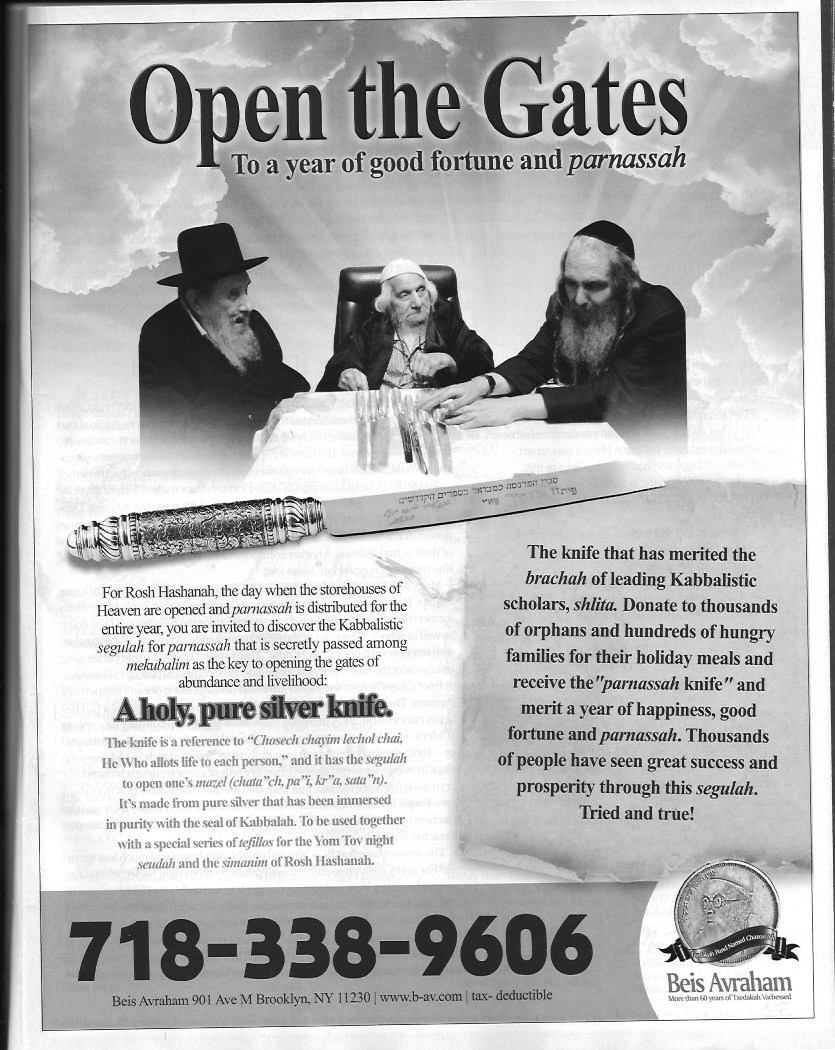
I don't know whether to laugh or cry ...

after seeing this ad. They must be really desperate to be pulling completely unknown segulas out of a hat.


Has anyone even heard of this sefer? The sefer may be from someone who lived before R' Shimon Bar Yochai or may be from the time of the Ramban. That is a big difference.

Friday, November 20, 2009

Very funny conversation

http://conversationsinklal.blogspot.com/2009/11/words-we-use.html

Girl #1: I'm so tired of dating! I wish I were married already!

Girl #2: Yeah, I'm really tired of spending nights at the Marriott
Hotel with guys I really don't want to be there with.

Girl #1: But if you don't go to a hotel what else is there to do on a date?

Girl #2: Maybe we need to find a different hotel to go to instead of
the Marriott.


To the frum listener the meaning is obvious, however, the non-frum listener is liable to really misintrepret this badly.

Thursday, November 19, 2009

ותלך לדרוש את ה

Rashi comments that she went to Shem and Ever. The question can be asked why didn't she ask her husband Yitzchak or Avraham who was still alive? Also, once she got the amswer why didn't she tell Yitzchak. After all, she was told that רב יעבוד צעיר, and that when one was up the other would be down. if she had told Yitzchak, it probably would have changed his views on the Berachos.

Wednesday, November 18, 2009

R' Hirsch: Chinuch lessons from Yaakov and Esav

The following is from RSRH's essay "Lessons From Jacob and Esau" that appears on pages 319 - 331 of his Collected Writing VII. It is amazing how his words below are so relevant to our generation. There is no question that R' Hirsch could be speaking about the current Charedi educational system. It is a terrible shame that his approach has basically died out as it is so needed in our modern world.

Down to our present day we have been able to observe the disastrous consequences of a one-sided approach to the unique task of being a Jew. Many a son of a pious talmid chacham has been totally lost to Judaism because his father insisted on training him to become a talmid chacham without considering whether his personality and inclinations truly lay in that direction. Thus he is exposed to Jewish life in only one context: that of a quiet existence of study and meditation for which he has neither talent nor desire. What attracts him instead is the busy, colorful life of the world outside. But as a result of the narrow view of life in which he has been trained he gets the impression that in order to participate in the active, variegated life for which he yearns, he must give up his mission as a Jew. He consequently abandons his Judaism in order to fling himself into the maelstrom of excitement and temptations offered by the world outside.

The story of such an individual might end quite differently if only, instead of forcing him into the mold of a talmid chacham, his father would raise him from the very beginning to become a man of the world who, at the same time, is faithful to his duties as a Jew; if only that father would teach this son that the activities of the world outside, too, have their place in God's plan, that it is possible to preserve and to demonstrate one's complete loyalty to Judaism even as a sophisticated man of the world. He should make his son understand that, as a matter of fact, many, if not perhaps the most important, aspects of Jewish living are intended primarily to be practiced amidst the conditions and aspirations of everyday life, in the midst of the world and not in isolation from it. He should make his son understand that the Taryag Mitzvos are not meant to be observed in the klaus [Judeo-German equivalent for a small synagogue. (Ed.)] or in the beth hamidrash but precisely in the practical life of the farmer or the public-spirited citizen. If only that father would make it clear to his son that the spirit and the happiness of Judaism are just as accessible to a Zevulun "in the world outside" as they are to an Issachar "in the tents,"?who knows whether that son might not stand by his father's
deathbed and gently close his father's eyes as a loyal, pious Jew?


He explains in his commentary on Chumash that Yitzchak and Rivka made exactly this mistake with Esav. They tried to educate Esav the same way as Yaakov, to sit and learn all day in the Beis Medrash. However, Esav's personality and inclinations did not lie in that direction. Because he was not given an alternative he turned into Esav harasha.