After all, this has caused tremendous damage to the PM to allow Talansky's testimony to go unrefuted. Olmert's attorneys could have cross examined Talansky yesterday. Their excuse that they needed more time to prepare is a joke, these are some of the best lawyers in Israel, I am sure that they could have managed in the timeframe given them
I believe that Olmert did this for a number of reasons:
1. Olmert is trying to buy time. By delaying Talansky's cross-examination for almost 2 months he thought he would buy that time. His line of defense is now, give me time to defend myself. This has also pushed out any indictment and in Israel's legalized society what the Attorney General and the courts say goes.
2. It allows them to easily negate Talansky's testimony. All you hear from Olmert's camp is "just wait until we cross examine him" and "we have an answer for everything he said". They can say that now because they don't have to back it up for another month and a half. I am sure that his lawyers on cross examination will be able to refute some minor points and score some points. However, I am quite sure that the overall thrust of Talansky's testimony will not be impugned. Therefore, if they had cross examined him yesterday, they would have no defense. Everyone would realize that the Emperorer has no clothes. By delaying for a month and a half they hope that things die down and people forget what exactly Talansky said.
Luckily, it seems that Olmert miscalculated. The fallout from Talansky's testimony has been overwhelming and will most likely not allow Olmert the time he so desperately wants.
Thursday, May 29, 2008


Wednesday, May 28, 2008
The legalization of politics
With regards to Olmert, all everyone is talking about is the legal process. Olmert doesn't deny that he took envelopes of cash, he just says it was legal. This is a byproduct of the judicial dictatorship that rules Israel. The judges have the final word on everything, they decide whether government decisions are reasonable. Therefore, everyone has come to think that if something is legal there is no problem, it is ethical and moral. Because of this everyone is saying let's wait and see if he is indicted.
Unfortunately, this is completely false, Something can be perfectly legal but unethical and immoral. As the Ramban famously says at the beginning of Parshas קדושים, one can be a נבל ברשות התורה. I am waiting for someone, anyone, to get up and say I don't care whether he is indicted, I don't care if it was legal, the PM of Israel should not be taking cash in envelopes from rich Americans. It is unethical and he needs to go. If any President of the US was in the same situation, he would be out the door in a few days. Everyone in America would understand that the legality of his actions is irrelevant, a leader can't do that. Unfortunately, this kind of accountability and ethical sense is completely missing from Israeli politics.
Unfortunately, this is completely false, Something can be perfectly legal but unethical and immoral. As the Ramban famously says at the beginning of Parshas קדושים, one can be a נבל ברשות התורה. I am waiting for someone, anyone, to get up and say I don't care whether he is indicted, I don't care if it was legal, the PM of Israel should not be taking cash in envelopes from rich Americans. It is unethical and he needs to go. If any President of the US was in the same situation, he would be out the door in a few days. Everyone in America would understand that the legality of his actions is irrelevant, a leader can't do that. Unfortunately, this kind of accountability and ethical sense is completely missing from Israeli politics.
Tuesday, May 27, 2008
Something I really don't understand about the Olmert - Talansky case
Forget about bribery. Olmert admitted to getting envelopes of cash, he claims for election purposes. Aren't there laws in Israel regarding campaign contributions? I am 99% sure that the simple fact of hiding them and not recording them is a violation of the law. In addition, Talansky is claiming that he gave Olmert money for personal expenses like business class seats, hotel rooms, expensive cigars etc. Again forget about bribery, what about taxes? All of these things are taxable and Olmert "forgot" to report them. Again I am sure that Olmert violated a number of tax laws by accepting the money and not reporting it.
How can anyone think that Olmert will not be indicted? What am I missing?
I understand that bribery sounds a lot better and makes a much sexier case, but remember, Al Capone went to jail for income tax fraud.
How can anyone think that Olmert will not be indicted? What am I missing?
I understand that bribery sounds a lot better and makes a much sexier case, but remember, Al Capone went to jail for income tax fraud.
Thursday, May 22, 2008
The so called "negotiations" with Syria
In an interview to the London-based daily Al Hayat, Syrian Foreign Minister Walid Moallem reiterated on Thursday Syria's demand that Israel fully withdraw from the Golan Heights. Moallem said, "Syria cannot progress even one step forward in negotiations before it receives assurances that Israel will fully withdraw from the Golan Heights. This is not a precondition, it's Syria's right."
What a joke. So what exactly are we negotiating? Withdrawal from the Golan Heights is a fait accompli. Where did Olmert and company learn to negotiate? Why say we are going to need to make painful concessions? I don't hear the Syrians saying that. What exactly are we going to get from this? Who wants a cold peace with a Syria which has practically melded its foreign and military policies with Iran? The Golan has been peaceful for 40 years what exactly is a peace treaty with Syria going to change? Does anyone really believe that Syria will abandon Hamas and Hizbullah and stop trying to take over Lebanon?
It is just amazing that anyone with half a brain can support this.
What a joke. So what exactly are we negotiating? Withdrawal from the Golan Heights is a fait accompli. Where did Olmert and company learn to negotiate? Why say we are going to need to make painful concessions? I don't hear the Syrians saying that. What exactly are we going to get from this? Who wants a cold peace with a Syria which has practically melded its foreign and military policies with Iran? The Golan has been peaceful for 40 years what exactly is a peace treaty with Syria going to change? Does anyone really believe that Syria will abandon Hamas and Hizbullah and stop trying to take over Lebanon?
It is just amazing that anyone with half a brain can support this.
Some things never change, Shas is staying in the government
This is amazing. Eli Yishai the head of Shas said the following:
"It is forbidden to negotiate with the axis of evil and certainly to abandon the Golan to the axis of evil," Yishai told reporters.
How exactly does this fit in with yesterday's dramatic announcement of peace talks with Syria? It is Shas and only Shas that is keeping the government alive. Olmert right now has a coalition of 64 MK's, if Shas leaves he only has 53 and the government falls.
Of course Eli Yishai made the following statement as well:
"At the moment when we see that there is real danger of giving the Golan to the axis of evil, Shas, of course, won't be in the government. We are constantly evaluating whether we should remain in the government."
When is that going to be? 5 minutes before they actually sign the peace treaty? The damage is already done, every minute that Shas stays in the government is just allowing Olmert to cause more and more harm.
So why is Shas staying in the government? Very simple, Olmert is bribing them. This time is is 286 new settlement homes in Beitar Illit, a Haredi "settlement" in the West Bank.
"It is forbidden to negotiate with the axis of evil and certainly to abandon the Golan to the axis of evil," Yishai told reporters.
How exactly does this fit in with yesterday's dramatic announcement of peace talks with Syria? It is Shas and only Shas that is keeping the government alive. Olmert right now has a coalition of 64 MK's, if Shas leaves he only has 53 and the government falls.
Of course Eli Yishai made the following statement as well:
"At the moment when we see that there is real danger of giving the Golan to the axis of evil, Shas, of course, won't be in the government. We are constantly evaluating whether we should remain in the government."
When is that going to be? 5 minutes before they actually sign the peace treaty? The damage is already done, every minute that Shas stays in the government is just allowing Olmert to cause more and more harm.
So why is Shas staying in the government? Very simple, Olmert is bribing them. This time is is 286 new settlement homes in Beitar Illit, a Haredi "settlement" in the West Bank.
Wednesday, May 21, 2008
Peace talks with Syria now?
Is anyone surprised by the timing? A day after the Supreme Court rules against him and allows Talansky to testify next week, the day when the court imposed gag order expires, Olmert makes a big announcement that Israel is negotiating with Syria using Turkey as a go-between.
Even a left winger like Shelly Yachimovitch sees this announcement by Olmert as desperation move to save his job:
MK Shelley Yachimovich (Labor) called the announcement a "meaningless spin," saying that Olmert was using the declaration of negotiations to try to steer public attention from the corruption scandal embroiling him.
"Olmert is cynically trying to fool decent, peace-advocating citizens to deflect attention from the cash envelope," she said.
We saw the disaster that happened when Sharon acted out of desperation to keep himself in office and out of jail, hopefully it won't happen again.
This statement sums it up best:
כעומק החקירות, כך עומק הנסיגות
Even a left winger like Shelly Yachimovitch sees this announcement by Olmert as desperation move to save his job:
MK Shelley Yachimovich (Labor) called the announcement a "meaningless spin," saying that Olmert was using the declaration of negotiations to try to steer public attention from the corruption scandal embroiling him.
"Olmert is cynically trying to fool decent, peace-advocating citizens to deflect attention from the cash envelope," she said.
We saw the disaster that happened when Sharon acted out of desperation to keep himself in office and out of jail, hopefully it won't happen again.
This statement sums it up best:
כעומק החקירות, כך עומק הנסיגות
Monday, May 19, 2008
Why does the Torah prohibit lending money with interest?
In last week's parsha (בהר) we have the prohibition of lending money to a Jew with interest. The question is why? At first glance we can ask why should money be any different then anything else? After all, I can rent out a house, car, tools, etc. Any possession I have I can rent out for money so why not my money? Interest is really rent for the usage of money.
There are a number of different approaches.
1. In בהר we have many mitzvos that are socio-economic, shemitta and yovel for example. These mitzvos come to teach us that ultimately everything belongs to Hashem and therefore for example, land goes back to it's original owners during Yovel. The prohibition of interest is coming to emphasize this point. You can't rent out your money because it is not really yours, rather it is Hashem's on loan to you. Hashem only gave it to you to use to serve him. Therefore the Torah prohibits interest.
2. R' Hirsch explains in Parshas Mishpatim that the prohibition of interest makes for a more fair society. When capital can only be used for investment or to pay for labor and cannot be used to just make more money, the gap between rich and poor becomes smaller. This also aligns the interest of the capitalist and his workers as money is used to pay the laborer. R' Hirsch is clearly coming to answer Marx's Communist Manifesto which was written in his lifetime.
3. Money is fundamentally different then other things. When I rent out my car, house, etc. the use of the object causes a loss in value. Even if the renter returns the object in perfect condition, the object devaluates simply because it was used. In addition, the price of commodities fluctuates. If I rent out my house for a year, at the end of the rental it may be worth less simply because prices dropped. Because you have the possibility of loss (the use devaluates the object and the value can go down), the Torah allows you to take payment in return to compensate.
Money however, is different. Money does not lose value through use. In fact, when you lend money the borrower generally pays you back with different money. In addition, the Torah views money as never changing it's value. Money doesn't fluctuate only commodities change values. Therefore, when I lend you money there is no risk of loss. At the end of the loan you will pay me back the same amount that I lent you. It is worth the same amount. Therefore the Torah does not allow you to charge rent for your money.
It is fascinating how due to the exigencies of life this prohibition has been basically wiped off the books. The Heter Iska although technically not interest but rather an investment, basically allows us to borrow and lend money with interest. The Heter Iska is clearly a circumvention of what the Torah wanted.
There are a number of different approaches.
1. In בהר we have many mitzvos that are socio-economic, shemitta and yovel for example. These mitzvos come to teach us that ultimately everything belongs to Hashem and therefore for example, land goes back to it's original owners during Yovel. The prohibition of interest is coming to emphasize this point. You can't rent out your money because it is not really yours, rather it is Hashem's on loan to you. Hashem only gave it to you to use to serve him. Therefore the Torah prohibits interest.
2. R' Hirsch explains in Parshas Mishpatim that the prohibition of interest makes for a more fair society. When capital can only be used for investment or to pay for labor and cannot be used to just make more money, the gap between rich and poor becomes smaller. This also aligns the interest of the capitalist and his workers as money is used to pay the laborer. R' Hirsch is clearly coming to answer Marx's Communist Manifesto which was written in his lifetime.
3. Money is fundamentally different then other things. When I rent out my car, house, etc. the use of the object causes a loss in value. Even if the renter returns the object in perfect condition, the object devaluates simply because it was used. In addition, the price of commodities fluctuates. If I rent out my house for a year, at the end of the rental it may be worth less simply because prices dropped. Because you have the possibility of loss (the use devaluates the object and the value can go down), the Torah allows you to take payment in return to compensate.
Money however, is different. Money does not lose value through use. In fact, when you lend money the borrower generally pays you back with different money. In addition, the Torah views money as never changing it's value. Money doesn't fluctuate only commodities change values. Therefore, when I lend you money there is no risk of loss. At the end of the loan you will pay me back the same amount that I lent you. It is worth the same amount. Therefore the Torah does not allow you to charge rent for your money.
It is fascinating how due to the exigencies of life this prohibition has been basically wiped off the books. The Heter Iska although technically not interest but rather an investment, basically allows us to borrow and lend money with interest. The Heter Iska is clearly a circumvention of what the Torah wanted.
Sunday, May 18, 2008
בה"ב and פסח שני
This year we have a relatively rare occurrence, the last day of בה"ב falls out on פסח שני. The question is what takes precedence? The Minhag in EY seems to be that פסח שני takes precedence and you simply skip the last day of בה"ב. Interestingly enough when בה"ב falls out on Yom Haaztmaut those who say Hallel say both Selichos and Hallel.
Thursday, May 15, 2008
Ashkelon Rocket Attack launched from what used to be Dugit
To all of those disengagement supporters what do you say now? The disengagement was supposed bring security and yet, now Ashkelon is under rocket fire from the very Jewish towns that were evacuated. Can anyone in their right mind still think that the disengagement was a success? Will any disengagement supporters apologize?
Why are you turning into a schnorrer?
This is the question the Jonathan Rosenblum asked a Charedi Yeshiva Bachur who was trying to hitch a ride for a few blocks. The answer was, מקובל, it is accepted practice.
In his latest column (in Hebrew) in the Mishpacha magazine, Jonathan Rosenblum talks about his encounter with a Yeshiva Bachur who was trying to hitch a ride a few blocks.
His point was that today's Yeshiva Bachur has no compunction and feels no shame to take things for free even if he could do it himself. He points out that the idea of נהמא דכיסופא (literally free bread), which means that Hashem put us on this world so that we could earn our עולם הבא so we wouldn't be embarrassed by being נהנה מזיו השכינה for free, is a completely foreign concept to today's Yeshiva Bachur.
The only point I disagree with him on is that he blames it on Israeli Socialism. IMHO this is just not true. The same attitude can be found in American Yeshiva Bachurim as well. When your whole lifestyle is predicated on you sitting and learning and someone else supporting you (in style), of course you can't understand נהמא דכיסופא, it is a contradiction to your whole lifestyle.
In his latest column (in Hebrew) in the Mishpacha magazine, Jonathan Rosenblum talks about his encounter with a Yeshiva Bachur who was trying to hitch a ride a few blocks.
His point was that today's Yeshiva Bachur has no compunction and feels no shame to take things for free even if he could do it himself. He points out that the idea of נהמא דכיסופא (literally free bread), which means that Hashem put us on this world so that we could earn our עולם הבא so we wouldn't be embarrassed by being נהנה מזיו השכינה for free, is a completely foreign concept to today's Yeshiva Bachur.
The only point I disagree with him on is that he blames it on Israeli Socialism. IMHO this is just not true. The same attitude can be found in American Yeshiva Bachurim as well. When your whole lifestyle is predicated on you sitting and learning and someone else supporting you (in style), of course you can't understand נהמא דכיסופא, it is a contradiction to your whole lifestyle.
More threats and more threats but no action
The Israeli governments of the past 15 years (since Oslo) have been great at making threats and not carrying them out. Remember Rabin's threat about what would happen to the Palestinians if they used the rifles against us? Was the threat carried out? Do you remember Barak's threat right before we pulled out of Lebanon? Do you remember Sharon and Mofaz's threat right before the disengagement?
Israel has become the boy who cried wolf. The governments have made so many threats and not carried them out that threats now have zero credibility.
Israel has become the boy who cried wolf. The governments have made so many threats and not carried them out that threats now have zero credibility.
Wednesday, May 07, 2008
Peres: I didn't imagine Qassams would be fired from Gaza after pullout
Here is a list of things that Peres didn't think were going to happen:
1. He believed the separation between the West Bank and Gaza would make things easier not harder.
2. He did not imagine that we would leave Gaza and they would fire Qassams from there.
3. He did not imagine that Hamas would show so strongly in the elections.
(taken from here)
In other words on some of the most important issues of the past decade he was absolutely wrong. The thing is he is not embarrassed at all for being wrong on every single one of these. It isn't just Peres, everyone on the left made the same mistakes. The problem is that they don't learn from their mistakes rather they repeat them over and over again.
1. He believed the separation between the West Bank and Gaza would make things easier not harder.
2. He did not imagine that we would leave Gaza and they would fire Qassams from there.
3. He did not imagine that Hamas would show so strongly in the elections.
(taken from here)
In other words on some of the most important issues of the past decade he was absolutely wrong. The thing is he is not embarrassed at all for being wrong on every single one of these. It isn't just Peres, everyone on the left made the same mistakes. The problem is that they don't learn from their mistakes rather they repeat them over and over again.
Monday, May 05, 2008
Some facts about the Palestinians
Dov Bear is spouting his stupidity again about the Palestinians.
Here are some facts. These are in no particular order.
1. There has never ever in history been a state of Palestine Here is a great quote about Palestine and Palestinians Myths of the Middle East
The truth is that Palestine is no more real than Never-Never Land. The first time the name was used was in 70 A.D. when the Romans committed genocide against the Jews, smashed the Temple and declared the land of Israel would be no more. From then on, the Romans promised, it would be known as Palestine.
...
Palestine has never existed -- before or since -- as an autonomous entity. It was ruled alternately by Rome, by Islamic and Christian crusaders, by the Ottoman Empire and, briefly, by the British after World War I. The British agreed to restore at least part of the land to the Jewish people as their homeland.
There is no language known as Palestinian. There is no distinct Palestinian culture. There has never been a land known as Palestine governed by Palestinians. Palestinians are Arabs, indistinguishable from Jordanians (another recent invention), Syrians, Lebanese, Iraqis, etc. Keep in mind that the Arabs control 99.9 percent of the Middle East lands. Israel represents one-tenth of 1 percent of the landmass.
2. In the late 1800's every travelogue written about the area (the most famous being Mark Twain's) invariably said that the country was desolate and void of inhabitants, where were all the millions of Palestinians? For instance, a travel guide to Palestine and Syria, published in 1906 by Karl Baedeker, illustrates the fact that, even when the Islamic Ottoman Empire ruled the region, the Muslim population in Jerusalem was minimal. The book estimates the total population of the city at 60,000, of whom 7,000 were Muslims, 13,000 were Christians and 40,000 were Jews. So much for the myth of Arab East Jerusalem.
3. In the Middle East there are 22 Arab countries occupying 99% of the land. Israel occupies less then 1% of the Middle East
4. There is no distinctive Palestinian culture, language, etc. Palestinians are Arabs, they speak Arabic, they are mostly Moslem. The leader of the Palestinians, Yasir Arafat was born in Cairo. What makes Arafat more of a Palestinian then me?
5. From 1948-1967 Israel did not occupy the West Bank and Gaza, where was the call for a Palestinian state?
6. There actually is a Palestinian state already, Jordan. The mandate of Palestine included what is now Jordan, in 1922, the British created an Arab state from 80% of mandatory Palestine called Jordan
7. The 20th century has seen tremendous movement of population. When India and Pakistan were created more then 20 million people moved one way of the other. Yet, no one is calling for a right of return.
8. About 800,000 Palestinians became refugees in 1948 (mostly on the urgings of Arab leaders), from 1948-1953 about 800,000 Jews living in Arab countries became refugees. Contrary to the Palestinians, these Jews were absorbed by Israel and are now productive citizens
9. In 1948 the Palestinians were offered a state they rejected it, the same happened in July 2000.
Let's double click on the 1800's.
When the Jews first started coming back in numbers in the 1800's, the land was desolate, this is not me talking but Mark Twain and every other traveler to Palestine in the late 1800's. And I quote from Twain:
"Desolate country whose soil is rich enough but is given over wholly to weeds—a silent mournful expanse…A desolation is here that not even imagination can grace with the pomp of life and action. We reached Tabor safely…We never saw a human being on the whole route…
"There was hardly a tree or a shrub anywhere. Even the olive and the cactus, those fast friends of a worthless soil, had almost deserted the country…
Stirring scenes ... occur in the valley [Jezreel] no more. There is not a solitary village throughout its whole extent-not for thirty miles in either direction. There are two or three small clusters of Bedouin tents, but not a single permanent habitation. One may ride ten miles hereabouts and not see ten human beings
"Palestine sits in sackcloth and ashes. Over it broods the spell of a curse that has withered its fields and fettered its energies. Palestine is desolate and unlovely."
Lamartine wrote:
"Outside the gates of Jerusalem we saw Indeed no living object, heard no living object, heard no living sound, we found the same void the same silence…as we should have expected before the entombed gates of Pompeli or Herculaneam…a complete eternal silence reigns in the town, on the highways in the country…the tomb of a whole people."(Recollections of the East, vol. 1, pp. 268, 308, London, 1815).
The British Consul in Palestine reported in 1857 that
The country is in a considerable degree empty of inhabitants and therefore its greatest need is that of a body of population.... 18 In the 1860s, it was reported that "depopulation is even now advancing."19 At the same time, H. B. Tristram noted in his journal that
The north and south [of the Sharon plain] land is going out of cultivation and whole villages are rapidly disappearing from the face of the earth. Since the year 1838, no less than 20 villages there have been thus erased from the map [by the Bedouin] and the stationary population extirpated. 20
Where were all those indigenous Palestinians???????
The fact is that the Jews purchased land from absentee owners started to work the land and revived the economy. Because of that Arabs from all over the region migrated to Palestine.
This old post Is Gaza "captured" territory? is very relevant as well.
Here are some facts. These are in no particular order.
1. There has never ever in history been a state of Palestine Here is a great quote about Palestine and Palestinians Myths of the Middle East
The truth is that Palestine is no more real than Never-Never Land. The first time the name was used was in 70 A.D. when the Romans committed genocide against the Jews, smashed the Temple and declared the land of Israel would be no more. From then on, the Romans promised, it would be known as Palestine.
...
Palestine has never existed -- before or since -- as an autonomous entity. It was ruled alternately by Rome, by Islamic and Christian crusaders, by the Ottoman Empire and, briefly, by the British after World War I. The British agreed to restore at least part of the land to the Jewish people as their homeland.
There is no language known as Palestinian. There is no distinct Palestinian culture. There has never been a land known as Palestine governed by Palestinians. Palestinians are Arabs, indistinguishable from Jordanians (another recent invention), Syrians, Lebanese, Iraqis, etc. Keep in mind that the Arabs control 99.9 percent of the Middle East lands. Israel represents one-tenth of 1 percent of the landmass.
2. In the late 1800's every travelogue written about the area (the most famous being Mark Twain's) invariably said that the country was desolate and void of inhabitants, where were all the millions of Palestinians? For instance, a travel guide to Palestine and Syria, published in 1906 by Karl Baedeker, illustrates the fact that, even when the Islamic Ottoman Empire ruled the region, the Muslim population in Jerusalem was minimal. The book estimates the total population of the city at 60,000, of whom 7,000 were Muslims, 13,000 were Christians and 40,000 were Jews. So much for the myth of Arab East Jerusalem.
3. In the Middle East there are 22 Arab countries occupying 99% of the land. Israel occupies less then 1% of the Middle East
4. There is no distinctive Palestinian culture, language, etc. Palestinians are Arabs, they speak Arabic, they are mostly Moslem. The leader of the Palestinians, Yasir Arafat was born in Cairo. What makes Arafat more of a Palestinian then me?
5. From 1948-1967 Israel did not occupy the West Bank and Gaza, where was the call for a Palestinian state?
6. There actually is a Palestinian state already, Jordan. The mandate of Palestine included what is now Jordan, in 1922, the British created an Arab state from 80% of mandatory Palestine called Jordan
7. The 20th century has seen tremendous movement of population. When India and Pakistan were created more then 20 million people moved one way of the other. Yet, no one is calling for a right of return.
8. About 800,000 Palestinians became refugees in 1948 (mostly on the urgings of Arab leaders), from 1948-1953 about 800,000 Jews living in Arab countries became refugees. Contrary to the Palestinians, these Jews were absorbed by Israel and are now productive citizens
9. In 1948 the Palestinians were offered a state they rejected it, the same happened in July 2000.
Let's double click on the 1800's.
When the Jews first started coming back in numbers in the 1800's, the land was desolate, this is not me talking but Mark Twain and every other traveler to Palestine in the late 1800's. And I quote from Twain:
"Desolate country whose soil is rich enough but is given over wholly to weeds—a silent mournful expanse…A desolation is here that not even imagination can grace with the pomp of life and action. We reached Tabor safely…We never saw a human being on the whole route…
"There was hardly a tree or a shrub anywhere. Even the olive and the cactus, those fast friends of a worthless soil, had almost deserted the country…
Stirring scenes ... occur in the valley [Jezreel] no more. There is not a solitary village throughout its whole extent-not for thirty miles in either direction. There are two or three small clusters of Bedouin tents, but not a single permanent habitation. One may ride ten miles hereabouts and not see ten human beings
"Palestine sits in sackcloth and ashes. Over it broods the spell of a curse that has withered its fields and fettered its energies. Palestine is desolate and unlovely."
Lamartine wrote:
"Outside the gates of Jerusalem we saw Indeed no living object, heard no living object, heard no living sound, we found the same void the same silence…as we should have expected before the entombed gates of Pompeli or Herculaneam…a complete eternal silence reigns in the town, on the highways in the country…the tomb of a whole people."(Recollections of the East, vol. 1, pp. 268, 308, London, 1815).
The British Consul in Palestine reported in 1857 that
The country is in a considerable degree empty of inhabitants and therefore its greatest need is that of a body of population.... 18 In the 1860s, it was reported that "depopulation is even now advancing."19 At the same time, H. B. Tristram noted in his journal that
The north and south [of the Sharon plain] land is going out of cultivation and whole villages are rapidly disappearing from the face of the earth. Since the year 1838, no less than 20 villages there have been thus erased from the map [by the Bedouin] and the stationary population extirpated. 20
Where were all those indigenous Palestinians???????
The fact is that the Jews purchased land from absentee owners started to work the land and revived the economy. Because of that Arabs from all over the region migrated to Palestine.
This old post Is Gaza "captured" territory? is very relevant as well.
Tuesday, April 29, 2008
Ben Gurion Airport ranked as the best airport in the Middle East
The World's Best Airports
South Korea's Incheon tops the list for the third year, Porto leads Europe, Dallas-Fort Worth wins first place stateside, and Ben Gurion is best in the Mideast
Some good news for a change.
South Korea's Incheon tops the list for the third year, Porto leads Europe, Dallas-Fort Worth wins first place stateside, and Ben Gurion is best in the Mideast
Some good news for a change.
Here we go again: Another Knesset split
The Pensioners party is splitting up and it looks like 3 of the 7 are forming a new party.
Israel has a list based election system. You don't vote for any individual person but you vote for a party list. Given that, it makes no sense to allow any Knesset member to leave his party and and form a new one. He was not elected and it is not his seat. The party was elected and the party should control the seat. If an MK doesn't like it let him resign. The current system is the worst of both worlds. There is no personal accountability, you cannot vote anyone out of office, if they are high on the list they will be in the Knesset. On the other hand the MK's can do whatever they want with the seat once they get it. This is a formula for disaster and is anti-democratic (remember Sharon and Kadima).
Israel has a list based election system. You don't vote for any individual person but you vote for a party list. Given that, it makes no sense to allow any Knesset member to leave his party and and form a new one. He was not elected and it is not his seat. The party was elected and the party should control the seat. If an MK doesn't like it let him resign. The current system is the worst of both worlds. There is no personal accountability, you cannot vote anyone out of office, if they are high on the list they will be in the Knesset. On the other hand the MK's can do whatever they want with the seat once they get it. This is a formula for disaster and is anti-democratic (remember Sharon and Kadima).
Friday, April 25, 2008
Starting Shacharis at 11:30AM
I went to the Kotel on Chol Hamoed late in the morning. We go there about 11:30 and it was really hot so we went inside. We saw a number of Chasidim with taleisim and then I heard them saying kaddish after korbanos and then starting הודו. It is hard to believe that people are starting to daven shacharis at 11:30AM.


Note the timestamps on the pictures.


Note the timestamps on the pictures.
Wednesday, April 16, 2008
בדיקת חמץ nowadays, what do you need to check?
Nowadays that we clean for Pesach for weeks before, what do you need to check when you do בדיקת חמץ?
RSZA is quoted in הליכות שלמה פרק ה as saying that nowadays you do not need to go and check every little nook and cranny. What a person needs to do is check every place to make sure that it was cleaned for Pesach, that is the בדיקה. This means that the בדיקה does not need to take all night but rather a short time where you check each room, closet, etc. to make sure that it was cleaned for Pesach.
I heard a similar idea from R' Willig as well that the cleaning that you do before Pesach is מצטרף to your בדיקה and on the night of the 14th you do not need to spend hours checking every spot. All you need to do is make sure that you cleaned everything. The בדיקה is like the final check of all the cleaning that you did.
RSZA is quoted in הליכות שלמה פרק ה as saying that nowadays you do not need to go and check every little nook and cranny. What a person needs to do is check every place to make sure that it was cleaned for Pesach, that is the בדיקה. This means that the בדיקה does not need to take all night but rather a short time where you check each room, closet, etc. to make sure that it was cleaned for Pesach.
I heard a similar idea from R' Willig as well that the cleaning that you do before Pesach is מצטרף to your בדיקה and on the night of the 14th you do not need to spend hours checking every spot. All you need to do is make sure that you cleaned everything. The בדיקה is like the final check of all the cleaning that you did.
Monday, April 14, 2008
When to bake the matzah when Erev Pesach falls out on Shabbos?
There is a famous שיטת Rashi that the Matzas mitzva needs to be baked erev Pesach after חצות, otherwise you are not יוצא. Rashi gets this from the Gemara on Pesachim 120b where Rava has a היקש between מצה and קרבן פסח, that the זמן of eating מצה is the same as the זמן of eating קרבן פסח. Rashi understands that the היקש would likewise apply to the preparations, just like the קרבן פסח has to be prepared on erev Pesach after חצות, so too does the מצה. This is quoted as a יש אומרים in Shulchan Aruch. The Gra disagrees, one of his proofs is the following. What happens when erev Pesach is on Shabbos like this year? קרבן פסח is דוחה Shabbos and is therefore brought on Shabbos afternoon, however baking מצה is not דוחה Shabbos and therefore cannot be done on Shabbos afternoon. If so, how is anyone יוצא the mitzva of מצה, the מצה was not prepared in the זמן of the קרבן פסח? In truth, those rishonim who hold like Rashi say that when erev pesach is Shabbos, you bake the מצה on the seder night. However, the Gra's question stil holds. If the מצה needs to be baked in the זמן of the קרבן פסח, the seder night is too late, you cannot bring the קרבן פסח at that time.
A number of later acharonim answer as follows. The Gemara earlier states that the קרבן פסח is brought on Shabbos (and not that night after Shabbos) because it is זמנו קבוע. Rashi explains because there is a general din that korbanos cannot be brought at night. The acharonim ask, why didn't Rashi simply answer because the Torah says that the קרבן פסח needs to be brought on the 14th of Nisan and that night is already the 15th? They answer as follows. In halacha day follows night. However, by קרבנות the din is that night follows day. Therefore they say as follows. Although the seder night is the 15th in the calendar, with regards to קרבנות it is still the 14th as night follows day. Therefore, Rashi can't answer that the seder night is too late because that night is considered the 14th for קרבנות so Rashi needs to answer that קרבנות in general cannot be brought at night.
Based on this, we can answer the Gra's question as well. From the perspective of the קרבן פסח the night of the 15th is still the זמן, there is just a technical problem that you can't bring קרבנות at night, but from the pure קרבן פסח perspective it is the זמן and therefore you can bake the מצה that night. The היקש between מצה and קרבן פסח only relates to those special dinim of קרבן פסח, not to the regular dinim of קרבנות. Therefore from that perspective the seder night is still considered to be the זמן of the קרבן פסח and therefore you can bake the מצה then.
Some rishonim have a different version of Rashi. They understand that according to Rashi you need to bake the מצה on erev Pesach but even in the morning. This is clearly not connected to קרבן פסח as the קרבן פסח cannot be brought in the morning. The question is if so, why do you need to bake the מצה on erev Pesach?
RYBS explained as follows. The Yerushalmi has a din that it is prohibited to eat מצה on erev Pesach. The Ramban explains this as follows (why is the prohibition limited to erev Pesach). מצה is defined as being not חמץ. Without חמץ there can be no מצה. Before erev Pesach there is no halachic significance to חמץ, it doesn't really exist, therefore there can be no issur to eat מצה as if there is no חמץ there is no מצה. On erev Pesach when the mitzva of תשביתו destroying חמץ starts, then you can have מצה and therefore there is an issur to eat מצה.
Based on this RYBS explained Rashi. We know that מצת מצוה needs to be made לשמה. Rashi holds like this Ramban, that מצה is defined as being not חמץ and that without חמץ there can be no מצה. Therefore, before erev Pesach you cannot bake מצת מצוה because it can't be made לשמה as there is no שם מצה yet. Only on erev Pesach where there is halachic significance to חמץ can there be מצה made לשמה. Therefore Rashi says that the מצה needs to be baked on erev Pesach, even in the morning, to create the לשמה of מצת מצוה, and מצה baked earlier is no good because it lacks לשמה.
This also explains why they would bake the מצה on the seder night if erev Pesach was Shabbos.
A number of later acharonim answer as follows. The Gemara earlier states that the קרבן פסח is brought on Shabbos (and not that night after Shabbos) because it is זמנו קבוע. Rashi explains because there is a general din that korbanos cannot be brought at night. The acharonim ask, why didn't Rashi simply answer because the Torah says that the קרבן פסח needs to be brought on the 14th of Nisan and that night is already the 15th? They answer as follows. In halacha day follows night. However, by קרבנות the din is that night follows day. Therefore they say as follows. Although the seder night is the 15th in the calendar, with regards to קרבנות it is still the 14th as night follows day. Therefore, Rashi can't answer that the seder night is too late because that night is considered the 14th for קרבנות so Rashi needs to answer that קרבנות in general cannot be brought at night.
Based on this, we can answer the Gra's question as well. From the perspective of the קרבן פסח the night of the 15th is still the זמן, there is just a technical problem that you can't bring קרבנות at night, but from the pure קרבן פסח perspective it is the זמן and therefore you can bake the מצה that night. The היקש between מצה and קרבן פסח only relates to those special dinim of קרבן פסח, not to the regular dinim of קרבנות. Therefore from that perspective the seder night is still considered to be the זמן of the קרבן פסח and therefore you can bake the מצה then.
Some rishonim have a different version of Rashi. They understand that according to Rashi you need to bake the מצה on erev Pesach but even in the morning. This is clearly not connected to קרבן פסח as the קרבן פסח cannot be brought in the morning. The question is if so, why do you need to bake the מצה on erev Pesach?
RYBS explained as follows. The Yerushalmi has a din that it is prohibited to eat מצה on erev Pesach. The Ramban explains this as follows (why is the prohibition limited to erev Pesach). מצה is defined as being not חמץ. Without חמץ there can be no מצה. Before erev Pesach there is no halachic significance to חמץ, it doesn't really exist, therefore there can be no issur to eat מצה as if there is no חמץ there is no מצה. On erev Pesach when the mitzva of תשביתו destroying חמץ starts, then you can have מצה and therefore there is an issur to eat מצה.
Based on this RYBS explained Rashi. We know that מצת מצוה needs to be made לשמה. Rashi holds like this Ramban, that מצה is defined as being not חמץ and that without חמץ there can be no מצה. Therefore, before erev Pesach you cannot bake מצת מצוה because it can't be made לשמה as there is no שם מצה yet. Only on erev Pesach where there is halachic significance to חמץ can there be מצה made לשמה. Therefore Rashi says that the מצה needs to be baked on erev Pesach, even in the morning, to create the לשמה of מצת מצוה, and מצה baked earlier is no good because it lacks לשמה.
This also explains why they would bake the מצה on the seder night if erev Pesach was Shabbos.
Tuesday, April 08, 2008
Selling Chametz on pesach in Israel
There has been an unenforced law on the books for a long time that permits the public selling of Chametz in Israel. Last week a judge reinterpretated the law that it doesn't apply to stores rather it only applies to open markets. In other words, stores, restaurants, etc. are now free to sell chametz this Pesach.
The charedi and religious parties jumped on this and are trying to change the law so that it prohibits the sale of Chametz period.
IMHO, this is a big mistake. Religious coercion does not work in Israel. It just makes things worse. The real chiloni who wants his bread will get it even if he needs to break the law. The traditional person who doesn't eat chametz on pesach will still not eat chametz on pesach. So what is the point? This law will not make a single person not eat chametz. Religious even Charedi Jews manage to walk around Boro Park where all the stores are selling Chametz on Pesach and survive. All these kinds of laws do is make the chiloni population anti-religious. This is populism at it's worst.
The charedi and religious parties jumped on this and are trying to change the law so that it prohibits the sale of Chametz period.
IMHO, this is a big mistake. Religious coercion does not work in Israel. It just makes things worse. The real chiloni who wants his bread will get it even if he needs to break the law. The traditional person who doesn't eat chametz on pesach will still not eat chametz on pesach. So what is the point? This law will not make a single person not eat chametz. Religious even Charedi Jews manage to walk around Boro Park where all the stores are selling Chametz on Pesach and survive. All these kinds of laws do is make the chiloni population anti-religious. This is populism at it's worst.
Tuesday, April 01, 2008
The dollar is still worth 4 shekels according to the Gedolim
The dollar today, April 1, 2008, is worth 3.54809 Israeli New Shekel. I posted last month, The dollar is still worth 4 shekels according to the Gedolim, that the Gedolim decided that for the Areivim project the $18 monthly contribution is to be calculated at 4 shekel to the dollar. This month again both Areivim and the Gemach Hamercazi reiterated that the dollar is still 4 shekels.


It will be interesting to see how long they continue with this as opposed to just switching to the shekel.


It will be interesting to see how long they continue with this as opposed to just switching to the shekel.
Sunday, March 30, 2008
Misleading statements in the name of Kiruv
Aish Hatorah published an article Women at Work which claims that Orthodox women can work at any job that they want.
Let's get something perfectly clear: Jewish women work. One of my neighbors is a nuclear physicist. I'm a zoo veterinarian.
...
And nowadays, like women all over the Western world, they work in every field. Some run their own businesses or are part of a larger corporation. Here in Israel one of my neighbors is a nuclear physicist. Another is a school principal. Several good friends are lawyers. One's a pediatrician. Two are successful artists. I'm a zoo veterinarian.
...
My point is, little is forbidden to us. We work in the fields we want. We have open choices. We can choose to work part-time or full-time.
If Aish Hatorah was a Modern or Centrist Orthodox institution then these statements would be perfectly true and not misleading. However, Aish Hatorah is a Charedi institution and it's goal for it's students is that they join Israeli Charedi society. The fact is that if Elizabeth had been born to a Charedi family she would not have had a choice to be a veterinarian, a nuclear physicist or anything other then a school teacher. University study is strictly prohibited. In Yerushalayim and Bnei Brak even getting a high school diploma is prohibited (see this post No Bagrut for Beis Yaakov girls?). All the women that she brings as examples fall into one of 2 categories:
1. Baalei teshuva
2. They grew up in modern homes
None of the women cited grew up in a Charedi home in Israel, because if they had they would not be where they are today.
In addition to the issue with secular education and university, there is an issue of tznius. In many parts of the Israeli Charedi world women are not allowed to drive a car because it is not tzanua. There are many seforim published in the last few years on tznius which prohibit women from working in any non-religious workplace. Therefore to state little is forbidden to us is misleading if not an outright lie according to Aish Hatorah's hashkafa.
I find it very offensive when Charedi kiruv institutions use examples of Baalei Teshiva or people who were brought up in a more Modern home. Using these people as examples of how well religious Jews can fit into society is very misleading when the institutions themselves don't believe in that hashkafa. According to Charedi hashkafa, Modern Orthodoxy is pasul and University study is prohibited, yet those are the examples they site when trying to be mekarev people. None of the faculty at Aish Hatorah in Yerushalayim send their daughters to university and their daughters do not have the ability to do what they want. They will be kollel wives who support their husbands by teaching or being a secretary, cashier etc. They have absolutely no choice to be Veterinarians, Nuclear Physicists, Lawyers, etc. To say otherwise is simply a lie.
Let's get something perfectly clear: Jewish women work. One of my neighbors is a nuclear physicist. I'm a zoo veterinarian.
...
And nowadays, like women all over the Western world, they work in every field. Some run their own businesses or are part of a larger corporation. Here in Israel one of my neighbors is a nuclear physicist. Another is a school principal. Several good friends are lawyers. One's a pediatrician. Two are successful artists. I'm a zoo veterinarian.
...
My point is, little is forbidden to us. We work in the fields we want. We have open choices. We can choose to work part-time or full-time.
If Aish Hatorah was a Modern or Centrist Orthodox institution then these statements would be perfectly true and not misleading. However, Aish Hatorah is a Charedi institution and it's goal for it's students is that they join Israeli Charedi society. The fact is that if Elizabeth had been born to a Charedi family she would not have had a choice to be a veterinarian, a nuclear physicist or anything other then a school teacher. University study is strictly prohibited. In Yerushalayim and Bnei Brak even getting a high school diploma is prohibited (see this post No Bagrut for Beis Yaakov girls?). All the women that she brings as examples fall into one of 2 categories:
1. Baalei teshuva
2. They grew up in modern homes
None of the women cited grew up in a Charedi home in Israel, because if they had they would not be where they are today.
In addition to the issue with secular education and university, there is an issue of tznius. In many parts of the Israeli Charedi world women are not allowed to drive a car because it is not tzanua. There are many seforim published in the last few years on tznius which prohibit women from working in any non-religious workplace. Therefore to state little is forbidden to us is misleading if not an outright lie according to Aish Hatorah's hashkafa.
I find it very offensive when Charedi kiruv institutions use examples of Baalei Teshiva or people who were brought up in a more Modern home. Using these people as examples of how well religious Jews can fit into society is very misleading when the institutions themselves don't believe in that hashkafa. According to Charedi hashkafa, Modern Orthodoxy is pasul and University study is prohibited, yet those are the examples they site when trying to be mekarev people. None of the faculty at Aish Hatorah in Yerushalayim send their daughters to university and their daughters do not have the ability to do what they want. They will be kollel wives who support their husbands by teaching or being a secretary, cashier etc. They have absolutely no choice to be Veterinarians, Nuclear Physicists, Lawyers, etc. To say otherwise is simply a lie.
Thursday, March 27, 2008
The Torah world in Israel by the numbers
Here are the number from this week's Mishpacha.

30,150 yeshiva students in 400 Yeshivos
61,243 married men learning in Kollel in 1239 different Kollelim (an average of 50 people per Kollel).
These are unprecedented numbers, over 90,000 people sitting and learning full time, (and this excludes all the kids in Yeshiva Ketana who learn full time).

30,150 yeshiva students in 400 Yeshivos
61,243 married men learning in Kollel in 1239 different Kollelim (an average of 50 people per Kollel).
These are unprecedented numbers, over 90,000 people sitting and learning full time, (and this excludes all the kids in Yeshiva Ketana who learn full time).
Saturday, March 22, 2008
The Torah world in Israel is on the verge of financial collapse
This was on the front page of this weeks Mishpacha magazine.

"We don't have from where to pay the kollel stipends"
There is panic in the administrative ranks of the torah institutions because of the economic crisis in the US, the fall of the dollar, the deep problems in the real estate sector in the US, and the rise in prices of basic products (e.g. flour, bread, etc.). For the first time, the administers of the Torah institutions who control huge budgets are talking in terms of a financial crisis that we haven't seen in many years in the Torah world. A number of the large Kollel chains did not pay stipends this past month and don't know how they are going to pay the Pesach stipends. Donors in the US who are affected by the crisis have shut off the flow of money to the Torah world. The heads of Tzedaka funds: The poor will have to make do with less this year.
This is not a surprise to me, the Torah world in Israel has for many years been on a non-sustainable economic path. The sub-prime crisis in the US has just speeded up the timetable a bit. Given what is going on in the US, this is not going to end soon and the damage will be great.

"We don't have from where to pay the kollel stipends"
Financial terror attack on the Torah world
There is panic in the administrative ranks of the torah institutions because of the economic crisis in the US, the fall of the dollar, the deep problems in the real estate sector in the US, and the rise in prices of basic products (e.g. flour, bread, etc.). For the first time, the administers of the Torah institutions who control huge budgets are talking in terms of a financial crisis that we haven't seen in many years in the Torah world. A number of the large Kollel chains did not pay stipends this past month and don't know how they are going to pay the Pesach stipends. Donors in the US who are affected by the crisis have shut off the flow of money to the Torah world. The heads of Tzedaka funds: The poor will have to make do with less this year.
This is not a surprise to me, the Torah world in Israel has for many years been on a non-sustainable economic path. The sub-prime crisis in the US has just speeded up the timetable a bit. Given what is going on in the US, this is not going to end soon and the damage will be great.
Thursday, March 20, 2008
Avos U'Banim time changes get the approval of the Gedolei Hador
Avos U'Banim is a big deal on Purim with special prizes etc. This year with Purim being on Friday it is difficult to find time for the hour of Avos U'Banim. Therefore a number of shuls decided to have Avos U'Banim on Taanis Esther between Mincha and Maariv.
One of the shuls put up a sign which stated that Avos Ubanim is Thursday between Mincha and Maariv and then at the bottom it stated the following:
This sign was shown to R' Chaim Kanievsky and he said Bracha V'Hatzlacha
In other words something as trivial as changing Avos U'Banim to Taanis Esther now needs the haskama of the Gedolei Hador. The shul in question has a Rabbi who is a big Talimd Chacham yet they felt the need to say that they had the approval of R' Chaim Kanievsky. What have we come to? Can no one other then the "Gedolei Hador" have an opinion anymore? Do we really need to bother someone like R' Chaim Kanievsky about what time we should make Avos Ubanim on Purim?
Rafi G has another example of this phenomenon. The Kupa shel tzdeka in RBS felt the need to go to put out the following flyer:
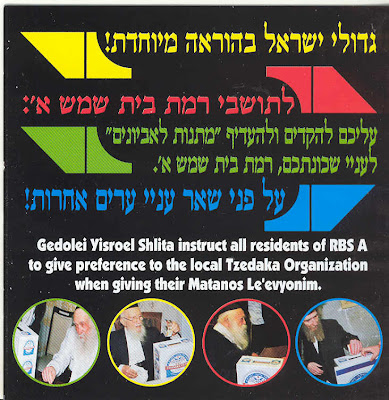
Again, this is a basic halacha of עניי עירך קודמים. Why do we need to hear this in the name of the "Gedolim"? Why wouldn't people ask their local Rav what to do?
One of the shuls put up a sign which stated that Avos Ubanim is Thursday between Mincha and Maariv and then at the bottom it stated the following:
This sign was shown to R' Chaim Kanievsky and he said Bracha V'Hatzlacha
In other words something as trivial as changing Avos U'Banim to Taanis Esther now needs the haskama of the Gedolei Hador. The shul in question has a Rabbi who is a big Talimd Chacham yet they felt the need to say that they had the approval of R' Chaim Kanievsky. What have we come to? Can no one other then the "Gedolei Hador" have an opinion anymore? Do we really need to bother someone like R' Chaim Kanievsky about what time we should make Avos Ubanim on Purim?
Rafi G has another example of this phenomenon. The Kupa shel tzdeka in RBS felt the need to go to put out the following flyer:

Again, this is a basic halacha of עניי עירך קודמים. Why do we need to hear this in the name of the "Gedolim"? Why wouldn't people ask their local Rav what to do?
Wednesday, March 19, 2008
Matanos L'evyonim a מחלוקת הקופות? II
Rafi G (Local RBS Tzedaka: corrupting the words of Rav Kanievsky) has another flyer which purports to tell people in the name of R' Chaim Kanievsky to whom to give Matanos L'Evyonim. Of course it contradicts all the flyers that I posted yesterday.
Here is the flyer courtesy of Rafi G:


Here is the flyer courtesy of Rafi G:


חייב איניש לבסומי בפוריא עד דלא ידע
The idea of Purim is that we are supposed to see the hand of God in everything. Purim was a נס נסתר, it could easily have been explained away as coincidence etc., yet the Jews realized that it was all from Hashem. A person who has true בטחון is a happy person. he doesn't let things bother him because he knows that everything is from Hashem even what seem to be problems/difficulties. It is like the old story about the guy who is rushing to catch a plane and just misses it, he gets really upset. An hour later he hears that the plane crashed. At that point he realizes that it was for the best that he missed the plane. We are supposed to view everything in life that way. Someone who is drunk isn't bothered by anything and therefore we get drunk on Purim to reach this state (even artificially) of not being bothered by lifes problems.
There are a number of caveats to the mitzva of getting drunk:
1. The mitzva is only during the day, there is NO mitzva whatsoever to get drunk on Purim night and therefore it is no different then getting drunk on any other night, e.g. assur.
2. According to many Rishonim the mitzva is only with wine (see the Rambam, Rashi in Megilla and others). Therefore anyone who drinks hard liquor is not mekayem the mitzva
3. The mitzva may only be in the seuda. The Rambam clearly holds this way as he puts this din with the halachos of the seuda. The Shulchan Aruch follows in the Rambam's footsteps and put this din in סי' תרצ"ה דיני סעודת פורים
4. The Mishna Berura writes that if you are going to be מזלזל in even the smallest mitva by getting drunk you shouldn't.
There are a number of caveats to the mitzva of getting drunk:
1. The mitzva is only during the day, there is NO mitzva whatsoever to get drunk on Purim night and therefore it is no different then getting drunk on any other night, e.g. assur.
2. According to many Rishonim the mitzva is only with wine (see the Rambam, Rashi in Megilla and others). Therefore anyone who drinks hard liquor is not mekayem the mitzva
3. The mitzva may only be in the seuda. The Rambam clearly holds this way as he puts this din with the halachos of the seuda. The Shulchan Aruch follows in the Rambam's footsteps and put this din in סי' תרצ"ה דיני סעודת פורים
4. The Mishna Berura writes that if you are going to be מזלזל in even the smallest mitva by getting drunk you shouldn't.
When to eat the Purim Seuda on Friday
See this post from the last time it happened, 3 years ago, When to eat the Purim Seuda this year?
Tuesday, March 18, 2008
Matanos L'evyonim a מחלוקת הקופות?
The קופת העיר ב"ב had the following ad in today's Yated Neeman.

The Gedolei Hador decided that you should give Matonos L'Evyonim to the Kupas Hair Bnei Brak the cleanest and best of tzedakos
It would seem that the Gedolim paskened that everyone should give their מתנות לאביונים to the קופת העיר ב"ב.
But wait. The ועד הרבנים לעניני צדקה בארה"ק seems to disagree. Their ad says:

The Hidur: the poskim of the generation said that the fulfillment of the mitzva of Matonos L'Evyonim in it's greatest form (hidur) is through the Vaad Harabanim
Here is a third ad from a Kupa in Kiryas Sefer:

The Kupa of the Gedolei Hador
If this is the Kupa of the Gedolei Hador then what about the Vaad Harabanim and the Kupas Hair Bnei Brak? Is the biggest hidur giving to the Vaad Harabanim or Kupas Hair Bnei Brak? I could go on but the questions are glaring.
What is my point here? The point is very simple. The use of the words "Gedolim" and "פסקו" or "הכריעו" is misleading and turns the gedolim and psak into a joke. Can there really be a psak that a certain tzedaka organization is "cleaner" then others?
Unfortunately, this is a trend where psak is being used on non-halachic issues (see this post פסקי הלכה on non-halachik issues for more) and it is a very dangerous and disturbing trend.

The Gedolei Hador decided that you should give Matonos L'Evyonim to the Kupas Hair Bnei Brak the cleanest and best of tzedakos
It would seem that the Gedolim paskened that everyone should give their מתנות לאביונים to the קופת העיר ב"ב.
But wait. The ועד הרבנים לעניני צדקה בארה"ק seems to disagree. Their ad says:

The Hidur: the poskim of the generation said that the fulfillment of the mitzva of Matonos L'Evyonim in it's greatest form (hidur) is through the Vaad Harabanim
Here is a third ad from a Kupa in Kiryas Sefer:

The Kupa of the Gedolei Hador
If this is the Kupa of the Gedolei Hador then what about the Vaad Harabanim and the Kupas Hair Bnei Brak? Is the biggest hidur giving to the Vaad Harabanim or Kupas Hair Bnei Brak? I could go on but the questions are glaring.
What is my point here? The point is very simple. The use of the words "Gedolim" and "פסקו" or "הכריעו" is misleading and turns the gedolim and psak into a joke. Can there really be a psak that a certain tzedaka organization is "cleaner" then others?
Unfortunately, this is a trend where psak is being used on non-halachic issues (see this post פסקי הלכה on non-halachik issues for more) and it is a very dangerous and disturbing trend.
Sunday, March 16, 2008
R' Chaim Kanievsky: It is prohibited to employ Arabs
YNET has a fascinating article, הרב קנייבסקי: לפטר עובדים ערבים בישיבות, which quotes R' Chaim Kanievsky on this issue.
After the attack on Mercaz Harav, several Yeshiva administrators asked R' Kanievsky if they should fire their Arab workers. He replied:
אסור בשום אופן להעסיק ערבים, חס ושלום. זו סכנת נפשות
It is absolutely prohibited to employ Arabs, it is life threatening
He also said that in any case we should hire Jews to give them a livelihood:
וכי אין יהודים שיעבדו ויתפרנסו?
are there no Jews who will work and make a living?
What is very encouraging is that almost all the talkbacks (including many non-religious Jews) are very supportive of what R' Kanievsky said.
I can't wait to hear what the left wing Knesset members say. It wouldn't surprise me if they had him investigated for incitement.
After the attack on Mercaz Harav, several Yeshiva administrators asked R' Kanievsky if they should fire their Arab workers. He replied:
אסור בשום אופן להעסיק ערבים, חס ושלום. זו סכנת נפשות
It is absolutely prohibited to employ Arabs, it is life threatening
He also said that in any case we should hire Jews to give them a livelihood:
וכי אין יהודים שיעבדו ויתפרנסו?
are there no Jews who will work and make a living?
What is very encouraging is that almost all the talkbacks (including many non-religious Jews) are very supportive of what R' Kanievsky said.
I can't wait to hear what the left wing Knesset members say. It wouldn't surprise me if they had him investigated for incitement.
Wednesday, March 12, 2008
Olmert to Ashkelon: Get used to rockets
ולמרט באשקלון: אין דרך למנוע ירי גראד
Unbelievable. He is failing in his most basic responsibility, to provide security to the citizens of Israel. How can the government just accept the fact that missiles are falling on a major city? If he and his government refuse to provide security then they should go home and let someone else try. The disengagement which he was an ardent supporter of is a good part of why this is happening.
There are over 500 talkbacks on this article and the overwhelming majority are very critical. I can't see how Olmert can stay in power much longer.
Unbelievable. He is failing in his most basic responsibility, to provide security to the citizens of Israel. How can the government just accept the fact that missiles are falling on a major city? If he and his government refuse to provide security then they should go home and let someone else try. The disengagement which he was an ardent supporter of is a good part of why this is happening.
There are over 500 talkbacks on this article and the overwhelming majority are very critical. I can't see how Olmert can stay in power much longer.
Tuesday, March 11, 2008
Shechting animals upside down
For a while now there has been a chumra that animals should only be slaughtered when they are upside down so that the weight of the animal does not push down on the knife.
This has led to methods like hoist and shackle which have come under fire from animal rights groups.
In the latest issue of Mesorah, R' Yisroel Belsky writes the following about this practice:
שלא הוזכר אף פעם בש"ס וראשונים ואחרונים ופוסקים
it is not mentioned in Shas, Rishonim, or Poskim.
This is all based on a diyuk in a Shach which he says is completely unfounded. He (as well as R' Genack in the name of RYBS) points out that the Rambam (הל' שחיטה ב:ז) makes absolutely no distinction between if the animal is standing or not.
כיצד שוחטין: מותח הצוואר, ומוליך הסכין ומביאה עד ששוחט; בין שהייתה הבהמה רבוצה בין שהייתה עומדת, ואחז בעורפה והסכין בידו מלמטה ושחט--הרי זו כשרה
I am absolutely stunned by this. This practice of only shechting when the animal is on it's back has become very widespread and has led to many problems. To find out that it is not even a legitimate chumra is very disturbing.
R' Belsky concludes with the following
ואני רוצה להדגיש כי צער גדול הוא ובלבול המוחים להמציא דעות
חדשות שלא הוזכרו בש"ס וראשונים על פי איזה דקדוק הלשון
...
לכן ישתתק הדבר ולא יזכר עוד
I want to emphasize that it is very painful and misleading to make up new opinions that are not mentioned in Shash and Rishonim based on some diyuk
...
therefore we should be silent about this and not mention it anymore
This has led to methods like hoist and shackle which have come under fire from animal rights groups.
In the latest issue of Mesorah, R' Yisroel Belsky writes the following about this practice:
שלא הוזכר אף פעם בש"ס וראשונים ואחרונים ופוסקים
it is not mentioned in Shas, Rishonim, or Poskim.
This is all based on a diyuk in a Shach which he says is completely unfounded. He (as well as R' Genack in the name of RYBS) points out that the Rambam (הל' שחיטה ב:ז) makes absolutely no distinction between if the animal is standing or not.
כיצד שוחטין: מותח הצוואר, ומוליך הסכין ומביאה עד ששוחט; בין שהייתה הבהמה רבוצה בין שהייתה עומדת, ואחז בעורפה והסכין בידו מלמטה ושחט--הרי זו כשרה
I am absolutely stunned by this. This practice of only shechting when the animal is on it's back has become very widespread and has led to many problems. To find out that it is not even a legitimate chumra is very disturbing.
R' Belsky concludes with the following
ואני רוצה להדגיש כי צער גדול הוא ובלבול המוחים להמציא דעות
חדשות שלא הוזכרו בש"ס וראשונים על פי איזה דקדוק הלשון
...
לכן ישתתק הדבר ולא יזכר עוד
I want to emphasize that it is very painful and misleading to make up new opinions that are not mentioned in Shash and Rishonim based on some diyuk
...
therefore we should be silent about this and not mention it anymore
Thursday, March 06, 2008
8 people are massacred and this is the government's response
Israel: Peace talks will go on
Israel said Thursday it would continue with U.S.-backed peace talks with the Palestinians despite a terrorist attack at a Jerusalem yeshiva that killed eight people.
Just unbelievable. People are being massacred and they want to talk peace.
Israel said Thursday it would continue with U.S.-backed peace talks with the Palestinians despite a terrorist attack at a Jerusalem yeshiva that killed eight people.
Just unbelievable. People are being massacred and they want to talk peace.
Monday, March 03, 2008
Lebanon Redux II
Unbelievable. The Palestinians are still shooting missiles at Ashkelon and the government pulls out the troops from Gaza.
Grad missile hits Ashkelon home after IDF troops exit Gaza
This is exactly the mistake that the government made in Lebanon. Instead of applying massive concentrated force, the government is making do with small raids that cannot accomplish the main goal, stopping the firing of missiles on Israeli cities. Unfortunately, the government has learned nothing from the Lebanon war and is continuing to waste lives and times while it dithers around.
Even Haaretz agrees with me
On the path to bitter disappointment
...It seems that the government is also affected by the same spirit that guided its steps during the first days of the Second Lebanon War. While it appears to have adopted the insights of the Winograd Committee and has at its disposal more successful leaders than Amir Peretz and Dan Halutz, the impression created during the past 48 hours is that even now its declarations are hollow and that is has lost its way in its search for a solution to the current situation.
We need a fundamental change, and the way to do this is by either one of two tracks - the military or the political. If the violent option is selected, preparations need to be made regarding its scale, the determination for carrying it through and the means that are necessary to achieve the goal. In other words, to act militarily from the air and the ground with the necessary force that would destroy Hamas' ability to launch rockets against Israel.
If this goal cannot be achieved - either because of the cost in lives such an operation will claim or for other reasons - the diplomatic option needs to be adopted and a dialogue needs to commence with the Hamas leadership. If this angle is not realistic - because of considerations involving Israel's relations with the Palestinian Authority, the United States, or other reasons - the broad military operation needs to be chosen.
A limited military operation, like the one that has been taking place over the past two days, is is not effective: it does not even seek to bring an end to the rocket attacks, it does not aspire to alter the situation fundamentally, and it does not even pose clear goals. The way things are currently being conducted, the government is in danger of once more bitterly disappointing its citizens in an area they are particularly sensitive about: their security.
Grad missile hits Ashkelon home after IDF troops exit Gaza
This is exactly the mistake that the government made in Lebanon. Instead of applying massive concentrated force, the government is making do with small raids that cannot accomplish the main goal, stopping the firing of missiles on Israeli cities. Unfortunately, the government has learned nothing from the Lebanon war and is continuing to waste lives and times while it dithers around.
Update
Even Haaretz agrees with me
On the path to bitter disappointment
...It seems that the government is also affected by the same spirit that guided its steps during the first days of the Second Lebanon War. While it appears to have adopted the insights of the Winograd Committee and has at its disposal more successful leaders than Amir Peretz and Dan Halutz, the impression created during the past 48 hours is that even now its declarations are hollow and that is has lost its way in its search for a solution to the current situation.
We need a fundamental change, and the way to do this is by either one of two tracks - the military or the political. If the violent option is selected, preparations need to be made regarding its scale, the determination for carrying it through and the means that are necessary to achieve the goal. In other words, to act militarily from the air and the ground with the necessary force that would destroy Hamas' ability to launch rockets against Israel.
If this goal cannot be achieved - either because of the cost in lives such an operation will claim or for other reasons - the diplomatic option needs to be adopted and a dialogue needs to commence with the Hamas leadership. If this angle is not realistic - because of considerations involving Israel's relations with the Palestinian Authority, the United States, or other reasons - the broad military operation needs to be chosen.
A limited military operation, like the one that has been taking place over the past two days, is is not effective: it does not even seek to bring an end to the rocket attacks, it does not aspire to alter the situation fundamentally, and it does not even pose clear goals. The way things are currently being conducted, the government is in danger of once more bitterly disappointing its citizens in an area they are particularly sensitive about: their security.
Sunday, March 02, 2008
Lebanon Redux?
The Olmert government is committing the same mistakes that were committed in the Lebanon war.
It is patently clear that the government learned nothing from the Lebanon war and the ensuing Winograd report. How much longer can this go on?
- Over reliance on air power
- Reluctance to commit ground troops
- The same pattern of small scale incursions instead of a massive concentration of force
- Unclear goals
- Complete disregard for the safety of the civilian population
- ...
It is patently clear that the government learned nothing from the Lebanon war and the ensuing Winograd report. How much longer can this go on?
Saturday, March 01, 2008
Can anyone honestly say the disengagement was a success?
Remember 3 years ago all those leftists talking about how disengagement was a great thing and it would bring peace etc. There were quite a number of supporters in the J-Blog world.
2.5 years after the disengagement I challenge any disengagement supporter to honestly say that the disengagement was a good thing given the events since then. As predicted it is has completely blow up in our face. Now it is not only Sderot but Ashkelon is being hit by missiles. Does anyone have the courage to say I was wrong and lives are being lost because of the disengagement?
What about Mr. Disengagement, Olmert? Will he have the courage to say that it was a big mistake? What about the rest of his buddies in the government? Only in Israel, can something like the disengagement blow up in our faces and one of the architects continue as Prime Minister unmoved.
This post The current situation in Israel from a year and a half ago is still very relevant.
2.5 years after the disengagement I challenge any disengagement supporter to honestly say that the disengagement was a good thing given the events since then. As predicted it is has completely blow up in our face. Now it is not only Sderot but Ashkelon is being hit by missiles. Does anyone have the courage to say I was wrong and lives are being lost because of the disengagement?
What about Mr. Disengagement, Olmert? Will he have the courage to say that it was a big mistake? What about the rest of his buddies in the government? Only in Israel, can something like the disengagement blow up in our faces and one of the architects continue as Prime Minister unmoved.
This post The current situation in Israel from a year and a half ago is still very relevant.
Thursday, February 28, 2008
Abbas reveals his true face
Take a look at this article Abbas: Armed 'resistance' not ruled out
PA President Mahmoud Abbas on Thursday said that he does not rule out returning to the path of armed "resistance" against Israel and took pride in the fact that he had been the first to fire on Israel and that his organization had trained Hizbullah.
...
"At this present juncture, I am opposed to the armed struggle because we can't succeed in it, but maybe in the future things will be different," he said.
In other words, the so called "peace process" is a complete and utter fraud. The Palestinians realized that they can't win a war so now they are trying to get what they can in a different way, however, fundamentally , they believe in "armed struggle".
Here is another great quote
"I had the honor of firing the first shot in 1965 and of being the one who taught resistance to many in the region and around the world; what it's like; when it is effective and when it isn't effective; its uses, and what serious, authentic and influential resistance is," Abbas said.
The bottom line is that there is very little difference between Abbas, Arafat, Hamas, Hizbullah, etc. in terms of their ultimate goal, the destruction of Israel. The only difference is tactical, what is the best way to accomplish it.
PA President Mahmoud Abbas on Thursday said that he does not rule out returning to the path of armed "resistance" against Israel and took pride in the fact that he had been the first to fire on Israel and that his organization had trained Hizbullah.
...
"At this present juncture, I am opposed to the armed struggle because we can't succeed in it, but maybe in the future things will be different," he said.
In other words, the so called "peace process" is a complete and utter fraud. The Palestinians realized that they can't win a war so now they are trying to get what they can in a different way, however, fundamentally , they believe in "armed struggle".
Here is another great quote
"I had the honor of firing the first shot in 1965 and of being the one who taught resistance to many in the region and around the world; what it's like; when it is effective and when it isn't effective; its uses, and what serious, authentic and influential resistance is," Abbas said.
The bottom line is that there is very little difference between Abbas, Arafat, Hamas, Hizbullah, etc. in terms of their ultimate goal, the destruction of Israel. The only difference is tactical, what is the best way to accomplish it.
Wednesday, February 27, 2008
The Arabs of Palestine a view from 1961
The Arabs of Palestine is an amazing article from 1961 which explodes many of the so called "truths" and myths related to the Palestinians.
Here are some great quotes relating to some "Mad Hatter" conversations she had with Palestinians in 1961. Please read the whole article it is really worth it.
I listened to the first of what became an almost daily Mad Hatter conversation.
It went like this:
"The Arab countries invaded Israel in 1948 to save the Palestine Arabs from being massacred by the Jews."
"Were there massacres? Where?"
"Oh, yes, everywhere. Terrible, terrible."
"Then you must have lost many relatives and friends."
This, being a tiresome deduction from a previous statement, is brushed aside without comment.
"Israel overran the truce lines and stole our country. We left from fear. We have a right to our property, which brings in 47 million pounds a year in income. If we had our own money, we would need nothing from UNRWA. Our own money is much more. We do not have to be grateful for the little money spent on us. We should have our own."
"Then, of course, you want to return to your property and to Israel?"
"Not to Israel. Never to Israel. To our own country, to our own part."
"But didn't the Jews accept Partition, while the Palestine Arabs and the Arab governments refused?"
"Yes, yes. And England protected the Jews. An Arab was arrested if he carried a pistol only to defend himself, but Jews could go through the streets in tanks and nothing happened to them. Also, England told the Arab states to attack Israel."
The principal of the school then spoke up. "In our school, we teach the children from their first year about their country and how it was stolen from them. I tell my son of seven. You will see: one day a man of eighty and a child so high, all, all will go home with arms in their hands and take back their country by force."
...
ANOTHER Mad Hatter conversation, practically a public meeting, took place in the office of the leader of two adjacent camps, a man in charge of some 29,000 people. The camp leader, the self-appointed orator, sat behind his desk. The Secret Service youth, mentioned earlier, the quiet UNRWA Palestinian, my regular chaperone, and the three uniformed cops of highish rank completed the company.
First the camp leader told me how rich they had all been in Palestine and how miserable they were now and how much land they had all owned. I do not doubt for one minute how much land some of them owned, nor how rich some of them were, and I did not point out this subtle distinction: if everyone owned the land claimed, Palestine would be the size of Texas; if everyone had been so rich, it would have been largely populated by millionaires. To gild the past is only human, we all do it; and to gild it with solid gold is even more human if you are a refugee.
...
"The Jews are criminals," the camp leader continued in a rising voice. "Murderers! They are the worst criminals in the whole world."
Had he ever heard of Hitler?
He banged his table and said, "Hitler was far better than the Jews!"
"Far better murderer? He killed six million Jews as a start," I observed.
"Oh, that is all exaggerated. He did not. Besides, the Jews bluffed Hitler. They arranged in secret that he should kill a few of them--old ones, weak ones--to make the others emigrate to Palestine."
"Thirty-six thousand of them," said the Secret Service man, proving the point, "came here, before the war, from Central Europe."
"It's amazing," I said. "I have never before heard anywhere that the Jews arranged with Hitler for him to kill them."
"It was a secret!" the camp leader shouted. "The documents have been found. Everyone knows. It was published. The Jews arranged it all with Hitler."
...
Hat tip Aliyah! Step-by-Step: Making a Life in Israel
Here are some great quotes relating to some "Mad Hatter" conversations she had with Palestinians in 1961. Please read the whole article it is really worth it.
I listened to the first of what became an almost daily Mad Hatter conversation.
It went like this:
"The Arab countries invaded Israel in 1948 to save the Palestine Arabs from being massacred by the Jews."
"Were there massacres? Where?"
"Oh, yes, everywhere. Terrible, terrible."
"Then you must have lost many relatives and friends."
This, being a tiresome deduction from a previous statement, is brushed aside without comment.
"Israel overran the truce lines and stole our country. We left from fear. We have a right to our property, which brings in 47 million pounds a year in income. If we had our own money, we would need nothing from UNRWA. Our own money is much more. We do not have to be grateful for the little money spent on us. We should have our own."
"Then, of course, you want to return to your property and to Israel?"
"Not to Israel. Never to Israel. To our own country, to our own part."
"But didn't the Jews accept Partition, while the Palestine Arabs and the Arab governments refused?"
"Yes, yes. And England protected the Jews. An Arab was arrested if he carried a pistol only to defend himself, but Jews could go through the streets in tanks and nothing happened to them. Also, England told the Arab states to attack Israel."
The principal of the school then spoke up. "In our school, we teach the children from their first year about their country and how it was stolen from them. I tell my son of seven. You will see: one day a man of eighty and a child so high, all, all will go home with arms in their hands and take back their country by force."
...
ANOTHER Mad Hatter conversation, practically a public meeting, took place in the office of the leader of two adjacent camps, a man in charge of some 29,000 people. The camp leader, the self-appointed orator, sat behind his desk. The Secret Service youth, mentioned earlier, the quiet UNRWA Palestinian, my regular chaperone, and the three uniformed cops of highish rank completed the company.
First the camp leader told me how rich they had all been in Palestine and how miserable they were now and how much land they had all owned. I do not doubt for one minute how much land some of them owned, nor how rich some of them were, and I did not point out this subtle distinction: if everyone owned the land claimed, Palestine would be the size of Texas; if everyone had been so rich, it would have been largely populated by millionaires. To gild the past is only human, we all do it; and to gild it with solid gold is even more human if you are a refugee.
...
"The Jews are criminals," the camp leader continued in a rising voice. "Murderers! They are the worst criminals in the whole world."
Had he ever heard of Hitler?
He banged his table and said, "Hitler was far better than the Jews!"
"Far better murderer? He killed six million Jews as a start," I observed.
"Oh, that is all exaggerated. He did not. Besides, the Jews bluffed Hitler. They arranged in secret that he should kill a few of them--old ones, weak ones--to make the others emigrate to Palestine."
"Thirty-six thousand of them," said the Secret Service man, proving the point, "came here, before the war, from Central Europe."
"It's amazing," I said. "I have never before heard anywhere that the Jews arranged with Hitler for him to kill them."
"It was a secret!" the camp leader shouted. "The documents have been found. Everyone knows. It was published. The Jews arranged it all with Hitler."
...
Hat tip Aliyah! Step-by-Step: Making a Life in Israel
Why is Shas still in the government?
Everyone knows that negotiations on Jerusalem and other critical subjects are going on under fire. Didn't Shas promise to leave the government the moment that Jerusalem was put on the table? The answer is very simple, money. Today the government transferred 475 million shekel to Shas's institutions (
אושרה העברת 475 מיליון שקל למוסדות ש"ס).
Shas is playing a very dangerous game. One of the writers in Mishpacha magazine wrote, all the money in the world is not going to help Shas if Olmert gives away half of Jerusalem with Shas's help.
אושרה העברת 475 מיליון שקל למוסדות ש"ס).
Shas is playing a very dangerous game. One of the writers in Mishpacha magazine wrote, all the money in the world is not going to help Shas if Olmert gives away half of Jerusalem with Shas's help.
When was משה רבינו born and when did he die?
The Gemara in Kiddushin (38a) states that Moshe died on ז' אדר. The Gemara learns this out from the pesukim in וזאת הברכה and Yeshoshua. In וזאת הברכה it says that Bnei Yisrael mourned Moshe for 30 days. In Yehoshua it says that after they finished mourning for Moshe they prepared for 3 days and then crossed the ירדן. The Pasuk states that this was on the tenth of Nissan. If you count backwards 33 days you get to the 7th of Adar. The Gemara then comments that Moshe said on the day of his death that he is 120 years old היום meaning that he died on the day he was born because Hashem is ממלא the years of a Tzaddik to the day.
However, the Gemara in Sota (12b) has a machlokes when Moshe was born. ר' חנינא בר פפא says that the 3 months of hiding of Moshe ended on the 21st of Nisan, and therefore it had to be that Moshe was born on ז' אדר ראשון and the 3 months are most of אדר ראשון, אדר שני and most of Nissan.
According to ר' חנינא בר פפא when did Moshe die? The Gemara in Kiddushin's proof from the pesukim seems airtight and therefore it is hard to imagine how ר' חנינא בר פפא could argue on that. Therefore it must be that Moshe died on ז' אדר either in a regular year or if it was in a leap year on ז' אדר שני. However, this is difficult because we assume להלכה that אדר שני is אדר and אדר ראשון is the extra month. If so, Moshe did not die on the same day that he was born.
In fact, the Magen Avraham in סי' תק"פ paskens that the fast for the death of Moshe is on ז' אדר ראשון. The fact is that the Rama writes that a yahrtzeit is observed in אדר ראשון as well even though he paskens that for a bar mitzva you need to wait until אדר שני. The reason for this is either אין מעבירים על המצות of that this is what he was מקבל, and therefore the same would apply to fasting for Moshe.
However, the Gemara in Sota (12b) has a machlokes when Moshe was born. ר' חנינא בר פפא says that the 3 months of hiding of Moshe ended on the 21st of Nisan, and therefore it had to be that Moshe was born on ז' אדר ראשון and the 3 months are most of אדר ראשון, אדר שני and most of Nissan.
According to ר' חנינא בר פפא when did Moshe die? The Gemara in Kiddushin's proof from the pesukim seems airtight and therefore it is hard to imagine how ר' חנינא בר פפא could argue on that. Therefore it must be that Moshe died on ז' אדר either in a regular year or if it was in a leap year on ז' אדר שני. However, this is difficult because we assume להלכה that אדר שני is אדר and אדר ראשון is the extra month. If so, Moshe did not die on the same day that he was born.
In fact, the Magen Avraham in סי' תק"פ paskens that the fast for the death of Moshe is on ז' אדר ראשון. The fact is that the Rama writes that a yahrtzeit is observed in אדר ראשון as well even though he paskens that for a bar mitzva you need to wait until אדר שני. The reason for this is either אין מעבירים על המצות of that this is what he was מקבל, and therefore the same would apply to fasting for Moshe.
Tuesday, February 26, 2008
The dollar is still worth 4 shekels according to the Gedolim
I posted last week ( The Gedolim say the dollar is worth 4 shekels) that the Gedolim decided that for the Areivim project the payout would be $50,000 at 4 shekel to the dollar even though the dollar is only worth about 3.6 shekels.
This week they announced that the $18 monthly contribution is also to be calculated at 4 shekel to the dollar. Why they just don't switch to the shekel is beyond me.

This week they announced that the $18 monthly contribution is also to be calculated at 4 shekel to the dollar. Why they just don't switch to the shekel is beyond me.

Monday, February 25, 2008
Drowning in Seforim
There are so many Seforim being published it is practically impossible to sift the wheat from the chaff. Where I daven in the mornings every week they put out 5 or 6 new Seforim to sell. Are they any good? Who knows. Every sefer has haskamos from people who didn't read the sefer. It is so easy and cheap to publish a sefer that many many people are doing it who shouldn't be.
This is bad for a number of reasons.
1. It is hard to know which seforim are worth buying and which are not, imagine what it is going to be like 50 years from now
2. Many of these seforim are halacha type seforim where they collect all the chumras from various sources and publish them (because you can't publish kulas) This is part of the reason for the trend towards chumra
This is bad for a number of reasons.
1. It is hard to know which seforim are worth buying and which are not, imagine what it is going to be like 50 years from now
2. Many of these seforim are halacha type seforim where they collect all the chumras from various sources and publish them (because you can't publish kulas) This is part of the reason for the trend towards chumra
Tuesday, February 19, 2008
The Gedolim say the dollar is worth 4 shekels
Even though the official exchange rate is only about 3.6.

A little background (based on Look Before You Leap).
Not so long ago the Charedi world addressed the plague of tragedies involving the loss of parents of young children, often after long and agonizing illnesses.
Many of the stricken families are left without even the money for basic necessities, not to mention resources to cover all the extra help required in the wake of such tragedies. About money to help the orphans marry, we need not even speak.
In virtually every case, the deceased parent had no life or health insurance. So the family is left without any recourse other than to turn to the already overburdened community, and to ask strangers to open their hearts and purses.
The current system of ad hoc appeals is not working and they came up with the idea of creating large groups of ten thousand or more families, whose members would in effect self-insure one another. The initial plan promised approximately $50,000 to every unmarried child, upon the death of a parent in one of the participating families. This is what is called Areivim (and is the basis for the ad that appears above).
In truth, this plan does not actually work from a financial standpoint. Actuaries expressed their view that the numbers did not make sense. Indeed the developers of the plan did not even have the information available upon which to make informed actuarial decisions – such as the age of those covered by the program and the number of children who would be eligible for payments. Finally, they noted a number of ways in which the plan might be in violation of Israeli insurance law. In short, this is a sophisticated tzedakah plan, not insurance.
In any case the plan has enrolled over 20,000 people.
The problem is that as I mentioned a few days ago, the Charedi world prices everything in dollars. With the decline of the dollar, the $50,000 promised is now worth only 180,000 shekel a significant decline. Therefore the Gedolim in charge have decided that the dollar will be worth no less then 4 shekel when paying out. The ad doesn't say how to figure out the $18 monthly contribution, if that is based on the official exchange rate then there is going to be a serious funds shortage in the plan.
This is like a dream world. Price things in dollars but when the dollar goes down (or up) make up an arbitrary value for the dollar. This begs the question, why not just price everything in shekels?

A little background (based on Look Before You Leap).
Not so long ago the Charedi world addressed the plague of tragedies involving the loss of parents of young children, often after long and agonizing illnesses.
Many of the stricken families are left without even the money for basic necessities, not to mention resources to cover all the extra help required in the wake of such tragedies. About money to help the orphans marry, we need not even speak.
In virtually every case, the deceased parent had no life or health insurance. So the family is left without any recourse other than to turn to the already overburdened community, and to ask strangers to open their hearts and purses.
The current system of ad hoc appeals is not working and they came up with the idea of creating large groups of ten thousand or more families, whose members would in effect self-insure one another. The initial plan promised approximately $50,000 to every unmarried child, upon the death of a parent in one of the participating families. This is what is called Areivim (and is the basis for the ad that appears above).
In truth, this plan does not actually work from a financial standpoint. Actuaries expressed their view that the numbers did not make sense. Indeed the developers of the plan did not even have the information available upon which to make informed actuarial decisions – such as the age of those covered by the program and the number of children who would be eligible for payments. Finally, they noted a number of ways in which the plan might be in violation of Israeli insurance law. In short, this is a sophisticated tzedakah plan, not insurance.
In any case the plan has enrolled over 20,000 people.
The problem is that as I mentioned a few days ago, the Charedi world prices everything in dollars. With the decline of the dollar, the $50,000 promised is now worth only 180,000 shekel a significant decline. Therefore the Gedolim in charge have decided that the dollar will be worth no less then 4 shekel when paying out. The ad doesn't say how to figure out the $18 monthly contribution, if that is based on the official exchange rate then there is going to be a serious funds shortage in the plan.
This is like a dream world. Price things in dollars but when the dollar goes down (or up) make up an arbitrary value for the dollar. This begs the question, why not just price everything in shekels?
Sunday, February 17, 2008
The declining dollar and the Charedi world
The dollar has plunged from 4.27 shekel to the dollar 6 months ago to 3.6 shekel to the dollar today. This has affected the Charedi world much more then the average Israeli. Where I work, no one is upset about this in fact, people are happy. We get paid in shekels and therefore people's salaries are worth more. Airline prices for example are in dollars so now a trip to the US that costs $1000 a ticket is 600 shekel cheaper.
However, the Charedi world for various reasons is wedded to the dollar. Kollel stipends, teacher salaries, etc. are all in dollars. Many institutions, to prevent people from getting hurt are paying at a rate of 4 or even 4.25 shekel to the dollar. The problem is that the donations that they get are being exchanged at only 3.6 shekels to the dollar causing the institutions to lose a lot of money.
What really is hurting the Charedi world is the fact that much of the money to support the Charedi world in Israel comes from the US. Most of the fundraising is done in the US, and the dollar is not going nearly as far. Every yeshiva has been hit very hard by this, they have raised a lot of money in the US and come back to Israel and find that it just doesn't go that far. In addition, many unmarried or young married couples are being supported by parents in the US on dollars.
The Mishpacha magazine this week had a long article about this where they interviewed people changing money who were very disappointed at how few shekels they got for their dollars.
The problems with the US economy are another nail in the coffin of the Kollel only society in Israel. The money is simply running out.
However, the Charedi world for various reasons is wedded to the dollar. Kollel stipends, teacher salaries, etc. are all in dollars. Many institutions, to prevent people from getting hurt are paying at a rate of 4 or even 4.25 shekel to the dollar. The problem is that the donations that they get are being exchanged at only 3.6 shekels to the dollar causing the institutions to lose a lot of money.
What really is hurting the Charedi world is the fact that much of the money to support the Charedi world in Israel comes from the US. Most of the fundraising is done in the US, and the dollar is not going nearly as far. Every yeshiva has been hit very hard by this, they have raised a lot of money in the US and come back to Israel and find that it just doesn't go that far. In addition, many unmarried or young married couples are being supported by parents in the US on dollars.
The Mishpacha magazine this week had a long article about this where they interviewed people changing money who were very disappointed at how few shekels they got for their dollars.
The problems with the US economy are another nail in the coffin of the Kollel only society in Israel. The money is simply running out.
Wednesday, February 13, 2008
Shas is playing a dangerous game
Shas has publicly declared that as soon as the government starts talking about Jerusalem they will leave the government. In the meantime, they are maintaining the fiction that such talks are not going on.
It is clear to everyone that such talks are being held in secret (or not so secret).
Sha's strategy is to stay in the government as long as possible and squeeze as much money out of Olmert as possible. There is no question this i working (in terms of teh money). However, this is a very dangerous strategy. A very likely result will be that the government will be presented with a fait accompli regarding the secret negotiations over Jerusalem. Shas will leave, but it will be too late, the damage will have been done. Shas is also risking a lot politically. Most of Shas's voters are traditional Sefardim who are generally right wing. If Shas is perceived as allowing Olmert the time to divide Jerusalem they will pay dearly at the ballot box.
It is clear to everyone that such talks are being held in secret (or not so secret).
Sha's strategy is to stay in the government as long as possible and squeeze as much money out of Olmert as possible. There is no question this i working (in terms of teh money). However, this is a very dangerous strategy. A very likely result will be that the government will be presented with a fait accompli regarding the secret negotiations over Jerusalem. Shas will leave, but it will be too late, the damage will have been done. Shas is also risking a lot politically. Most of Shas's voters are traditional Sefardim who are generally right wing. If Shas is perceived as allowing Olmert the time to divide Jerusalem they will pay dearly at the ballot box.
Monday, February 11, 2008
Mehadrin buses in Mexico?
Not exactly, but in Mexico they have started running women's only buses to prevent men from groping women on the buses.
On Single-Sex Buses, Relief From Unwanted Contact
Body-to-body contact is inescapable on Mexico City’s crowded public transportation system.
...
But many women complain that not all the contact is incidental. Among the 22 million passengers who use the bus and subway system daily, women say, are lecherous men taking advantage of the cheek-to-jowl conditions to leer and grope and then quietly disappear.
...
One place they are not is on new women-only buses that Mexico City began running in January to reduce the harassment. With pink placards and insistent drivers who growl at any man who tries to step aboard, the buses are quickly becoming a hit among women.
It is so interesting how things come full circle.
On Single-Sex Buses, Relief From Unwanted Contact
Body-to-body contact is inescapable on Mexico City’s crowded public transportation system.
...
But many women complain that not all the contact is incidental. Among the 22 million passengers who use the bus and subway system daily, women say, are lecherous men taking advantage of the cheek-to-jowl conditions to leer and grope and then quietly disappear.
...
One place they are not is on new women-only buses that Mexico City began running in January to reduce the harassment. With pink placards and insistent drivers who growl at any man who tries to step aboard, the buses are quickly becoming a hit among women.
It is so interesting how things come full circle.
Where am I?
I have just been really really busy the past few weeks with work and family and have not had any tine to post. Hopefully, things have calmed down a bit and I will resume posting.
Monday, January 21, 2008
No Bagrut for Beis Yaakov girls?
Bagrut is a state issued diploma something like a Regents diploma in NY (although much tougher). Generally, girls have much less of a problem learning secular studies because they have no mitzva of talmud torah and therefore many Beis Yaakov's prepare the girls for Bagrut. The success of these schools has led to a backlash. A notice in the name of R' Elyashiv was published last week, that a school can either be a Beis Yaakov or offer Bagrut not both.

The reason was given that if girls take Bagrut they may (heaven forbid) want to go to university or get a good paying job in the secular world. The problem with this is that the women are now supporting the husbands who are learning. By cutting off heir education they are being doomed to low paying jobs.
Below is an excerpt from a recent article that explains the reasoning.


The reason was given that if girls take Bagrut they may (heaven forbid) want to go to university or get a good paying job in the secular world. The problem with this is that the women are now supporting the husbands who are learning. By cutting off heir education they are being doomed to low paying jobs.
Below is an excerpt from a recent article that explains the reasoning.

Thursday, January 10, 2008
Bush implores government ministers to keep Olmert in power
Bush implores government ministers to keep Olmert in power
U.S. President George W. Bush implored government ministers Thursday to stay behind Prime Minister Ehud Olmert, urging them to keep him in power.
At a dinner held in his honor at the Prime Minister's Residence in Jerusalem, Bush referred to the prime minister as a strong leader, adding that he holds him in high regard.
How pathetic is this? The only good thing is that Bush is a lame duck and can't do anything and hopefully Olmert is on his way out after the Winograd report is published.
U.S. President George W. Bush implored government ministers Thursday to stay behind Prime Minister Ehud Olmert, urging them to keep him in power.
At a dinner held in his honor at the Prime Minister's Residence in Jerusalem, Bush referred to the prime minister as a strong leader, adding that he holds him in high regard.
How pathetic is this? The only good thing is that Bush is a lame duck and can't do anything and hopefully Olmert is on his way out after the Winograd report is published.
Wednesday, January 09, 2008
"Blei Gissen" an old Pagan custom?
A few days ago I posted about "Blei Gissen" and asked whether we should believe it or not. One of the commenters pointed out that this is an ancient German New Year's custom, still popular, called Bleigießen. Just Google Bleigießen and see for yourself.
parshablog refers to a similar practice among the Pennsylvania Dutch, Charms and Superstitions.
From all of this it is quite clear that Blei Gissen was/is a pagan superstitious custom that we should have nothing to do with and in fact doing so may violate a number of issurim d'oraysa related to witchcraft and divination.
It amazes me that the Charedi population either won't go to a magic show or will make the performer state that what he is doing isn't magic and is just sleight of hand etc. but will do things like Blei Gissen with no problem.
parshablog refers to a similar practice among the Pennsylvania Dutch, Charms and Superstitions.
From all of this it is quite clear that Blei Gissen was/is a pagan superstitious custom that we should have nothing to do with and in fact doing so may violate a number of issurim d'oraysa related to witchcraft and divination.
It amazes me that the Charedi population either won't go to a magic show or will make the performer state that what he is doing isn't magic and is just sleight of hand etc. but will do things like Blei Gissen with no problem.
Sunday, January 06, 2008
Torah only is like chemotherapy
No, I didn't make this up, Yonasan (Jonathan) Rosenblum said it. I am thrilled to see a prominent Charedi spokesman make the statement that Torah only e.g. every male sitting and learning is a "horaas shaah" and is not the ideal. Unfortunately, the Charedi educational system is not saying this (and understandably so, it is very hard to promote a system as a horaas shaah). The question now is what happens next.
Chemotherapy As a Metaphor
Let us think of the destruction of the major centers of Torah learning during the Holocaust as the “disease.” The body of Klal Yisrael could not go on after the Holocaust without its heart – the talmidei chachamim produced in the great yeshivos. Time was of the essence, for how long can a body survive without its heart?
As a hora’as sha’a, in the wake of the Holocaust, the Torah leaders of the post-Holocaust generation advanced a societal model that had no obvious precedent in Jewish history. That new model was one of long-term, full-time Torah study for virtually all males.
...
The societal model adopted in the wake of the Holocaust was a radical departure from all pre-Holocaust models. In pre-War Lithuania, for instance, usually only one or two boys from each town were sent off to one of the great famous yeshivos. That is why yeshiva bochurim were known by the name of the town from which they came; there was rarely anyone else from the same town.
And the model of women bearing the principal responsibility for parnassah is not only new, it is seemingly in radical contrast to the Torah model. Adam, not Chava, received the curse that he would wrest his livelihood from the earth by the sweat of his brow. The husband gives his wife a ketubah in which he undertakes to support her. The woman, in Torah literature, is always described as the mainstay of the home and as bearing the principal responsibility for the nurturing her children.
What he fails to state, is that chemotherapy is by necessity a short term treatment. Chemotherapy for long periods of time will kill the patient. Chemotherapy is never for the life of the patient. The question that needs to be answered is have we passed the critical period that required the chemotherapy, I believe that we have, and how do we stop the chemotherapy and get Charedi society to move on to normal life.
Chemotherapy As a Metaphor
Let us think of the destruction of the major centers of Torah learning during the Holocaust as the “disease.” The body of Klal Yisrael could not go on after the Holocaust without its heart – the talmidei chachamim produced in the great yeshivos. Time was of the essence, for how long can a body survive without its heart?
As a hora’as sha’a, in the wake of the Holocaust, the Torah leaders of the post-Holocaust generation advanced a societal model that had no obvious precedent in Jewish history. That new model was one of long-term, full-time Torah study for virtually all males.
...
The societal model adopted in the wake of the Holocaust was a radical departure from all pre-Holocaust models. In pre-War Lithuania, for instance, usually only one or two boys from each town were sent off to one of the great famous yeshivos. That is why yeshiva bochurim were known by the name of the town from which they came; there was rarely anyone else from the same town.
And the model of women bearing the principal responsibility for parnassah is not only new, it is seemingly in radical contrast to the Torah model. Adam, not Chava, received the curse that he would wrest his livelihood from the earth by the sweat of his brow. The husband gives his wife a ketubah in which he undertakes to support her. The woman, in Torah literature, is always described as the mainstay of the home and as bearing the principal responsibility for the nurturing her children.
What he fails to state, is that chemotherapy is by necessity a short term treatment. Chemotherapy for long periods of time will kill the patient. Chemotherapy is never for the life of the patient. The question that needs to be answered is have we passed the critical period that required the chemotherapy, I believe that we have, and how do we stop the chemotherapy and get Charedi society to move on to normal life.
Is this Orthodox Judaism?
In last week's English Hamodia there is a whole story printed about a Rebbitzen who neutralizes ayin hara through blei gissen that is pouring of lead. The article tells us a story about how there was a fire at a wedding and someone called up this Rebbitzen and asked her to help and she checked and found an ayin hara on the parents and then she proceeds to nullify the ayin hara in a miraculous fashion. You can read the whole article below.
What have we come to? Is this what we believe in, magic and superstition? Is this really al pi torah? This is printed in a mainstream Charedi newspaper.

What have we come to? Is this what we believe in, magic and superstition? Is this really al pi torah? This is printed in a mainstream Charedi newspaper.

Wednesday, January 02, 2008
No moving Jewish lips in prayer on Temple Mount, says Dichter
Can you believe this? In the Jewish state which is supposedly a democracy Jews are not allowed to even pray silently at our holiest place.
No moving Jewish lips in prayer on Temple Mount, says Dichter
"It is not possible to arrest a person for 'conversing with his maker,'" Dichter replied, using the same terminology of the MKs' letter.
"However it is possible to carry out an arrest for expressions of outward and demonstrative signs [of prayer]."
Where is that bastion of justice the Supreme Court? When it comes to the security fence, the protection of Sderot, etc. they have no problem in overruling the security forces. However suddenly here, when it is an issue relating to Judaism, the justices are silent.
No moving Jewish lips in prayer on Temple Mount, says Dichter
"It is not possible to arrest a person for 'conversing with his maker,'" Dichter replied, using the same terminology of the MKs' letter.
"However it is possible to carry out an arrest for expressions of outward and demonstrative signs [of prayer]."
Where is that bastion of justice the Supreme Court? When it comes to the security fence, the protection of Sderot, etc. they have no problem in overruling the security forces. However suddenly here, when it is an issue relating to Judaism, the justices are silent.
Monday, December 31, 2007
Living in dangerous places
The Acharaonim discuss whether a person is allowed to put himself in a ספק סכנה to help the רבים. One of the sources they bring is the Mishna in Makos 9b which states that the killer is not allowed to leave the עיר מקלט even if the Jewish People need him even if he is the greatest General around. The Tiferes Yisrael on that Mishna asks why not? Pikuach Nefesh is דוחה everything except the big 3 aveiros, he leaves the question בצ"ע. From here the אור שמח extrapolates that a person is not chayav to put himself in a ספק סכנה to help others. The Tiferes Yisrael (and many other Acharonim) clearly argue.
The Aruch Hashulchan discusses whether he is allowed to volunteer and thinks that he can. In other words while there may be no חיוב for him to put himself in a dangerous situation he can certainly volunteer.
The Minchas Chinuch discusses the case of soldiers and war and states that since soldiers are killed in war on one hand and Hashem commanded us to fight wars on the other hand, by definition war must be exempt from the general rules of pikuach nefesh and therefore these rules don't apply.
RHS holds that we have been in a state of war with the Arabs since 1948 and therefore in EY today the situation is one of wartime and therefore we need to apply the position of the Minchas Chinuch and Pikuach Nefesh does not necessarily apply. R' Yaakov Kaminetsky made a similar comment about people living in Gush Katif (see this post More Charedi censorship):
The settlers in Gush Katif asked R' Yaakov Kamenetsky if they are allowed to live there, maybe they should move because of Pikuach Nefesh? He answered that it is a milchemes miztva (and therefore there is no halacha of pikuach nefesh like the Minchas Chinuch, my interpretation).
Based on the above, there are a number of reasons why a person can live in a dangerous place in EY.
1. According to RHS and RYK we are in the middle of a war and therefore the rules of pikuach nefesh don't apply.
2. According to many Acharonim a person is allowed to put himself in a ספק סכנה to help the רבים
3. According to the Aruch Hashulchan a person can volunteer to put himself in a ספק סכנה to help the רבים
The Aruch Hashulchan discusses whether he is allowed to volunteer and thinks that he can. In other words while there may be no חיוב for him to put himself in a dangerous situation he can certainly volunteer.
The Minchas Chinuch discusses the case of soldiers and war and states that since soldiers are killed in war on one hand and Hashem commanded us to fight wars on the other hand, by definition war must be exempt from the general rules of pikuach nefesh and therefore these rules don't apply.
RHS holds that we have been in a state of war with the Arabs since 1948 and therefore in EY today the situation is one of wartime and therefore we need to apply the position of the Minchas Chinuch and Pikuach Nefesh does not necessarily apply. R' Yaakov Kaminetsky made a similar comment about people living in Gush Katif (see this post More Charedi censorship):
The settlers in Gush Katif asked R' Yaakov Kamenetsky if they are allowed to live there, maybe they should move because of Pikuach Nefesh? He answered that it is a milchemes miztva (and therefore there is no halacha of pikuach nefesh like the Minchas Chinuch, my interpretation).
Based on the above, there are a number of reasons why a person can live in a dangerous place in EY.
1. According to RHS and RYK we are in the middle of a war and therefore the rules of pikuach nefesh don't apply.
2. According to many Acharonim a person is allowed to put himself in a ספק סכנה to help the רבים
3. According to the Aruch Hashulchan a person can volunteer to put himself in a ספק סכנה to help the רבים
Thursday, December 27, 2007
Jonathan Rosenblum on Chareidim and Poverty
Thsi article Money Matters really surprised me. It is great that the Mishpacha magazine is delaing with this really important issue.
Here are some interesting excerpts
While the Israeli chareidi community has been largely untouched by the social pathologies associated with welfare recipients around the world, a certain “culture of dependency” – the sapping of individual initiative that accompanies long-term dependence on welfare – has not entirely passed us by.
More than twenty years ago, while returning from the levaya of the Steipler Gaon, zt”l, I asked my rosh yeshiva, why the Chazon Ish had chosen to live in Bnei Brak, rather than in the “old yishuv” of Jerusalem. He replied that the Chazon Ish felt that more than 200 years of the “chaluka” system (contributions from Jewish communities abroad) had deprived the “old yishuv” of its vitality, and he hoped to build something entirely new in the “new yishuv.” And that was before there were any government social benefits to speak of.
We tell ourselves that poverty in the chareidi world is a function of our commitment to Torah learning. And to a large extent that is true. But there are large pockets of endemic poverty in our world that have little to do with Torah learning. The majority of those who descend on every affluent Torah community abroad are not in full-time learning nor do their efforts allow them much time for Torah study.
...
A disconnect between effort and family income, which is one effect of government benefits, creates a sense of entitlement to even those things that would have been considered unimaginable luxuries one or two generations ago, including an apartment for every newlywed couple. Even in families struggling to make basic ends meet, it is not uncommon to find a number of children with their own cell phone and family cell phone bills of a thousand shekels or more per month. In supermarkets catering to the cost-conscious chareidi consumer, one still sees shopping carts piled high with soft drinks and junk food that are not only unhealthy but costly.
Poverty is exacting a terrible toll on the Israeli chareidi community. The government has an important role to play in reducing the deepening despair. But so do we as individuals and as a community.
Here are some interesting excerpts
While the Israeli chareidi community has been largely untouched by the social pathologies associated with welfare recipients around the world, a certain “culture of dependency” – the sapping of individual initiative that accompanies long-term dependence on welfare – has not entirely passed us by.
More than twenty years ago, while returning from the levaya of the Steipler Gaon, zt”l, I asked my rosh yeshiva, why the Chazon Ish had chosen to live in Bnei Brak, rather than in the “old yishuv” of Jerusalem. He replied that the Chazon Ish felt that more than 200 years of the “chaluka” system (contributions from Jewish communities abroad) had deprived the “old yishuv” of its vitality, and he hoped to build something entirely new in the “new yishuv.” And that was before there were any government social benefits to speak of.
We tell ourselves that poverty in the chareidi world is a function of our commitment to Torah learning. And to a large extent that is true. But there are large pockets of endemic poverty in our world that have little to do with Torah learning. The majority of those who descend on every affluent Torah community abroad are not in full-time learning nor do their efforts allow them much time for Torah study.
...
A disconnect between effort and family income, which is one effect of government benefits, creates a sense of entitlement to even those things that would have been considered unimaginable luxuries one or two generations ago, including an apartment for every newlywed couple. Even in families struggling to make basic ends meet, it is not uncommon to find a number of children with their own cell phone and family cell phone bills of a thousand shekels or more per month. In supermarkets catering to the cost-conscious chareidi consumer, one still sees shopping carts piled high with soft drinks and junk food that are not only unhealthy but costly.
Poverty is exacting a terrible toll on the Israeli chareidi community. The government has an important role to play in reducing the deepening despair. But so do we as individuals and as a community.
Wednesday, December 26, 2007
Living with people who are a little different
Here is a really good article about how people should live with people who are a little different from them. Like-minded neighbors
Monday, December 24, 2007
Learning Torah tonight (eve of Dec 25th) - Nittel Nacht
Many Chasidim have a Minhag not to learn Torah tonight (Nittel Nacht). It is pretty clear that the real reason for this was that it was very dangerous for Jews to leave their house that night for fear of being attacked. Therefore, they could not go to the Beis Medrash to learn. Until very recently Seforim were very expensive and most people did not have private seforim available in their house to learn from. Therefore, the minhag evolved not to learn Torah. Today this would seem to be a Minhag Shtus, there is no real reason for a person to refrain from learning Torah. All the other rationalizations that I have seen are to be blunt very weak:
I will be learning tonight like every other night.
- The Torah learned should not serve as a merit for Jesus's soul
- As a sign of Aveilus
- There is a tremendous כח הטומאה that night
- ...
I will be learning tonight like every other night.
Monday, December 10, 2007
Why aren't there 9 days of Chanukka?
See this post from years back Why aren't there 9 days of Chanukka?
Wednesday, December 05, 2007

Thursday, November 29, 2007
Should Diaspora Jews have a say about the fate of Jerusalem?
The Israeli government (including the current one) has always said no. On most issues I agree with this. If you don't live in the country and share the risks and sacrifices then you don't have a say.
However, Jerusalem is different. Jerusalem is something that all Jews have prayed for for generations. It is the spiritual capital of Judaism. Therefore, I think that all Jews should have a say as to the fate of Jerusalem. We can learn from Yasser Arafat, who at Camp David, said that he could not give the Western Wall to Israel, because Jerusalem belongs to the entire Muslim nation, so he first must go to Cairo and Saudi Arabia and Pakistan and ask them for permission. Jerusalem certainly belongs to the entire Jewish nation and therefore Olmert has no right to give it away.
However, Jerusalem is different. Jerusalem is something that all Jews have prayed for for generations. It is the spiritual capital of Judaism. Therefore, I think that all Jews should have a say as to the fate of Jerusalem. We can learn from Yasser Arafat, who at Camp David, said that he could not give the Western Wall to Israel, because Jerusalem belongs to the entire Muslim nation, so he first must go to Cairo and Saudi Arabia and Pakistan and ask them for permission. Jerusalem certainly belongs to the entire Jewish nation and therefore Olmert has no right to give it away.
Wednesday, November 28, 2007
Will Annapolis succeed?
Bernard Lewis (professor emeritus at Princeton) has a brilliant article about the chances of success for the Annapolis conference.
The first question (one might think it is obvious but apparently not) is, "What is the conflict about?" There are basically two possibilities: that it is about the size of Israel, or about its existence.
If the issue is about the size of Israel, then we have a straightforward border problem, like Alsace-Lorraine or Texas. That is to say, not easy, but possible to solve in the long run, and to live with in the meantime.
If, on the other hand, the issue is the existence of Israel, then clearly it is insoluble by negotiation. There is no compromise position between existing and not existing, and no conceivable government of Israel is going to negotiate on whether that country should or should not exist.
...
Without genuine acceptance of Israel's right to exist as a Jewish State, as the more than 20 members of the Arab League exist as Arab States, or the much larger number of members of the Organization of the Islamic Conference exist as Islamic states, peace cannot be negotiated.
...
A good example of how this problem affects negotiation is the much-discussed refugee question.
...
In the other Arab countries, they were and remained stateless aliens without rights or opportunities, maintained by U.N. funding. Paradoxically, if a Palestinian fled to Britain or America, he was eligible for naturalization after five years, and his locally-born children were citizens by birth. If he went to Syria, Lebanon or Iraq, he and his descendants remained stateless, now entering the fourth or fifth generation
...
Which brings us back to the Annapolis summit. If the issue is not the size of Israel, but its existence, negotiations are foredoomed. And in light of the past record, it is clear that is and will remain the issue, until the Arab leadership either achieves or renounces its purpose -- to destroy Israel. Both seem equally unlikely for the time being.
Until the Arabs accept Israel as a Jewish state there is nothing to talk about. Nothing that has happened recently has changed in terms of their accepting Israel, rather the tactics have changed. Why is it so hard for the leaders of Israel to see this?
This is why organizations like Peace Now are so misguided. They claim that if Israel really wanted to make peace then peace would happen. Unfortunately, they are sadly mistaken. As Bernard Lewis said, If the issue is not the size of Israel, but its existence, negotiations are foredoomed, if the other side doesn't want to make peace then peace will not happen. As Professor Robert Auman said The very act of running crazedly after the longed-for peace is precisely that which distances it from us.
Only decisive, unambiguous victory for one side or the other can end a long, bitter conflict. Until Israel learns this there will never be peace. Organizations like Peace Now not only don't bring peace now, but like Neville Chamberlain, actually encourage the other side to continue the battle.
The first question (one might think it is obvious but apparently not) is, "What is the conflict about?" There are basically two possibilities: that it is about the size of Israel, or about its existence.
If the issue is about the size of Israel, then we have a straightforward border problem, like Alsace-Lorraine or Texas. That is to say, not easy, but possible to solve in the long run, and to live with in the meantime.
If, on the other hand, the issue is the existence of Israel, then clearly it is insoluble by negotiation. There is no compromise position between existing and not existing, and no conceivable government of Israel is going to negotiate on whether that country should or should not exist.
...
Without genuine acceptance of Israel's right to exist as a Jewish State, as the more than 20 members of the Arab League exist as Arab States, or the much larger number of members of the Organization of the Islamic Conference exist as Islamic states, peace cannot be negotiated.
...
A good example of how this problem affects negotiation is the much-discussed refugee question.
...
In the other Arab countries, they were and remained stateless aliens without rights or opportunities, maintained by U.N. funding. Paradoxically, if a Palestinian fled to Britain or America, he was eligible for naturalization after five years, and his locally-born children were citizens by birth. If he went to Syria, Lebanon or Iraq, he and his descendants remained stateless, now entering the fourth or fifth generation
...
Which brings us back to the Annapolis summit. If the issue is not the size of Israel, but its existence, negotiations are foredoomed. And in light of the past record, it is clear that is and will remain the issue, until the Arab leadership either achieves or renounces its purpose -- to destroy Israel. Both seem equally unlikely for the time being.
Until the Arabs accept Israel as a Jewish state there is nothing to talk about. Nothing that has happened recently has changed in terms of their accepting Israel, rather the tactics have changed. Why is it so hard for the leaders of Israel to see this?
This is why organizations like Peace Now are so misguided. They claim that if Israel really wanted to make peace then peace would happen. Unfortunately, they are sadly mistaken. As Bernard Lewis said, If the issue is not the size of Israel, but its existence, negotiations are foredoomed, if the other side doesn't want to make peace then peace will not happen. As Professor Robert Auman said The very act of running crazedly after the longed-for peace is precisely that which distances it from us.
Only decisive, unambiguous victory for one side or the other can end a long, bitter conflict. Until Israel learns this there will never be peace. Organizations like Peace Now not only don't bring peace now, but like Neville Chamberlain, actually encourage the other side to continue the battle.
Sunday, November 25, 2007
Hashgocha Pratis, what does it mean?
I recently saw someone make the following statement on Avoda.
I have heard from a reliable source, in the name of Dayan Abramsky, that "today, anyone who does not believe in the Baal Shem Tov's shita in hashgacha pratis [i.e. the one that the Chinuch rejected] is an apikores".
Here is the opinion that the Chinuch rejected.
Sefer HaChinuch, Mitzvah 169:
There are sects among mankind who maintain that Divine providence controls all the matters of this world… that when a leaf falls from a tree, He decreed that it would fall…. This approach is far-removed from the intellect.
In other words anyone who doesn't believe what the Chinuch called far-removed from the intellect is an apikorsus. Anyone who doesn't believe that everything that happens (even the most insignificant thing like a leaf falling from a tree) is decreed from heaven is an apikorsus.
This kind of statement boggles the mind. Most of the Rishonim including both the Rambam and the Ramban hold like the Chinuch. They state explicitly that except for exceptional tzadikkim everyone is exposed to (chance) מקרה. The amount of hashgocha a person has is directly related to how close they are to Hashem. The average person is very much exposed to chance (the forces of nature etc.).
Interestingly enough this also comes up in this week's parsha (וישב).
When the brothers are planning on killing Yosef, Reuven saves him by suggesting to throw him into the pit. The mefarshim ask what did Reuven accomplish, the pit was very dangerous (full of snakes, etc.), even life threatening. The אור החיים and the אלשיך both answer as follows. A person has בחירה חפשית and therefore the brothers could kill Yosef even if he was not supposed to die. However, animals since they have no בחירה חפשית cannot kill someone if he is not supposed to die. In other words, בחירה חפשית trumps hashgocha pratis. A person can be killed even though there was no gezera on him to die. The Netziv gives this answer as well, however he qualifies it by saying that this only applies to someone who is not a צדיק גמור, but a צדיק גמור cannot be harmed even through בחירה חפשית (as both the Rambam and the Ramban say that the closer a person is to Hashem the more hashgacha they have).
Believe it or not people defend the original statement (anyone who does not believe in the Baal Shem Tov's shita in hashgacha pratis is an apikores) as follows.
Many rishonim lived before the discovery of the Zohar, and all lived before the AriZal and the Baal Shem Tov, so they were missing information. The AriZal was taught by Eliyahu Hanavi, and the Baal Shem Tov by Achiyah Hashiloni, and therefore knew things that had been completely forgotten in previous generations.
In my mind this is very dangerous if not apikorsus. This destroys the whole idea of the mesora. What happened to לא בשמים היא? How can we believe that the Rishonim מפיהם אנו חיים for life and death issues could be so mistaken on such a fundamental issue? How can we think that they were missing such a vital chunk of the mesora?
It is also based on "chassidishe maases". Was the Baal Shem Tov really taught by Ahiyah Hashiloni? The Gra and all those who opposed (and still oppose) chasidus obviously did not think so.
In any case the fact is that many Acharonim after the Ari and the Besht agreed with the Rishonim.
The Meshech Chochma( Shemos 13:9)writes:
Divine Providence is manifest for each Jew according to his spiritual level as the Rambam explains in Moreh Nevuchim (3:18): Divine Providence is not equal for everyone but rather is proportional to their spiritual level. Consequently the Divine Providence for the prophets is extremely powerful each according to their level of prophecy. The Divine Providence for the pious and saintly is according to their level of perfection. In contrast the fools and the rebels lacking spirituality are in essence in the same category as animals... This concept that Divine Providence is proportional to spiritual level is one of foundations of Judaism...
The Meshech Chochma died less then a hundred years ago, did he not know the Ari and the Besht?
What is even more interesting is that the Or Hachaim Hakadosh was a Kabbalist after the Ari and he still says what he says in this week's parsha (see above). The Alshich was a talmid of the Ari, and the Netziv bases this idea on the Zohar. They didn't know the Ari's shita?
This is historical revisionism at it's worst.
I think that the Besht's shita has been accepted in the last 50 years for the following reasons:
1. It is theologically simple. It is a very black and white answer which fits into the current Charedi mindset and it promotes emuna peshuta
2. It is as the Chinuch wrote far-removed from the intellect, which fits the current anti-intellectual climate
3. It fits very well with a Torah only mindset. If everything (even a leaf falling) is from Hashem then Torah only makes a lot of sense. Everything else doesn't count anyway.
I have heard from a reliable source, in the name of Dayan Abramsky, that "today, anyone who does not believe in the Baal Shem Tov's shita in hashgacha pratis [i.e. the one that the Chinuch rejected] is an apikores".
Here is the opinion that the Chinuch rejected.
Sefer HaChinuch, Mitzvah 169:
There are sects among mankind who maintain that Divine providence controls all the matters of this world… that when a leaf falls from a tree, He decreed that it would fall…. This approach is far-removed from the intellect.
In other words anyone who doesn't believe what the Chinuch called far-removed from the intellect is an apikorsus. Anyone who doesn't believe that everything that happens (even the most insignificant thing like a leaf falling from a tree) is decreed from heaven is an apikorsus.
This kind of statement boggles the mind. Most of the Rishonim including both the Rambam and the Ramban hold like the Chinuch. They state explicitly that except for exceptional tzadikkim everyone is exposed to (chance) מקרה. The amount of hashgocha a person has is directly related to how close they are to Hashem. The average person is very much exposed to chance (the forces of nature etc.).
Interestingly enough this also comes up in this week's parsha (וישב).
When the brothers are planning on killing Yosef, Reuven saves him by suggesting to throw him into the pit. The mefarshim ask what did Reuven accomplish, the pit was very dangerous (full of snakes, etc.), even life threatening. The אור החיים and the אלשיך both answer as follows. A person has בחירה חפשית and therefore the brothers could kill Yosef even if he was not supposed to die. However, animals since they have no בחירה חפשית cannot kill someone if he is not supposed to die. In other words, בחירה חפשית trumps hashgocha pratis. A person can be killed even though there was no gezera on him to die. The Netziv gives this answer as well, however he qualifies it by saying that this only applies to someone who is not a צדיק גמור, but a צדיק גמור cannot be harmed even through בחירה חפשית (as both the Rambam and the Ramban say that the closer a person is to Hashem the more hashgacha they have).
Believe it or not people defend the original statement (anyone who does not believe in the Baal Shem Tov's shita in hashgacha pratis is an apikores) as follows.
Many rishonim lived before the discovery of the Zohar, and all lived before the AriZal and the Baal Shem Tov, so they were missing information. The AriZal was taught by Eliyahu Hanavi, and the Baal Shem Tov by Achiyah Hashiloni, and therefore knew things that had been completely forgotten in previous generations.
In my mind this is very dangerous if not apikorsus. This destroys the whole idea of the mesora. What happened to לא בשמים היא? How can we believe that the Rishonim מפיהם אנו חיים for life and death issues could be so mistaken on such a fundamental issue? How can we think that they were missing such a vital chunk of the mesora?
It is also based on "chassidishe maases". Was the Baal Shem Tov really taught by Ahiyah Hashiloni? The Gra and all those who opposed (and still oppose) chasidus obviously did not think so.
In any case the fact is that many Acharonim after the Ari and the Besht agreed with the Rishonim.
The Meshech Chochma( Shemos 13:9)writes:
Divine Providence is manifest for each Jew according to his spiritual level as the Rambam explains in Moreh Nevuchim (3:18): Divine Providence is not equal for everyone but rather is proportional to their spiritual level. Consequently the Divine Providence for the prophets is extremely powerful each according to their level of prophecy. The Divine Providence for the pious and saintly is according to their level of perfection. In contrast the fools and the rebels lacking spirituality are in essence in the same category as animals... This concept that Divine Providence is proportional to spiritual level is one of foundations of Judaism...
The Meshech Chochma died less then a hundred years ago, did he not know the Ari and the Besht?
What is even more interesting is that the Or Hachaim Hakadosh was a Kabbalist after the Ari and he still says what he says in this week's parsha (see above). The Alshich was a talmid of the Ari, and the Netziv bases this idea on the Zohar. They didn't know the Ari's shita?
This is historical revisionism at it's worst.
I think that the Besht's shita has been accepted in the last 50 years for the following reasons:
1. It is theologically simple. It is a very black and white answer which fits into the current Charedi mindset and it promotes emuna peshuta
2. It is as the Chinuch wrote far-removed from the intellect, which fits the current anti-intellectual climate
3. It fits very well with a Torah only mindset. If everything (even a leaf falling) is from Hashem then Torah only makes a lot of sense. Everything else doesn't count anyway.
Wednesday, November 21, 2007
Now Olmert is giving them armored vehicles
Believe it or not Olmert is giving the PA armored cars. PM agrees to give PA 25 armored cars. Every day that passes he sinks to a new low. It was bad enough to give them automatic weapons and ammunition but armored cars? Does anyone have a doubt that these will be used against Israel? It is amazing how the 1990's is repeating itself right before our eyes, I feel like I am in the movie Groundhog Day. A peace conference that has no chance at succeeding. Concession after concession to the Palestinians. Giving the PA weapons to "fight" terror. We tried all of these in the 1990's and they all blew up in our faces. Why can't we learn from history?
Sunday, November 18, 2007
Dina and Yosef
In last week's parsha (ויצא) we have the story of the birth of Dina. Rashi there comments (based on the Medrash) that Leah understood that she was pregnant with a boy and if she had another boy then Rachel would only have 1 of the shevatim, therefore she davened and Hashem made a miracle and turned the baby into a girl, Dina.
There are a number of problems with this Rashi as well as with the whole story of Dina.
In Parshas ויגש, the Torah writes when it lists the descendents of Yaakov, ואת דינה בתו. Rashi comments (based on the Gemara in Nidda) that we see that the Torah calls Dina the daughter of Yaakov to show us that the father is responsible for having a daughter. The Maharsha there asks, what is the proof from Dina, after all Dina started off as a boy (per the medrash in ויצא) and therefore how can any proof be brought from Dina?
Another problem that comes up in Parshas Vayigash is that Rashi comments (based on the medrash) on the pasuk ושאול בן הכנענית, that after what happened with Shechem, Dina made Shimon promise to marry her. The obvious question is how could Shimon marry Dina, his full sister? Even though there is a machlokes whether the shevatim had the status of klal yisrael and had to keep all the mitzvos, they certaionly had to keep the 7 mitzvos of בני נח, and one of those is arayos which prohibits them to marry their sister from their mother.
Both the Tur and the Maharsha answer based on the תרגום יונתן in ויצא. The תרגום יונתן explains the birth of Dina as follows. Both Leah and Rachel were pregnant, Leah was pregnant with Yosef and Rachel with Dina and miraculously the fetuses were switched. Therefore, Dina was always a girl and the proof from the pasuk (that the man is responsible for girls) is fine because Yaakov caused Dina to be a girl. Also, since Yosef and Dina were switched, על פי הלכה Leah was not Dina's mother, rather Rachel was and a בן נח is allowed to marry his sister from his father.
This Tur however, raises another question, what about Yosef? Who על פי הלכה is considered to be his mother? If it is Leah, then what good was the נס? Rachel still ended up with only 1 of the shevatim. Therefore we need to differentiate and say that both Dina and Yosef were Rachel's children.
When we consider how the halacha determines who the the mother of a baby is there are 3 possible alternatives:
1. Whoever conceives the child
2. Wherever the fetus is 40 days after conception (as until then it is considered מיא בעלמא and for example you are allowed to daven for the sex of the child)
3. Whoever gives birth
We see that the Tur cannot hold from 1 because even though Yosef was conceived by Leah he is considered Rachel's son. The Tur cannot hold from 3 either as the Tur holds that Dina was considered Rachel's daughter even though Leah gave birth to her. It would seem that the Tur holds like option 2.
With this we can say the following about Yosef. Leah was pregnant with Yosef but it was before 40 days while Rachel was pregnant with Dina and it was after 40 days. Therefore when they switched Yosef was less then 40 days so he was considered Rachel's son as on day 40 he was in Rachel's womb, while Dina had already passed day 40 in Rachel's womb so she was considered Rachel's daughter even though Leah gave birth to her.
It turns out according to the Tur that Rachel was the mother of both Dina and Yosef.
This Tur clearly has ramifications l'halacha with regards to surrogate mothers etc.
There are a number of problems with this Rashi as well as with the whole story of Dina.
In Parshas ויגש, the Torah writes when it lists the descendents of Yaakov, ואת דינה בתו. Rashi comments (based on the Gemara in Nidda) that we see that the Torah calls Dina the daughter of Yaakov to show us that the father is responsible for having a daughter. The Maharsha there asks, what is the proof from Dina, after all Dina started off as a boy (per the medrash in ויצא) and therefore how can any proof be brought from Dina?
Another problem that comes up in Parshas Vayigash is that Rashi comments (based on the medrash) on the pasuk ושאול בן הכנענית, that after what happened with Shechem, Dina made Shimon promise to marry her. The obvious question is how could Shimon marry Dina, his full sister? Even though there is a machlokes whether the shevatim had the status of klal yisrael and had to keep all the mitzvos, they certaionly had to keep the 7 mitzvos of בני נח, and one of those is arayos which prohibits them to marry their sister from their mother.
Both the Tur and the Maharsha answer based on the תרגום יונתן in ויצא. The תרגום יונתן explains the birth of Dina as follows. Both Leah and Rachel were pregnant, Leah was pregnant with Yosef and Rachel with Dina and miraculously the fetuses were switched. Therefore, Dina was always a girl and the proof from the pasuk (that the man is responsible for girls) is fine because Yaakov caused Dina to be a girl. Also, since Yosef and Dina were switched, על פי הלכה Leah was not Dina's mother, rather Rachel was and a בן נח is allowed to marry his sister from his father.
This Tur however, raises another question, what about Yosef? Who על פי הלכה is considered to be his mother? If it is Leah, then what good was the נס? Rachel still ended up with only 1 of the shevatim. Therefore we need to differentiate and say that both Dina and Yosef were Rachel's children.
When we consider how the halacha determines who the the mother of a baby is there are 3 possible alternatives:
1. Whoever conceives the child
2. Wherever the fetus is 40 days after conception (as until then it is considered מיא בעלמא and for example you are allowed to daven for the sex of the child)
3. Whoever gives birth
We see that the Tur cannot hold from 1 because even though Yosef was conceived by Leah he is considered Rachel's son. The Tur cannot hold from 3 either as the Tur holds that Dina was considered Rachel's daughter even though Leah gave birth to her. It would seem that the Tur holds like option 2.
With this we can say the following about Yosef. Leah was pregnant with Yosef but it was before 40 days while Rachel was pregnant with Dina and it was after 40 days. Therefore when they switched Yosef was less then 40 days so he was considered Rachel's son as on day 40 he was in Rachel's womb, while Dina had already passed day 40 in Rachel's womb so she was considered Rachel's daughter even though Leah gave birth to her.
It turns out according to the Tur that Rachel was the mother of both Dina and Yosef.
This Tur clearly has ramifications l'halacha with regards to surrogate mothers etc.
Subscribe to:
Posts (Atom)