and a swing of the pendulum in one direction.
These are not my words these are Yonasan Rosenblum's words in his latest column.
Living with the Tension
After every catastrophic event that destroys the previous equilibrium, there is a pendulum swings until a new equilibrium is found. Let us take one contemporary example. The period between the beginning of World War I and end of World War II completely destroyed a European Jewish civilization built over nearly two millennia. In order to rebuild the entire world of Torah learning destroyed by the Nazis, Rabbi Aharon Kotler in the United States and the Chazon Ish in Eretz Yisrael declared a societal ideal of long-term Torah study for all males that had few precedents in Jewish history. The pendulum swung in one direction, as part of the rebuilding.
As the original small flock of dedicated idealists who rallied to the banner of Reb Aharon and the Chazon Ish has miraculously swelled today to an entire community of hundreds of thousands, encompassing a wide range of abilities and spiritual levels, the pendulum has begun to swing in the other direction in search of a new equilibrium.
It is heartening to read that he understands that Kollel only is not a sustainable model and that the pendulum is starting to swing back in search of equilibrium.
What is absolutely fascinating is that this piece was published in 3 different places, Cross Currents, English Mishpacha, Hebrew Mishpacha, and each one it was changed to fit the venue. For an analysis of this see my post Different messages for different people.
Sunday, December 06, 2009


Friday, December 04, 2009
Santa Coke
It seems that Coke bottles in the US have a picture of Santa on them (see below).

Matzav.com is all worked up about this:
...Did you also know that the affect of this tumah will cause you and your prodigy to learn Torah improperly and could, G-d forbid, influence your offspring to go off the derech!?
How do I know this to be true?
Anything that takes you close to Hashem is emes while anything that takes you away is sheker! There is nothing in the world but emes and sheker. There’s no neutral zone! Does that make sense to you?
Please ask that your yeshiva not distribute this drink to your kinderlach. Please also ask the frum stores not to sell this stumbling block. Consider that when a non-Jew sees this product in your shopping cart, they see this, even in a minutia way, as your participation in their holiday and this causes a chillul Hashem.
Do you think that this is an issue? Or do you think this is another overreaction to something harmless?

Matzav.com is all worked up about this:
...Did you also know that the affect of this tumah will cause you and your prodigy to learn Torah improperly and could, G-d forbid, influence your offspring to go off the derech!?
How do I know this to be true?
Anything that takes you close to Hashem is emes while anything that takes you away is sheker! There is nothing in the world but emes and sheker. There’s no neutral zone! Does that make sense to you?
Please ask that your yeshiva not distribute this drink to your kinderlach. Please also ask the frum stores not to sell this stumbling block. Consider that when a non-Jew sees this product in your shopping cart, they see this, even in a minutia way, as your participation in their holiday and this causes a chillul Hashem.
Do you think that this is an issue? Or do you think this is another overreaction to something harmless?
Thursday, December 03, 2009
The West Bank Palestinians doing pretty well
This article details how the Palestinians in the West Bank are doing very well now and have no real interest in having their own state. Right now they have the best of both worlds.
...As I sat in the plush office of Ahmad Aweidah, the suave British-educated banker who heads the Palestinian Securities Exchange, he told me that the Nablus stock market was the second best-performing in the world so far in 2009, after Shanghai. (Aweidah's office looks directly across from the palatial residence of Palestinian billionaire Munib al-Masri, the wealthiest man in the West Bank.)
Later I met Bashir al-Shakah, director of Nablus's gleaming new cinema, where four of the latest Hollywood hits were playing that day. Most movies were sold out, he noted, proudly adding that the venue had already hosted a film festival since it opened in June.
...
Palestinian economic growth so far this year—in a year dominated by economic crisis elsewhere—has been an impressive 7% according to the IMF, though Palestinian Prime Minister Salam Fayad, himself a former World Bank and IMF employee, says it is in fact 11%, partly helped along by strong economic performances in neighboring Israel.
...
Nablus stock exchange head Ahmad Aweidah went further in explaining to me why there is no rush to declare statehood, saying ordinary Palestinians need the IDF to help protect them from Hamas, as their own security forces aren't ready to do so by themselves yet.
...As I sat in the plush office of Ahmad Aweidah, the suave British-educated banker who heads the Palestinian Securities Exchange, he told me that the Nablus stock market was the second best-performing in the world so far in 2009, after Shanghai. (Aweidah's office looks directly across from the palatial residence of Palestinian billionaire Munib al-Masri, the wealthiest man in the West Bank.)
Later I met Bashir al-Shakah, director of Nablus's gleaming new cinema, where four of the latest Hollywood hits were playing that day. Most movies were sold out, he noted, proudly adding that the venue had already hosted a film festival since it opened in June.
...
Palestinian economic growth so far this year—in a year dominated by economic crisis elsewhere—has been an impressive 7% according to the IMF, though Palestinian Prime Minister Salam Fayad, himself a former World Bank and IMF employee, says it is in fact 11%, partly helped along by strong economic performances in neighboring Israel.
...
Nablus stock exchange head Ahmad Aweidah went further in explaining to me why there is no rush to declare statehood, saying ordinary Palestinians need the IDF to help protect them from Hamas, as their own security forces aren't ready to do so by themselves yet.
Wednesday, December 02, 2009
Are גמ"ח's a bad thing II?
This weeks Mishpacha magazine in English published a letter which drives home the point about how גמ"ח's can destroy people.
...When I began marrying off children, I saw no way over the fence except to take out gemach loans.
...
I knew that the only way I could keep going was to continue to juggle loans. I"ve married off five children and have another six to go. I"m currently juggling about 45 gemachim. My days and nights are consumed with paybck schedules deadlines and possibilities for other loan sources. For me it's to late to get out of the web. But it's not too late for others to not get sucked in.
Juggled to Death Jerusalem
It is not a typo, he is juggling 45 gemach loans. I know that he is not alone and the situation is clearly out of control.
Below is the actual printed letter:

...When I began marrying off children, I saw no way over the fence except to take out gemach loans.
...
I knew that the only way I could keep going was to continue to juggle loans. I"ve married off five children and have another six to go. I"m currently juggling about 45 gemachim. My days and nights are consumed with paybck schedules deadlines and possibilities for other loan sources. For me it's to late to get out of the web. But it's not too late for others to not get sucked in.
Juggled to Death Jerusalem
It is not a typo, he is juggling 45 gemach loans. I know that he is not alone and the situation is clearly out of control.
Below is the actual printed letter:

Sunday, November 29, 2009
Are גמ"ח's a bad thing?
Sounds ridiculous at first, what could be bad about providing interest free loans to people who need them? However, in this past weeks Mishpacha (Hebrew) the editor printed a letter in his weekly column which makes exactly this claim.
The main point of the letter is that גמ"ח's allow people to borrow money that they can never pay back. Someone who has a hard time getting through the month has very little chance of paying back a $50,000 loan that he took to marry off his children. The existence of גמ"ח's greatly increases the societal pressure to provide money to children without giving any thought to how the money will be paid back. According to the letter most people in the Charedi world are in debt and spend a lot of time running from גמ"ח to גמ"ח to pay back loans. גמ"ח's promote irresponsible financial behavior and let people drown themselves in debt.
I agree with the letter writer to a point. גמ"ח's are definitely enablers for risky financial behavior just like zero dollar mortgages were in the US. As a parent I know it is very difficult to say no to a child or not provide them what they need. If $50,000 is the going price to marry off your daughter it is very difficult to say no and unfortunately in today's Charedi society if you say no to the money your daughter will have a hard time getting married.
The bottom line is that the Charedi lifestyle is simply unsustainable financially. Sooner or later the bubble will burst.
In truth, I don't know what the answer is. In today's world (both in the US and in Israel) even if you have a good job it is very difficult to support a large family. Salaries are simply not made to support 6+ kids. Therefore telling people to work is not necessarily going to solve the problem. Large families and the modern finacial world just don't go together.
The main point of the letter is that גמ"ח's allow people to borrow money that they can never pay back. Someone who has a hard time getting through the month has very little chance of paying back a $50,000 loan that he took to marry off his children. The existence of גמ"ח's greatly increases the societal pressure to provide money to children without giving any thought to how the money will be paid back. According to the letter most people in the Charedi world are in debt and spend a lot of time running from גמ"ח to גמ"ח to pay back loans. גמ"ח's promote irresponsible financial behavior and let people drown themselves in debt.
I agree with the letter writer to a point. גמ"ח's are definitely enablers for risky financial behavior just like zero dollar mortgages were in the US. As a parent I know it is very difficult to say no to a child or not provide them what they need. If $50,000 is the going price to marry off your daughter it is very difficult to say no and unfortunately in today's Charedi society if you say no to the money your daughter will have a hard time getting married.
The bottom line is that the Charedi lifestyle is simply unsustainable financially. Sooner or later the bubble will burst.
In truth, I don't know what the answer is. In today's world (both in the US and in Israel) even if you have a good job it is very difficult to support a large family. Salaries are simply not made to support 6+ kids. Therefore telling people to work is not necessarily going to solve the problem. Large families and the modern finacial world just don't go together.
Thursday, November 26, 2009
I don't know whether to laugh or to cry ... Part II
Here are some quotes from some well known Gedolim about this (http://www.kikar.net/22238.html):
הגראי"ל שטינמן: אף פעם לא שמענו מכך, אבל הם מראים בספר אז כנראה זה נכון, אבל צדקה לבד זה גם סגולה.
הגר"ח קניבסקי: לא שמעתי על כך, מי שרוצה ישועה שיתפלל, אפשר להתפלל תמיד מתי שרוצים.
If R' Chaim Kanievsky never heard of this then it must be really obscure as he is a tremendous baki.
Hat tip: Rafi G.
הגראי"ל שטינמן: אף פעם לא שמענו מכך, אבל הם מראים בספר אז כנראה זה נכון, אבל צדקה לבד זה גם סגולה.
הגר"ח קניבסקי: לא שמעתי על כך, מי שרוצה ישועה שיתפלל, אפשר להתפלל תמיד מתי שרוצים.
If R' Chaim Kanievsky never heard of this then it must be really obscure as he is a tremendous baki.
Hat tip: Rafi G.
Tuesday, November 24, 2009
I don't know whether to laugh or cry ...
after seeing this ad. They must be really desperate to be pulling completely unknown segulas out of a hat.

Has anyone even heard of this sefer? The sefer may be from someone who lived before R' Shimon Bar Yochai or may be from the time of the Ramban. That is a big difference.

Has anyone even heard of this sefer? The sefer may be from someone who lived before R' Shimon Bar Yochai or may be from the time of the Ramban. That is a big difference.
Friday, November 20, 2009
Very funny conversation
http://conversationsinklal.blogspot.com/2009/11/words-we-use.html
Girl #1: I'm so tired of dating! I wish I were married already!
Girl #2: Yeah, I'm really tired of spending nights at the Marriott
Hotel with guys I really don't want to be there with.
Girl #1: But if you don't go to a hotel what else is there to do on a date?
Girl #2: Maybe we need to find a different hotel to go to instead of
the Marriott.
To the frum listener the meaning is obvious, however, the non-frum listener is liable to really misintrepret this badly.
Girl #1: I'm so tired of dating! I wish I were married already!
Girl #2: Yeah, I'm really tired of spending nights at the Marriott
Hotel with guys I really don't want to be there with.
Girl #1: But if you don't go to a hotel what else is there to do on a date?
Girl #2: Maybe we need to find a different hotel to go to instead of
the Marriott.
To the frum listener the meaning is obvious, however, the non-frum listener is liable to really misintrepret this badly.
Thursday, November 19, 2009
ותלך לדרוש את ה
Rashi comments that she went to Shem and Ever. The question can be asked why didn't she ask her husband Yitzchak or Avraham who was still alive? Also, once she got the amswer why didn't she tell Yitzchak. After all, she was told that רב יעבוד צעיר, and that when one was up the other would be down. if she had told Yitzchak, it probably would have changed his views on the Berachos.
Wednesday, November 18, 2009
R' Hirsch: Chinuch lessons from Yaakov and Esav
The following is from RSRH's essay "Lessons From Jacob and Esau" that appears on pages 319 - 331 of his Collected Writing VII. It is amazing how his words below are so relevant to our generation. There is no question that R' Hirsch could be speaking about the current Charedi educational system. It is a terrible shame that his approach has basically died out as it is so needed in our modern world.
Down to our present day we have been able to observe the disastrous consequences of a one-sided approach to the unique task of being a Jew. Many a son of a pious talmid chacham has been totally lost to Judaism because his father insisted on training him to become a talmid chacham without considering whether his personality and inclinations truly lay in that direction. Thus he is exposed to Jewish life in only one context: that of a quiet existence of study and meditation for which he has neither talent nor desire. What attracts him instead is the busy, colorful life of the world outside. But as a result of the narrow view of life in which he has been trained he gets the impression that in order to participate in the active, variegated life for which he yearns, he must give up his mission as a Jew. He consequently abandons his Judaism in order to fling himself into the maelstrom of excitement and temptations offered by the world outside.
The story of such an individual might end quite differently if only, instead of forcing him into the mold of a talmid chacham, his father would raise him from the very beginning to become a man of the world who, at the same time, is faithful to his duties as a Jew; if only that father would teach this son that the activities of the world outside, too, have their place in God's plan, that it is possible to preserve and to demonstrate one's complete loyalty to Judaism even as a sophisticated man of the world. He should make his son understand that, as a matter of fact, many, if not perhaps the most important, aspects of Jewish living are intended primarily to be practiced amidst the conditions and aspirations of everyday life, in the midst of the world and not in isolation from it. He should make his son understand that the Taryag Mitzvos are not meant to be observed in the klaus [Judeo-German equivalent for a small synagogue. (Ed.)] or in the beth hamidrash but precisely in the practical life of the farmer or the public-spirited citizen. If only that father would make it clear to his son that the spirit and the happiness of Judaism are just as accessible to a Zevulun "in the world outside" as they are to an Issachar "in the tents,"?who knows whether that son might not stand by his father's
deathbed and gently close his father's eyes as a loyal, pious Jew?
He explains in his commentary on Chumash that Yitzchak and Rivka made exactly this mistake with Esav. They tried to educate Esav the same way as Yaakov, to sit and learn all day in the Beis Medrash. However, Esav's personality and inclinations did not lie in that direction. Because he was not given an alternative he turned into Esav harasha.
Down to our present day we have been able to observe the disastrous consequences of a one-sided approach to the unique task of being a Jew. Many a son of a pious talmid chacham has been totally lost to Judaism because his father insisted on training him to become a talmid chacham without considering whether his personality and inclinations truly lay in that direction. Thus he is exposed to Jewish life in only one context: that of a quiet existence of study and meditation for which he has neither talent nor desire. What attracts him instead is the busy, colorful life of the world outside. But as a result of the narrow view of life in which he has been trained he gets the impression that in order to participate in the active, variegated life for which he yearns, he must give up his mission as a Jew. He consequently abandons his Judaism in order to fling himself into the maelstrom of excitement and temptations offered by the world outside.
The story of such an individual might end quite differently if only, instead of forcing him into the mold of a talmid chacham, his father would raise him from the very beginning to become a man of the world who, at the same time, is faithful to his duties as a Jew; if only that father would teach this son that the activities of the world outside, too, have their place in God's plan, that it is possible to preserve and to demonstrate one's complete loyalty to Judaism even as a sophisticated man of the world. He should make his son understand that, as a matter of fact, many, if not perhaps the most important, aspects of Jewish living are intended primarily to be practiced amidst the conditions and aspirations of everyday life, in the midst of the world and not in isolation from it. He should make his son understand that the Taryag Mitzvos are not meant to be observed in the klaus [Judeo-German equivalent for a small synagogue. (Ed.)] or in the beth hamidrash but precisely in the practical life of the farmer or the public-spirited citizen. If only that father would make it clear to his son that the spirit and the happiness of Judaism are just as accessible to a Zevulun "in the world outside" as they are to an Issachar "in the tents,"?who knows whether that son might not stand by his father's
deathbed and gently close his father's eyes as a loyal, pious Jew?
He explains in his commentary on Chumash that Yitzchak and Rivka made exactly this mistake with Esav. They tried to educate Esav the same way as Yaakov, to sit and learn all day in the Beis Medrash. However, Esav's personality and inclinations did not lie in that direction. Because he was not given an alternative he turned into Esav harasha.
Tuesday, November 17, 2009
ויתרוצצו הבנים בקרבה
Rashi comments that when Rivka passed a Beis Medrash Yaakov tried to get out and when she passed a house of Avoda Zara Esav tried to get out.
That obvious question is was Esav a Rasha already in the womb? What choice did he have there? Did he even have a Yetzer Hara before he was born? The same goes for Yaakov. Chazal state that a person's yetzer tov doesn't enter them until the age of 13, if so, what drove Yaakov to the Beis Medrash?
The Maharal gives a very perplexing and difficult answer. He says that Esav was not propelled by the Yetzer Hara to go to the house of Avoda Zara rather that was simply his nature. The same with Yaakov and the Beis Medrash. Esav's innate nature was drawn to tumah and Yaakov's was drawn to kedusha.
This Maharal seems to contradict a fundamental principle of Judaism that every person has free will and can choose to be a Tzadik or a Rasha. If Esav's innate nature in the womb was to worship Avoda Zara how can he blamed for his actions, likewise if Yaakov's innate nature was for kedusha why should he be rewarded for that?
That obvious question is was Esav a Rasha already in the womb? What choice did he have there? Did he even have a Yetzer Hara before he was born? The same goes for Yaakov. Chazal state that a person's yetzer tov doesn't enter them until the age of 13, if so, what drove Yaakov to the Beis Medrash?
The Maharal gives a very perplexing and difficult answer. He says that Esav was not propelled by the Yetzer Hara to go to the house of Avoda Zara rather that was simply his nature. The same with Yaakov and the Beis Medrash. Esav's innate nature was drawn to tumah and Yaakov's was drawn to kedusha.
This Maharal seems to contradict a fundamental principle of Judaism that every person has free will and can choose to be a Tzadik or a Rasha. If Esav's innate nature in the womb was to worship Avoda Zara how can he blamed for his actions, likewise if Yaakov's innate nature was for kedusha why should he be rewarded for that?
Monday, November 16, 2009
Davening 40 days in a row at the kotel, is it a segula?
The various tzedaka organizations promote davening 40 days straight at the kotel and other holy places at various times of the year to raise money.
R' Elyashiv is quoted as stating there is "no inyan" in such an act, adding one’s tefillos are accepted each time one davens at the Kosel.
It will be interesting to see how the various tzedaka organizations react to this.
R' Elyashiv is quoted as stating there is "no inyan" in such an act, adding one’s tefillos are accepted each time one davens at the Kosel.
It will be interesting to see how the various tzedaka organizations react to this.
Sunday, November 15, 2009
Chosson and Kallah Dancing Together at the Sanz Wedding
Take a look at Sanz Klausenburg Wedding In Israel 2009 Part 27 and you see clearly that they are dancing together holding hands.
I am absolutely stunned at this, that they would dance together holding hands. What happened to tznius?
I am absolutely stunned at this, that they would dance together holding hands. What happened to tznius?
Fascinating perspective on the Israeli economy
Israel: Leader of Business Innovation
Those of us living here don't always see it, but it is a very true look at the hi tech economy here.
Those of us living here don't always see it, but it is a very true look at the hi tech economy here.
Sunday, November 08, 2009
America's obsession with sports
I just came back from the US having spent a few weeks working there on site for a customer (one of the big reasons why I haven't posted much).
Being in America for an extended period of time helped me realize how obsessed America is with sports.
There is not 1 not 2, not 3, but at least 10 all sports channels available (Espn, ESPN 2, ESPN Classic, ESPN News, Yes, MSG, SNY, MLB...) in the NY area. There are also 2 all sports radio stations that talk sports 24 hours a day 7 days a week. Sunday afternoon is dominated by the NFL.
Peoples lives are defined by the sports teams that they are fans of and people live through their teams.
Being back in NY pulled me in a little and I am very happy that in Israel I am somewhat removed from this.
When I was in Israel learning for the year, I was completely disconnected. There was no way to be a US sports fan in Israel, you were completely cut off from everything. You couldn't even get the scores. Unfortunately, today, the internet has made it very possible to continue being a US sports fan in Israel. Everything is available online. The internet has made the world a much smaller place, you can feel connected to anywhere now. This is both a good thing and a bad thing. It is great that my kids can talk to their grandparents and cousins on Skype and keep up a very close relationship. It is bad that it makes it hard to pull away from the sports obsessed US culture.
Being in America for an extended period of time helped me realize how obsessed America is with sports.
There is not 1 not 2, not 3, but at least 10 all sports channels available (Espn, ESPN 2, ESPN Classic, ESPN News, Yes, MSG, SNY, MLB...) in the NY area. There are also 2 all sports radio stations that talk sports 24 hours a day 7 days a week. Sunday afternoon is dominated by the NFL.
Peoples lives are defined by the sports teams that they are fans of and people live through their teams.
Being back in NY pulled me in a little and I am very happy that in Israel I am somewhat removed from this.
When I was in Israel learning for the year, I was completely disconnected. There was no way to be a US sports fan in Israel, you were completely cut off from everything. You couldn't even get the scores. Unfortunately, today, the internet has made it very possible to continue being a US sports fan in Israel. Everything is available online. The internet has made the world a much smaller place, you can feel connected to anywhere now. This is both a good thing and a bad thing. It is great that my kids can talk to their grandparents and cousins on Skype and keep up a very close relationship. It is bad that it makes it hard to pull away from the sports obsessed US culture.
Sunday, November 01, 2009
יקח נא מעט מים ורחצו רגליכם
Rashi comments that Avraham was afraid that they were ערביים who worshiped the dust on their feet and Avraham was מקפיד not to bring avoda zara into his house. Lot on the other hand was not מקפיד and therefore did not have them wash their feet first.
It is clear from Rashi that he is praising Avraham Avinu for his behavior. However, if you look at the Gemara ב"מ פו you get a different picture. The Gemara says that because Avraham was חושד that they were עובדי עבודה זרה Yishmael came from him whose descendants worshiped exactly as Avraham was חושד the malachim. The Gemara is saying that Avraham was חושד בכשרים and punished for his behavior while Rashi seems to be praising Avraham for not wanting to let עבודה זרה in his house.
It is clear from Rashi that he is praising Avraham Avinu for his behavior. However, if you look at the Gemara ב"מ פו you get a different picture. The Gemara says that because Avraham was חושד that they were עובדי עבודה זרה Yishmael came from him whose descendants worshiped exactly as Avraham was חושד the malachim. The Gemara is saying that Avraham was חושד בכשרים and punished for his behavior while Rashi seems to be praising Avraham for not wanting to let עבודה זרה in his house.
Tuesday, September 29, 2009
Some halachos of building a succah
This post, Some halachic points regarding building a succah , covers many of the main issues.
I would like to add an addtional point.
R' Akiva Eiger has a famous teshuva where he quotes the Ran that you cannot put together 2 הלכות למשה מסיני to make a wall. Therefore the Ran (and others) hold that you you can only say דופן עקומה when the walls reach the סכך. If the walls don't reach the סכך, then you need the halacha of גוד אסיק to complete the wall and the halacha of דופן עקומה. This is 2 הלכות למשה מסיני which according to the Ran doesn't work.
This idea of 2 הלכות למשה מסיני can't be used together is only if the 2 are not independent. However, if they are independent then there is no issue. In the case of the walls not reaching the סכך they are not independent, you can only say דופן עקומה after you complete the wall with גוד אסיק. However, the following case would be good even according to the Ran. You have דופן עקומה and then you have a 2 טפח gap in the סכך. here you can say both halachos as the דופן עקומה stands independently of the לבוד and the לבוד is independent of the דופן עקומה.
The Mishna Berura quotes this chumra (he says it seems like the Shulchan Aruch holds this way). However, he comments that if the wall is within 3 טפחים of the סכך everyone agrees that it would be good. At first glance the MB is very difficult, why should לבוד be any different then גוד אסיק, they are both הלכות למשה מסיני and you can't say דופן עקומה without the לבוד. The מקראי קדש answers that maybe the pshat is that you can't be מכשיר a wall with 2 הלכות למשה מסיני of walls. However, לבוד works everywhere and is not a halacha of walls. Therefore לבוד would work even in conjunction with another הלכות למשה מסיני.
This is an important MB, without it we would almost never say דופן עקומה. In all of the succahs that I see the סכך doesn't actually rest on the walls it usually rests on some supports which rest on the walls. The סכך is generally a few inches on top of the wall (especially if you have a non-wooden succah where you have an issue of מעמיד). Therefore we are always relying on לבוד to fill in that little gap. Without the MB you would never be able to say דופן עקומה because you are relying on 2 הלכות למשה מסיני.
I would like to add an addtional point.
When do you say דופן עקומה?
R' Akiva Eiger has a famous teshuva where he quotes the Ran that you cannot put together 2 הלכות למשה מסיני to make a wall. Therefore the Ran (and others) hold that you you can only say דופן עקומה when the walls reach the סכך. If the walls don't reach the סכך, then you need the halacha of גוד אסיק to complete the wall and the halacha of דופן עקומה. This is 2 הלכות למשה מסיני which according to the Ran doesn't work.
This idea of 2 הלכות למשה מסיני can't be used together is only if the 2 are not independent. However, if they are independent then there is no issue. In the case of the walls not reaching the סכך they are not independent, you can only say דופן עקומה after you complete the wall with גוד אסיק. However, the following case would be good even according to the Ran. You have דופן עקומה and then you have a 2 טפח gap in the סכך. here you can say both halachos as the דופן עקומה stands independently of the לבוד and the לבוד is independent of the דופן עקומה.
The Mishna Berura quotes this chumra (he says it seems like the Shulchan Aruch holds this way). However, he comments that if the wall is within 3 טפחים of the סכך everyone agrees that it would be good. At first glance the MB is very difficult, why should לבוד be any different then גוד אסיק, they are both הלכות למשה מסיני and you can't say דופן עקומה without the לבוד. The מקראי קדש answers that maybe the pshat is that you can't be מכשיר a wall with 2 הלכות למשה מסיני of walls. However, לבוד works everywhere and is not a halacha of walls. Therefore לבוד would work even in conjunction with another הלכות למשה מסיני.
This is an important MB, without it we would almost never say דופן עקומה. In all of the succahs that I see the סכך doesn't actually rest on the walls it usually rests on some supports which rest on the walls. The סכך is generally a few inches on top of the wall (especially if you have a non-wooden succah where you have an issue of מעמיד). Therefore we are always relying on לבוד to fill in that little gap. Without the MB you would never be able to say דופן עקומה because you are relying on 2 הלכות למשה מסיני.
Monday, September 21, 2009
Some reflections on Rosh Hashana
Here area number of thoughts I have on this past Rosh Hashana.
1. It amazes me how people waltz in to shul late on Rosh Hashana. Yes, davening is earlier then a regular Shabbos, but still how hard is it to get to shul on time? I had a Rebbe in 9th grade, R' Yitzchak Cohen, who I still remember very well 25+ years later for his musar. One of the things I remember very clearly is how he exhorted us to come to to shul on Rosh Hashana on time. He gave the following reasons:
a. Imagine if you had a secular court case and the trial started at 9AM. You would not dream of waltzing in at 9:20AM, you would be too afraid to come late. You would make sure that you got there on time if not a few minutes early just to be sure. Forget about court cases, imagine if you had an important meeting at work, would you show up late 20 minutes late? Rosh Hashana is the Yom Hadin, we are all on trial for our lives. To come late to shul shows that we don't really believe it and don't take it seriously.
b. Rosh Hashana is supposed to be a day where we daven with extra כוונא. To come late and have to hurry through or skip parts of פסוקי דזמרא kills your כוונא and again shows what is really important.
2. The acharonim point out that although on Rosh Hashana there is no issur of fasting half a day and therefore davening should go a little past חצות, that is on a weekday. However, on Shabbos the issur of fasting applies and therefore you should try to finish before חצות. This din seems to have fallen by the wayside. Very few shuls seem to be makpid on this. I remember R' Willig telling us in shiur, that when Rosh Hashana fell out on Shabbos he would tell his Baal Habatim that he would compromise with them, he wouldn't speak and they would start 15 minutes earlier to finish before chatzos.
3. A long speech by the Rabbi is counterproductive on Rosh Hashana. People are in shul for 5-6 hours, they are simply not able to sit and listen to a speech by the Rabbi for a half an hour. If the Rabbi feels the need to speak he should keep it short and simple.
4. Announcing how long the silent shemoneh esrei is going to be (15 minutes, a half an hour, whatever it is) is a tremendous help for kavana. This way people know how long they have to daven and how long they have to wait after they finish. You don't have people fidgeting and trying to figure out when is the chazan going to start chazaras hashatz and people who want to daven a long shemoneh esrei know exactly how long they have.
1. It amazes me how people waltz in to shul late on Rosh Hashana. Yes, davening is earlier then a regular Shabbos, but still how hard is it to get to shul on time? I had a Rebbe in 9th grade, R' Yitzchak Cohen, who I still remember very well 25+ years later for his musar. One of the things I remember very clearly is how he exhorted us to come to to shul on Rosh Hashana on time. He gave the following reasons:
a. Imagine if you had a secular court case and the trial started at 9AM. You would not dream of waltzing in at 9:20AM, you would be too afraid to come late. You would make sure that you got there on time if not a few minutes early just to be sure. Forget about court cases, imagine if you had an important meeting at work, would you show up late 20 minutes late? Rosh Hashana is the Yom Hadin, we are all on trial for our lives. To come late to shul shows that we don't really believe it and don't take it seriously.
b. Rosh Hashana is supposed to be a day where we daven with extra כוונא. To come late and have to hurry through or skip parts of פסוקי דזמרא kills your כוונא and again shows what is really important.
2. The acharonim point out that although on Rosh Hashana there is no issur of fasting half a day and therefore davening should go a little past חצות, that is on a weekday. However, on Shabbos the issur of fasting applies and therefore you should try to finish before חצות. This din seems to have fallen by the wayside. Very few shuls seem to be makpid on this. I remember R' Willig telling us in shiur, that when Rosh Hashana fell out on Shabbos he would tell his Baal Habatim that he would compromise with them, he wouldn't speak and they would start 15 minutes earlier to finish before chatzos.
3. A long speech by the Rabbi is counterproductive on Rosh Hashana. People are in shul for 5-6 hours, they are simply not able to sit and listen to a speech by the Rabbi for a half an hour. If the Rabbi feels the need to speak he should keep it short and simple.
4. Announcing how long the silent shemoneh esrei is going to be (15 minutes, a half an hour, whatever it is) is a tremendous help for kavana. This way people know how long they have to daven and how long they have to wait after they finish. You don't have people fidgeting and trying to figure out when is the chazan going to start chazaras hashatz and people who want to daven a long shemoneh esrei know exactly how long they have.
Recommended seforim for the Yomim Noraim
Here are some seforim that I find very useful/inspiring for this time period.
שער הגמול - by the Ramban. This sefer spells out many of the Yesodos Haemuna that relate to this time period. It explains what we are judged for on Rosh Hashana, צדיק ורע לא, Gehinom and Gan Eden, etc. It is both a tremendous source of mussar and knowledge for this period.
קונטרוס עבודת התפילה - This explains every line of the shemoneh esrei giving you all of the sources. I find it helps my כוונא tremendously. I like the sefer in Hebrew but there is an English version as well.
אסופי מערכות ימים נוראים - This is a set of essays from R' Goldvicht (former R' Yeshiva of Kerem B'Yavneh and talmid of the Chazon Ish and the Brisker Rav). R' Goldvicht is a master in aggadda and he has some beautiful ideas about the ימים נוראים.
שער הגמול - by the Ramban. This sefer spells out many of the Yesodos Haemuna that relate to this time period. It explains what we are judged for on Rosh Hashana, צדיק ורע לא, Gehinom and Gan Eden, etc. It is both a tremendous source of mussar and knowledge for this period.
קונטרוס עבודת התפילה - This explains every line of the shemoneh esrei giving you all of the sources. I find it helps my כוונא tremendously. I like the sefer in Hebrew but there is an English version as well.
אסופי מערכות ימים נוראים - This is a set of essays from R' Goldvicht (former R' Yeshiva of Kerem B'Yavneh and talmid of the Chazon Ish and the Brisker Rav). R' Goldvicht is a master in aggadda and he has some beautiful ideas about the ימים נוראים.
Thursday, September 10, 2009
All men are created equal?
Is this a Torah value?
It seems that the answer is yes and no.
The Mishna in Horiyos (31a) states that for life and death situations a man comes before a woman. The next Mishna then continues the hierarchy, a Kohen is before a Levi, a Levi before a Yisrael, a Yisrael before a mamzer etc.
Interestingly enough, the Gemara explains how the Mishna knew that a Kohen is before a Levi etc. based on either pesukim or sevara. The one relationship that the Gemara doesn't explain is a man ahead of a woman. The Rambam in the peirush hamishnayos says that a man has more kedusha because he has more mitzvos. It would seem that for all of the others the kedusha is the same as they are חייב in basically the same mitzvos.
However, the Mishna has 1 very big caveat, that they are all equal בחכמה. If not, then a ממזר ת"ח comes before a Kohen Gadol עם הארץ.
What comes out is that yes, the Torah has a hierarchy, all men are not created equal, but, anyone can jump the hierarchy through his own efforts in Torah.
It seems that the answer is yes and no.
The Mishna in Horiyos (31a) states that for life and death situations a man comes before a woman. The next Mishna then continues the hierarchy, a Kohen is before a Levi, a Levi before a Yisrael, a Yisrael before a mamzer etc.
Interestingly enough, the Gemara explains how the Mishna knew that a Kohen is before a Levi etc. based on either pesukim or sevara. The one relationship that the Gemara doesn't explain is a man ahead of a woman. The Rambam in the peirush hamishnayos says that a man has more kedusha because he has more mitzvos. It would seem that for all of the others the kedusha is the same as they are חייב in basically the same mitzvos.
However, the Mishna has 1 very big caveat, that they are all equal בחכמה. If not, then a ממזר ת"ח comes before a Kohen Gadol עם הארץ.
What comes out is that yes, the Torah has a hierarchy, all men are not created equal, but, anyone can jump the hierarchy through his own efforts in Torah.
Sunday, September 06, 2009
Is the Charedi world turning against the Edah Hacharedis?
This weeks Mishpacha newspaper (Hebrew) had a number of very strong opinion pieces against the Edah. Basically they said that they have become like the boy who cried wolf with so many protests and when a really important issue comes up the protest will have no meaning.
They also mentioned something that I posted a while back (Who is a real kannoi? ), that the kanaus of the Edah is not defined by Torah. They quoted a protester who said he was willing to die to prevent chillus shabbos. That is a very nice sentiment but is anti-Torah. The Torah says וחי בהם, a person needs to take care of themselves. Only the 3 cardinal sins are יהרוג ועל יעבור. In fact, here it is on an even lower level, it is not that someone is forcing him to be מחלל shabbos, but rather he is trying to prevent some stranger from being מחלל שבת. Therefore, there is absolutely no basis in halacha for a person to put himself in a life threatening position to prevent a stranger, or be מוחה for chillul shabbos.
They also mentioned something that I posted a while back (Who is a real kannoi? ), that the kanaus of the Edah is not defined by Torah. They quoted a protester who said he was willing to die to prevent chillus shabbos. That is a very nice sentiment but is anti-Torah. The Torah says וחי בהם, a person needs to take care of themselves. Only the 3 cardinal sins are יהרוג ועל יעבור. In fact, here it is on an even lower level, it is not that someone is forcing him to be מחלל shabbos, but rather he is trying to prevent some stranger from being מחלל שבת. Therefore, there is absolutely no basis in halacha for a person to put himself in a life threatening position to prevent a stranger, or be מוחה for chillul shabbos.
Tuesday, September 01, 2009
And the moral of the story is ...
The Mishpacha magazine (Hebrew) had a fascinating story this past week. The story was about a mother and her quest for wives for her sons and the lesson that she learned. She had a number of sons (3 close together and then a gap). For the first 3 sons she was looking for a wife who would be able to support her son so that he could sit and learn. Therefore, she chose Beis Yaakov graduates with a real profession (not teachers). The first was a computer programmer, the second an architect, the third an accountant. To make a long story short, each one of them was very successful in their career and made good money. However, their family life and her son's learning suffered terribly. They all worked full time jobs and therefore had to work 9+ hours a day. That meant leaving the house before 8AM and coming home the earliest 5:30-6PM. This turned their husbands into Mr. Mom. The husband had to get the kids out to school, help prepare supper, etc. 2 of them opened their own offices and therefore the husband helped run the office. In short, the husband's learning suffered and the kids were being brought up by babysitters.
After a few years when son number 4 was looking for a wife, she decided that she had learned her lesson and things would be different for son number 4. Can anyone guess what lesson she learned?
The lesson that she learned was that she should not look for a career woman, money isn't everything. Rather, she would look for a girl like her, a teacher/gannenet who would have time for her children and husband.
It did not occur to her that maybe the whole system of the wife supporting the husband while he sits and learns is the root of the problem. It did not occur to her that maybe her precious son should actually go out and work and make a living to support his wife as he is מחייב himself to do in the כתובה. Instead, his wife should work and support him while he would sit and learn.
After a few years when son number 4 was looking for a wife, she decided that she had learned her lesson and things would be different for son number 4. Can anyone guess what lesson she learned?
The lesson that she learned was that she should not look for a career woman, money isn't everything. Rather, she would look for a girl like her, a teacher/gannenet who would have time for her children and husband.
It did not occur to her that maybe the whole system of the wife supporting the husband while he sits and learns is the root of the problem. It did not occur to her that maybe her precious son should actually go out and work and make a living to support his wife as he is מחייב himself to do in the כתובה. Instead, his wife should work and support him while he would sit and learn.
Monday, August 31, 2009
ועשית ככל אשר יורוך
This quote has become the battle cry of the Charedi world, that you have to unquestionably follow the decisions of the Gedolei Hador. Many also quote Rashi (Parshas Shoftim) where he quotes the Sifri that אפילו על שמאל שהוא ימין, even if they are making a mistake you still need to listen.
I would like to discuss whether the modern day application is necessarily correct and some other interpretations of this principle.
There are 2 premises here:
1. This din applies to the Gedolim today
2. You need to listen even if you know that they made a mistake.
Premise 1 would seem to be a שיטת יחיד.
The Chinuch says this in Mitzva 495,496 however, as the Minchas Chinuch points out there he doesn;t know what the source for this is. In fact, the Rambam seems to disagree as the Rambam puts all of these dinim in the Perek where he discusses the ב"ד הגדול. It would seem that according to the Rambam this din would only apply to the ב"ד הגדול.
The Gemara in Horiyos (2b) explicitly contradicts premise 2.
A little background. The beginning of Horiyos discusses the halachos of a פר העלם דבר של ציבור. If the ב"ד הגדול paskens that something where the punishment is כרת is permitted and the majority of the people follow the psak and do the aveira, the individuals do not need to bring a korban chatas, rather the ב"ד brings a פר העלם .דבר של ציבור
The first Mishna in Horiyos discusses the case where a member of the ב"ד disagrees or even if a talmid who is ראוי להוראה disagrees with the psak of the ב"ד. The Mishna says that if they rely on the psak of the ב"ד they will not be covered by the פר העלם דבר של ציבור, but rather will need to bring their own private חטאת. The Gemara asks why are they considered a שוגג if they knew the pask was wrong. The Gemara answers that they made a mistake in the מצוה לשמוע לדברי חכמים. They thought that they needed to listen even when the ב"ד made a mistake.
You see explicitly from the Gemara that you are not supposed to listen to the ב"ד הגדול if you know that they made a mistake.
This seems to contradict the Sifri that Rashi quoted. In addition, the Yerushalmi also seems to contradict the Sifri. The Yerushalmi writes that I might think that I should listen if the chachamim tell me על שמאל שהוא ימין, the Yerushalmi says קמ"ל that you should only listen when they say על ימין שהוא ימין.
The Rishonim and Acharonim offer a number of resolutions to these contradictions.
A number of mefarshim of Rashi claim that the Sifri is only talking about where you think that the ב"ד is wrong but you are not sure. In that situation you just listen to the ב"ד. However, if you are sure, then you should not listen and this is the Gemara in Horiyos and the Yerushalmi.
The Ramban in his השגות on the Sefer Hamitzvos (שורש ב) offers the following resolution. He says that if you disagree with the ב"ד הגדול you should follow your opinion until you go to them and present your arguments and they reject them. He says that this is pshat in the Gemara Horiyos. However, once they reject your arguments and maintain their psak the din of the Sifri applies that you must listen.
The Ramban is difficult because the case of the Mishna in Horiyos includes where a member of the ב"ד that ruled on the case disagrees. It is hard to imagine that he did not present his arguments when the case was heard and yet, the Gemara still says that he should not follow the psak of the ב"ד.
R' Elchanan in קונטרוס דברי סופרים offers the following resolution. Part of the איסור of בל תוסיף is that the חכמים are not allowed to label a דין דרבנן as a דין דאורייתא. The חכמים are allowed to create דינים דרבנן but they must be clearly labeled as such. Based on this he explains the Yerushalmi as follows. The Yerushalmi is talking about a case where the חכמים are labeling a דין דרבנן as a דין דאורייתא, that is what ימין שהוא שמאל means and therefore you are not allowed to listen. The Sifri on the other hand is talking about a completely different case. The Sifri is talking about where the חכמים tell you not to perform a mitzva, for example not to blow shofar on shabbos. Even though they are telling you not to do a mitzva (ימין שהוא שמאל) that is within their authority and therefore you have to listen.
According to R' Elchanan, it comes out that the Sifri has nothing to do with listening to the חכמים in general, it is talking about a very specific case.
The bottom line is that the application of this principle to the statements of the "Gedolim" regarding elections etc. and saying that everyone has a חיוב to listen would seem to be on very shaky ground.
I would like to discuss whether the modern day application is necessarily correct and some other interpretations of this principle.
There are 2 premises here:
1. This din applies to the Gedolim today
2. You need to listen even if you know that they made a mistake.
Premise 1 would seem to be a שיטת יחיד.
The Chinuch says this in Mitzva 495,496 however, as the Minchas Chinuch points out there he doesn;t know what the source for this is. In fact, the Rambam seems to disagree as the Rambam puts all of these dinim in the Perek where he discusses the ב"ד הגדול. It would seem that according to the Rambam this din would only apply to the ב"ד הגדול.
The Gemara in Horiyos (2b) explicitly contradicts premise 2.
A little background. The beginning of Horiyos discusses the halachos of a פר העלם דבר של ציבור. If the ב"ד הגדול paskens that something where the punishment is כרת is permitted and the majority of the people follow the psak and do the aveira, the individuals do not need to bring a korban chatas, rather the ב"ד brings a פר העלם .דבר של ציבור
The first Mishna in Horiyos discusses the case where a member of the ב"ד disagrees or even if a talmid who is ראוי להוראה disagrees with the psak of the ב"ד. The Mishna says that if they rely on the psak of the ב"ד they will not be covered by the פר העלם דבר של ציבור, but rather will need to bring their own private חטאת. The Gemara asks why are they considered a שוגג if they knew the pask was wrong. The Gemara answers that they made a mistake in the מצוה לשמוע לדברי חכמים. They thought that they needed to listen even when the ב"ד made a mistake.
You see explicitly from the Gemara that you are not supposed to listen to the ב"ד הגדול if you know that they made a mistake.
This seems to contradict the Sifri that Rashi quoted. In addition, the Yerushalmi also seems to contradict the Sifri. The Yerushalmi writes that I might think that I should listen if the chachamim tell me על שמאל שהוא ימין, the Yerushalmi says קמ"ל that you should only listen when they say על ימין שהוא ימין.
The Rishonim and Acharonim offer a number of resolutions to these contradictions.
A number of mefarshim of Rashi claim that the Sifri is only talking about where you think that the ב"ד is wrong but you are not sure. In that situation you just listen to the ב"ד. However, if you are sure, then you should not listen and this is the Gemara in Horiyos and the Yerushalmi.
The Ramban in his השגות on the Sefer Hamitzvos (שורש ב) offers the following resolution. He says that if you disagree with the ב"ד הגדול you should follow your opinion until you go to them and present your arguments and they reject them. He says that this is pshat in the Gemara Horiyos. However, once they reject your arguments and maintain their psak the din of the Sifri applies that you must listen.
The Ramban is difficult because the case of the Mishna in Horiyos includes where a member of the ב"ד that ruled on the case disagrees. It is hard to imagine that he did not present his arguments when the case was heard and yet, the Gemara still says that he should not follow the psak of the ב"ד.
R' Elchanan in קונטרוס דברי סופרים offers the following resolution. Part of the איסור of בל תוסיף is that the חכמים are not allowed to label a דין דרבנן as a דין דאורייתא. The חכמים are allowed to create דינים דרבנן but they must be clearly labeled as such. Based on this he explains the Yerushalmi as follows. The Yerushalmi is talking about a case where the חכמים are labeling a דין דרבנן as a דין דאורייתא, that is what ימין שהוא שמאל means and therefore you are not allowed to listen. The Sifri on the other hand is talking about a completely different case. The Sifri is talking about where the חכמים tell you not to perform a mitzva, for example not to blow shofar on shabbos. Even though they are telling you not to do a mitzva (ימין שהוא שמאל) that is within their authority and therefore you have to listen.
According to R' Elchanan, it comes out that the Sifri has nothing to do with listening to the חכמים in general, it is talking about a very specific case.
The bottom line is that the application of this principle to the statements of the "Gedolim" regarding elections etc. and saying that everyone has a חיוב to listen would seem to be on very shaky ground.
Tuesday, August 25, 2009
The Edah Hacharedis continues with their campaign for the "starving mother" ...
With a 50 page booklet detailing the crimes of Hadassa.

Here they attack Hadassa for being a research hospital. This is just silly. How do think the new treatments that save their lives will be discovered without research? Anyone who knows anything knows that a research hospital is generally the best place to go as they have access to the best and latest treatments.

The last page is absolutely fascinating. The caricature shows how they believe that the chiloni world is obsessed with attacking them. As someone who works in hi tech and deals with chilonim every day, I can say this is absolutely silly. The chiloni world has no interest in Charedim whatsoever and spends no time thinking about them.
Also, take note of the e-mail address.


Here they attack Hadassa for being a research hospital. This is just silly. How do think the new treatments that save their lives will be discovered without research? Anyone who knows anything knows that a research hospital is generally the best place to go as they have access to the best and latest treatments.

The last page is absolutely fascinating. The caricature shows how they believe that the chiloni world is obsessed with attacking them. As someone who works in hi tech and deals with chilonim every day, I can say this is absolutely silly. The chiloni world has no interest in Charedim whatsoever and spends no time thinking about them.
Also, take note of the e-mail address.

Thursday, August 20, 2009
For the first time since Moshe Rabenu ...
This is how the latest Kupat Hair flyer begins in dramatic fashion. What will they think of next? Who comes up with these ideas?
Is this really what gets people to give tzedaka?

Is this really what gets people to give tzedaka?

Wednesday, August 19, 2009
Jerualem Post: Most haredim want secular higher education
Most haredim want secular higher education
Over half of haredim would be interested in receiving advanced secular education in preparation for a profession if they could be assured of a religious, gender-segregated classroom environment, according to a survey released on Tuesday.
If this is really true this is absolutely fascinating and says a lot about how much Haredi society is changing.
Over half of haredim would be interested in receiving advanced secular education in preparation for a profession if they could be assured of a religious, gender-segregated classroom environment, according to a survey released on Tuesday.
If this is really true this is absolutely fascinating and says a lot about how much Haredi society is changing.
Sunday, August 16, 2009
Kiryas Yoel: an example of a Charedi town
This week is the 30th Yartzheit of the Satmar Rebbe and therefore Hamodia published a number of articles about him and Satmar. One of the articles focused on Kiryas Yoel. What was really interesting was that the writer took you around the town and in a surprised sort of voice kept saying that the Chasidim are doing everything from running the fire department, collecting garbage, public safety etc. It seems like Kiryas Yoel is basically self sufficient and all everything is done by Chasidim.
I obviously have major ideological differences with Satmar but this aspect is very admirable. Satmar has always been very practical and has never had a kollel only approach. Most men in Satmar learn 2-3 years after they get married (at 18-19) and then go out to work in the community. This seems to be a much more sustainable lifesytle then the kollel only style here in Israel.
I obviously have major ideological differences with Satmar but this aspect is very admirable. Satmar has always been very practical and has never had a kollel only approach. Most men in Satmar learn 2-3 years after they get married (at 18-19) and then go out to work in the community. This seems to be a much more sustainable lifesytle then the kollel only style here in Israel.
Tuesday, August 11, 2009
Been on vacation and now traveling on business
I haven't posted in a while because we went up to the Golan (very limited internet access) and now I am in the US on business.
I hope to get back to regular posting later this week.
I hope to get back to regular posting later this week.
Tuesday, August 04, 2009
The end of an era
R' Zelig Epstein Rosh Yeshiva of Shaar Torah and one of the few remaining Roshei Yeshiva who grew up and learned in pre-war Europe passed away yesterday.
While he is not the last, the number is dwindling and within 10 years there will be no one left who learned in pre-war Europe.
The question is how will this affect us? Until now, there has been a glorification/idealization of the Eastern European yeshivas and what they represented. The Yated Neeman goes so far as to call that generation the דור דעה. I wonder whether when they are all gone will this idealization of pre-war Europe get stronger or weaker?
Until now, the focus of the Torah world has been to replace what was lost from pre-war Europe by the Holocaust which has been a very big contributor to the Torah only hashkafa. Maybe with the passing of that generation we will be able to move forward and understand that it is time to move on and that the הוראת שעה has ended.
While he is not the last, the number is dwindling and within 10 years there will be no one left who learned in pre-war Europe.
The question is how will this affect us? Until now, there has been a glorification/idealization of the Eastern European yeshivas and what they represented. The Yated Neeman goes so far as to call that generation the דור דעה. I wonder whether when they are all gone will this idealization of pre-war Europe get stronger or weaker?
Until now, the focus of the Torah world has been to replace what was lost from pre-war Europe by the Holocaust which has been a very big contributor to the Torah only hashkafa. Maybe with the passing of that generation we will be able to move forward and understand that it is time to move on and that the הוראת שעה has ended.
Wednesday, July 29, 2009
The scandals just don't stop
Today there are 2 more cases of religious Jews being arrested for financial crimes.
Monsey couple charged with welfare fraud
A chasidish couple was arrested for stealing $75,000 from federal rent, Medicaid and food stamp programs
Mail Thieves Caught in Rockland County
2 frum guys (with 3 week beards) were arrested for stealing checks from mailboxes.
It is not hard to understand why this is happening. The Gemara in Kiddushin (30b)states:
ר' יהודה אומר כל שאינו מלמדו אומנות מלמדו מלמדו ליסטות
R' Yehuda says that whoever does not teach his son a profession is teaching him to be a robber
In many parts of the Charedi world today "work" is a 4 letter word and many people simply have no skills to make a living, therefore as the Gemara says they turn to theft.
Monsey couple charged with welfare fraud
A chasidish couple was arrested for stealing $75,000 from federal rent, Medicaid and food stamp programs
Mail Thieves Caught in Rockland County
2 frum guys (with 3 week beards) were arrested for stealing checks from mailboxes.
It is not hard to understand why this is happening. The Gemara in Kiddushin (30b)states:
ר' יהודה אומר כל שאינו מלמדו אומנות מלמדו מלמדו ליסטות
R' Yehuda says that whoever does not teach his son a profession is teaching him to be a robber
In many parts of the Charedi world today "work" is a 4 letter word and many people simply have no skills to make a living, therefore as the Gemara says they turn to theft.
Why is Tisha B'Av more strict then other fast days?
On Tisha B'Av in addition to not eating and drinking we have additional restrictions as well such as not wearing shoes, washing etc., why is that?
There is a fundamental machlokes regarding this.
The Gemara in Rosh Hashana (18b) quotes a pasuk in Zecharya which calls the 4 fast days both a צום and ששון ושמחה. The Gemara asks that the 2 contradict each other. The Gemara answers when there is shalom then these days are holidays (ששון ושמחה). When there are גזירות on the Jewish people, צום, when it is neither then רצו מתענים רצו אין מתענים. The Gemara then asks what about Tisha B'Av? The Gemara answers that Tisha B'Av is different because הוכפלו צרות and therefore if it is not a time of shalom you have to fast.
The Ramban explains the following based on the Gemara. Why do we fast at all today on the other 3 fast days, we are in that intermediate stage where רצו אין מתענים? He explains that the Jewish people accepted to fast on these days. Really, all 4 fast days really should be like Tisha B'Av with the 5 עינויים. However, since now there is no חיוב to fast, the RAmban says that the Jewish people did not accept a full fast but a partial fast and did not accept the other עינויים.
Others argue on the Ramban and say that really the only prohibition on all fast days is eating and drinking. Tisha B'Av is different because we add in halachos of Aveilus. The additional issurim on Tisha B'Av are issurim of Avelus.
There is a very big נפקא מינא between the 2. According to the Ramban during a time like the Holocaust there is a חיוב מדינה to observe the other 3 fast days like Tisha B'Av while according to the others there is not.
There is a fundamental machlokes regarding this.
The Gemara in Rosh Hashana (18b) quotes a pasuk in Zecharya which calls the 4 fast days both a צום and ששון ושמחה. The Gemara asks that the 2 contradict each other. The Gemara answers when there is shalom then these days are holidays (ששון ושמחה). When there are גזירות on the Jewish people, צום, when it is neither then רצו מתענים רצו אין מתענים. The Gemara then asks what about Tisha B'Av? The Gemara answers that Tisha B'Av is different because הוכפלו צרות and therefore if it is not a time of shalom you have to fast.
The Ramban explains the following based on the Gemara. Why do we fast at all today on the other 3 fast days, we are in that intermediate stage where רצו אין מתענים? He explains that the Jewish people accepted to fast on these days. Really, all 4 fast days really should be like Tisha B'Av with the 5 עינויים. However, since now there is no חיוב to fast, the RAmban says that the Jewish people did not accept a full fast but a partial fast and did not accept the other עינויים.
Others argue on the Ramban and say that really the only prohibition on all fast days is eating and drinking. Tisha B'Av is different because we add in halachos of Aveilus. The additional issurim on Tisha B'Av are issurim of Avelus.
There is a very big נפקא מינא between the 2. According to the Ramban during a time like the Holocaust there is a חיוב מדינה to observe the other 3 fast days like Tisha B'Av while according to the others there is not.
Monday, July 27, 2009
Instant Semicha
I saw this today and if I didn't know it was serious I would be sure that someone is playing a joke.

Semicha is not supposed to be easy and not supposed to be short. Would you trust someone who was confused by the intricacies of the Shach and Taz to pasken questions for you?
What is this semicha going to be used for? Does anyone think that someone who takes a short period of time to do this will really know anything?
This is another manifestation of the "instant" culture that we live in and is why we now have who knows how many compilation sefarim.

Semicha is not supposed to be easy and not supposed to be short. Would you trust someone who was confused by the intricacies of the Shach and Taz to pasken questions for you?
What is this semicha going to be used for? Does anyone think that someone who takes a short period of time to do this will really know anything?
This is another manifestation of the "instant" culture that we live in and is why we now have who knows how many compilation sefarim.
Thursday, July 23, 2009
3 weeks, 9 days, and Tisha B'av posts worth looking at
I have written a number of posts relating to Tisha B'Av over the years. I think they are worthwhile to be read again now during the 9 days.
Another Tisha B'Av gone by
Leather shoes on Tisha B'Av
Wearing crocs on Tisha B'Av
משנכנס אב ממעטין בשמחה
The Aveilus of the Three Weeks
Another Tisha B'Av gone by
Leather shoes on Tisha B'Av
Wearing crocs on Tisha B'Av
משנכנס אב ממעטין בשמחה
The Aveilus of the Three Weeks
משנכנס אב ממעטים בשמחה
Based on this we have many ניהוגי אבילות during this period such as not eating meat, not bathing, etc.
Although there are a number of different reasons for not eating meat during the 9 days:
1. Aveilus - Meat is something that makes us happy (אין שמחה אלא בבשר ויין) and therefore in these days of mourning we abstain
2. זכר לקרבנות - We are supposed to remember that during this time the קרבנות were stopped.
The bottom line is that we are not eating meat so that we feel the aveilus of the churban. Unfortunately, many people take not eating meat during the 9 days in the wrong direction. Some people love it, as I once heard "and best of all, there's always ice cream or cheese cake for desert".
Those who feel that it is easy and great and they get to eat ice cream all the time, are missing the whole point. They may be doing the minhag but by Aveilus there is supposed to be a kiyum balev, you are supposed to feel something. These people feel no aveilus because they are not eating meat, in fact they are happy. This is a perversion of the minhag. The minhagim are supposed to help you feel aveilus, if they don't you should do something else that will help you feel the aveilus as well. Clearly, we cannot violate the minhag and eat meat even if we don't like meat, on the other hand, we shouldn't be eating gourmet milchig meals and enjoying ourselves either.
These days are supposed to be sad, eating gourmet milchig meals while not technically violating the minhag is certainly violating it's spirit.
The same thing applies to listening to music. The whole idea of "3 week CD's" (a cappella no music) is absolutely ridiculous. The whole point of not listening to music is so that you should feel the aveilus. It is clear that whoever listens to these "3 week cd's" enjoys them, otherwise why would they listen. This is a classic case of observing the letter of the law but not the spirit of the law or as the Ramban would say, a נבל ברשות התורה. Listening to these CD's clearly give people simcha the opposite of what we are supposed to be feeling at this time.
Although there are a number of different reasons for not eating meat during the 9 days:
1. Aveilus - Meat is something that makes us happy (אין שמחה אלא בבשר ויין) and therefore in these days of mourning we abstain
2. זכר לקרבנות - We are supposed to remember that during this time the קרבנות were stopped.
The bottom line is that we are not eating meat so that we feel the aveilus of the churban. Unfortunately, many people take not eating meat during the 9 days in the wrong direction. Some people love it, as I once heard "and best of all, there's always ice cream or cheese cake for desert".
Those who feel that it is easy and great and they get to eat ice cream all the time, are missing the whole point. They may be doing the minhag but by Aveilus there is supposed to be a kiyum balev, you are supposed to feel something. These people feel no aveilus because they are not eating meat, in fact they are happy. This is a perversion of the minhag. The minhagim are supposed to help you feel aveilus, if they don't you should do something else that will help you feel the aveilus as well. Clearly, we cannot violate the minhag and eat meat even if we don't like meat, on the other hand, we shouldn't be eating gourmet milchig meals and enjoying ourselves either.
These days are supposed to be sad, eating gourmet milchig meals while not technically violating the minhag is certainly violating it's spirit.
The same thing applies to listening to music. The whole idea of "3 week CD's" (a cappella no music) is absolutely ridiculous. The whole point of not listening to music is so that you should feel the aveilus. It is clear that whoever listens to these "3 week cd's" enjoys them, otherwise why would they listen. This is a classic case of observing the letter of the law but not the spirit of the law or as the Ramban would say, a נבל ברשות התורה. Listening to these CD's clearly give people simcha the opposite of what we are supposed to be feeling at this time.
Tuesday, July 21, 2009
The 3 Bachurim in Japan - parental negligence?
Let's take as fact the claims that they are innocent and had no idea what they were doing because they are so sheltered etc. How on Earth did these kids parents let them travel abroad to Europe and Japan when that is the case? These kids don't speak or read English. They could not fill out the custom forms because they were in English. How could anyone expect them to function in a completely foreign country which has a very different culture? How did they expect to communicate with anyone in Japan for their most basic needs? I assume that they were planning to stay in Japan at least 1 night, how were they going to get from the airport to a hotel? Check in to the hotel? No one in Japan speaks Yiddish or Hebrew, they barely speak English. It is beyond me how any parent could allow a completely sheltered kid who has no understanding of the outside world abroad when they don't speak the language of the country or English. How were these kids supposed to communicate with anyone? Last I checked the universal translator has still not yet been invented.
No one would send an 8 year old to Japan by himself, yet, in essence that's what was done here. These bachurim in terms of worldly knowledge are probably not even the equivalent of an 8 year old. My 8 year old son (living in Israel) is more worldly then these kids. He speaks and read English and has been exposed to the outside world. He probably knows what drugs are. However, I would never dream of sending him by himself abroad.
You can't have it both ways. If you completely shelter your kids you cannot expect them to be able to deal with the outside world and travel around the world.
No one would send an 8 year old to Japan by himself, yet, in essence that's what was done here. These bachurim in terms of worldly knowledge are probably not even the equivalent of an 8 year old. My 8 year old son (living in Israel) is more worldly then these kids. He speaks and read English and has been exposed to the outside world. He probably knows what drugs are. However, I would never dream of sending him by himself abroad.
You can't have it both ways. If you completely shelter your kids you cannot expect them to be able to deal with the outside world and travel around the world.
Monday, July 20, 2009
All the news that is fit to print according to Hamodia
I have a subscription to both Mishpacha in Hebrew and Hamodia in English. It is absolutely fascinating to see what is printed in Mishpacha and not in Hamodia.
Last week there were 2 front page stories in Mishpacha that were not mentioned at all in Hamodia.
1. A Haredi Madoff. A Haredi investment broker seems to have pulled a Madoff and lost between 30-100 million dollars.
2. A summit about Chinuch Atzmai
What is the common denominator between them? They both involve Gerrer chasidim. The investment broker is a Gerrer Chossid and the Chinuch Atzmai meeting is an open challenge to the Gerrer Hasidim, an attempt to reduce their power. Anything negative regarding Ger is verboten in Hamodia.
It is sad that for some people Hamodia is their only source of news.
Last week there were 2 front page stories in Mishpacha that were not mentioned at all in Hamodia.
1. A Haredi Madoff. A Haredi investment broker seems to have pulled a Madoff and lost between 30-100 million dollars.
2. A summit about Chinuch Atzmai
What is the common denominator between them? They both involve Gerrer chasidim. The investment broker is a Gerrer Chossid and the Chinuch Atzmai meeting is an open challenge to the Gerrer Hasidim, an attempt to reduce their power. Anything negative regarding Ger is verboten in Hamodia.
It is sad that for some people Hamodia is their only source of news.
Sunday, July 19, 2009
Who is a real kannoi?
The past weeks we have seen the "kannoim" riot in Yerushalayim. The question that needs to be asked is can these people really be called kannoim?
After Shimon and Levi destroy the city of Shechem Yakov is very angry with them and asks for exposing their family to danger, they answer,הכזונה יעשה את אחותינו. Yaakov Avinu does not respond at that point but does respond when he gives the shevatim their berachos in ויחי. Yaakov says about Shimon and Levi, כלי חמס מכירותיהם, clearly negative and then he says אפיצם ביעקב אחלקם בישראל, that they will be spread around. However, Rashi comments that Yaakov was saying that they will be the מלמדים and סופרים for the Jewish people.
R' Yaakov Kamenetsky asks why should they be the כלי קדש? Yaakov Avinu was not happy with their actions. He answers that to be a כלי קדש you need to be a kannoi. Things have to bother you and you have to act on it.
R' Yaakov then pointed out that Levi fulfilled the beracha while Shimon did not. Levi rallied to Moshe Rabenu's side when he said מי לה' אלי by the עגל, however, Shimon did not. In fact, Shimon used his קנאות for bad in the מעשה of זמרי where the נשיא of Shimon was a kannoi against Moshe Rabenu and acted out his desires. And in fact, who killed Zimri, Pinchas from Shevet levi.
What was the difference between Shimon and Levi? R' Yaakov answers, Torah. Levi learned torah in מצרים and was therefore able to harness his קנאות to torah while Shimon was busy working and therefore his קנאות was not bound by torah and turned out to be a terrible thing.
The Chazon Ish once commented on the Kannoim in Yerushalayim that they were pre-matan torah Jews, meaning that their actions were not guided by torah but by emotion. This is a very bad thing which leads people to do terrible aveiros.
Unfortunately, this is the case of today's kannoim as well. They are pre-matan torah Jews like Shimon. Their קנאות is causing them to violate very serious aveiros for which they cannot do teshuva. They have been מזיק and stole from who knows how many people, an aveira from which there is no כפרה until you return the גזילה\היזק. There is absolutely no heter whatsoever to destroy public property to make a מחאה, it is simply גזילה from the ציבור. In addition, they have created a terrible chillul hashem, again an aveira with no kappara. Why? because their kanaus is not defined by Torah but by their emotions.
When R' Weiss was appointed the Av Beis Din of the Eidah Charedis people complained that he wasn't a big kannoi. The Satmar rebbe said that anyone can be a kannoi overnight, to become a Talmid Chacham like R' Weiss takes 20 years.
This is exactly the problem today, everyone is a kannoi but how many kannoim have their kanaus defined by the Torah?
After Shimon and Levi destroy the city of Shechem Yakov is very angry with them and asks for exposing their family to danger, they answer,הכזונה יעשה את אחותינו. Yaakov Avinu does not respond at that point but does respond when he gives the shevatim their berachos in ויחי. Yaakov says about Shimon and Levi, כלי חמס מכירותיהם, clearly negative and then he says אפיצם ביעקב אחלקם בישראל, that they will be spread around. However, Rashi comments that Yaakov was saying that they will be the מלמדים and סופרים for the Jewish people.
R' Yaakov Kamenetsky asks why should they be the כלי קדש? Yaakov Avinu was not happy with their actions. He answers that to be a כלי קדש you need to be a kannoi. Things have to bother you and you have to act on it.
R' Yaakov then pointed out that Levi fulfilled the beracha while Shimon did not. Levi rallied to Moshe Rabenu's side when he said מי לה' אלי by the עגל, however, Shimon did not. In fact, Shimon used his קנאות for bad in the מעשה of זמרי where the נשיא of Shimon was a kannoi against Moshe Rabenu and acted out his desires. And in fact, who killed Zimri, Pinchas from Shevet levi.
What was the difference between Shimon and Levi? R' Yaakov answers, Torah. Levi learned torah in מצרים and was therefore able to harness his קנאות to torah while Shimon was busy working and therefore his קנאות was not bound by torah and turned out to be a terrible thing.
The Chazon Ish once commented on the Kannoim in Yerushalayim that they were pre-matan torah Jews, meaning that their actions were not guided by torah but by emotion. This is a very bad thing which leads people to do terrible aveiros.
Unfortunately, this is the case of today's kannoim as well. They are pre-matan torah Jews like Shimon. Their קנאות is causing them to violate very serious aveiros for which they cannot do teshuva. They have been מזיק and stole from who knows how many people, an aveira from which there is no כפרה until you return the גזילה\היזק. There is absolutely no heter whatsoever to destroy public property to make a מחאה, it is simply גזילה from the ציבור. In addition, they have created a terrible chillul hashem, again an aveira with no kappara. Why? because their kanaus is not defined by Torah but by their emotions.
When R' Weiss was appointed the Av Beis Din of the Eidah Charedis people complained that he wasn't a big kannoi. The Satmar rebbe said that anyone can be a kannoi overnight, to become a Talmid Chacham like R' Weiss takes 20 years.
This is exactly the problem today, everyone is a kannoi but how many kannoim have their kanaus defined by the Torah?
Tuesday, July 14, 2009
Peace now?
The name of the Israeli "Peace Camp" has been Peace Now for the past almost 30 years. It is an idiotic name as it implies that if Israel wants it can make "peace now". The only problem is that the Palestinians don't want Peace Now.
Saeb Erekat, Palestinian Chief Negotiator, is quoted in the Jordanian newspapers as saying that the Palestinians are in no hurry. Israel is slowly but surely caving in to the PA positions and therefore the Palestinians need to be patient.
Saeb Ereqat: We Have No Reason to Hurry
Saeb Ereqat: Over the Years, Israel Has Gradually Withdrawn from Its Positions; Therefore, We Have No Reason to Hurry
In a June 25, 2009 interview with the Jordanian daily Al-Dustour, Palestinian Authority negotiations department head Saeb Ereqat said that the previous Israeli government, under Ehud Olmert, had offered PA President Mahmoud 'Abbas territory equal in size to 100% of the land occupied in 1967, by means of a land swap. Ereqat explained, however, that the PA would not agree to a land swap before Israel recognized the Palestinians' right to sovereignty over all the territory occupied in 1967. He added that there had been a steady erosion in Israel's position over the years, to the point that it had recently offered the Palestinians 100% of the territory; therefore, the Palestinians had no reason to rush into accepting the Israeli proposals. He stressed that the Right of Return and monetary compensation for the refugees were not mutually exclusive, and that the Palestinians would insist on receiving both.
Here is 1 short excerpt from the interview:
"[Some ask] where the negotiations with the Israeli side have brought us. First [the Israelis] said we would [only have the right to] run our own schools and hospitals. Then they consented to give us 66% [of the occupied territories].
"At Camp David they offered 90%, and [recently] they offered 100%. So why should we hurry, after the all the injustice we have suffered?
The Israeli government needs to understand that they are negotiating with themselves. The Palestinians have not offered a single real concession while every time the Palestinians say no Israel comes back with a new concession.
Saeb Erekat, Palestinian Chief Negotiator, is quoted in the Jordanian newspapers as saying that the Palestinians are in no hurry. Israel is slowly but surely caving in to the PA positions and therefore the Palestinians need to be patient.
Saeb Ereqat: We Have No Reason to Hurry
Saeb Ereqat: Over the Years, Israel Has Gradually Withdrawn from Its Positions; Therefore, We Have No Reason to Hurry
In a June 25, 2009 interview with the Jordanian daily Al-Dustour, Palestinian Authority negotiations department head Saeb Ereqat said that the previous Israeli government, under Ehud Olmert, had offered PA President Mahmoud 'Abbas territory equal in size to 100% of the land occupied in 1967, by means of a land swap. Ereqat explained, however, that the PA would not agree to a land swap before Israel recognized the Palestinians' right to sovereignty over all the territory occupied in 1967. He added that there had been a steady erosion in Israel's position over the years, to the point that it had recently offered the Palestinians 100% of the territory; therefore, the Palestinians had no reason to rush into accepting the Israeli proposals. He stressed that the Right of Return and monetary compensation for the refugees were not mutually exclusive, and that the Palestinians would insist on receiving both.
Here is 1 short excerpt from the interview:
"[Some ask] where the negotiations with the Israeli side have brought us. First [the Israelis] said we would [only have the right to] run our own schools and hospitals. Then they consented to give us 66% [of the occupied territories].
"At Camp David they offered 90%, and [recently] they offered 100%. So why should we hurry, after the all the injustice we have suffered?
The Israeli government needs to understand that they are negotiating with themselves. The Palestinians have not offered a single real concession while every time the Palestinians say no Israel comes back with a new concession.
Tuesday, July 07, 2009

Monday, July 06, 2009
Is the עדה החרדית becoming zionist?
Otherwise why do they care that the city of Yerushalayim is opening a parking lot on Shabbos? There is chillul shabbos in Yerushalayim and there will be whether or not the city opens the parking lot on shabbos. The עדה החרדית would not protest in NYC if Mayor Bloomberg (a Jew) opened a parking lot on shabbos who why should they care about Mayor Nir Barkat? After all, according to them the government is illegitimate and assur.
R' Amram Blau (a famous kannoi) once came back from an anti government demonstration and told the Brisker Rav how he laid down in front of the police cars to prevent them from going. The Brisker Rav said that he sees that R' Amram is also a Zionist. R' Amram was very puzzled, how was he a zionist? The Brisker Rav answered as follows. He asked R' Amram would you have laid down in front of a police car in Communist Russia? R' Amram answered no, I would have been afraid that they would just run me over and kill me. The Brisker Rav said that is the answer. You clearly believe that the zionists are better then the communists and would not kill you. That makes you in some small way a zionist.
The same point can be made today. Even the עדה החרדית understands that it is bad for the Jewish government of Yerushalayim to be מחלל שבת. As the Brisker Rav told R' Amra, Blau, they have bought in at least a little to zionism.
R' Amram Blau (a famous kannoi) once came back from an anti government demonstration and told the Brisker Rav how he laid down in front of the police cars to prevent them from going. The Brisker Rav said that he sees that R' Amram is also a Zionist. R' Amram was very puzzled, how was he a zionist? The Brisker Rav answered as follows. He asked R' Amram would you have laid down in front of a police car in Communist Russia? R' Amram answered no, I would have been afraid that they would just run me over and kill me. The Brisker Rav said that is the answer. You clearly believe that the zionists are better then the communists and would not kill you. That makes you in some small way a zionist.
The same point can be made today. Even the עדה החרדית understands that it is bad for the Jewish government of Yerushalayim to be מחלל שבת. As the Brisker Rav told R' Amra, Blau, they have bought in at least a little to zionism.
Tuesday, June 30, 2009
What did R' Aharon Kotler advise talmidim to do before WWII?
Here is a description of a letter that R' Aharon Kotler sent to R' Gedalya Schorr after R' Aharon found out that R' Schorr was going back to America. This letter was written in the summer of 1939. (source Hamodia magazine Parshas Chukas))

...he could calmly remain in Kletzk and that he did not have to worry about a war in the near future
WWII broke out less then 2 months later and if R' Schorr had followed R' Aharon's advice he most probably would not have survived.
The question we need to ask is what is the lesson we need to take from here? The answer IMHO is that no one is infallible. Yes, RAK was a great talmid chacham but he (and almost all of the Gedolim in pre-war Europe) completely misread the situation before WWII.
RYBS said that R' Chaim thought that there would be Jews living in Brisk in 1979 just like they lived there in 1879 and therefore he didn't see the need for changes like secular education etc.
Today, the world is changing so fast that חדש אסור מן התורה doesn't work.

...he could calmly remain in Kletzk and that he did not have to worry about a war in the near future
WWII broke out less then 2 months later and if R' Schorr had followed R' Aharon's advice he most probably would not have survived.
The question we need to ask is what is the lesson we need to take from here? The answer IMHO is that no one is infallible. Yes, RAK was a great talmid chacham but he (and almost all of the Gedolim in pre-war Europe) completely misread the situation before WWII.
RYBS said that R' Chaim thought that there would be Jews living in Brisk in 1979 just like they lived there in 1879 and therefore he didn't see the need for changes like secular education etc.
Today, the world is changing so fast that חדש אסור מן התורה doesn't work.
Tuesday, June 23, 2009
Why don't girls cover their head when davening?
This is a really simple question which does not have a simple answer.
The Shulchan Aruch (סי' צ"א סע' ג) paskens that it is אסור to say a Beracha without a head covering. The Shulchan Aruch is based on 1 opinion in מסכת סופרים which Rabenu Yerucham paskens like l'halacha. The Mishna Berura (סי' ב' ס"ק י"ב) paskens like the shulchan aruch.
By issurim, there is no distinction between men and women, issurim apply to both equally. Therefore, this issur of not saying berachos without a head covering should apply to women as well. We don't find any source to distinguish here between men and women.
In fact, the sefer ישכיל עבדי draws exactly this conclusion. He quotes the shulchan aruch and says he doesn't understand how the Beis Yakov's allows the girls to daven without covering their heads.
R' Ovadya Yosef has a teshuva about this (יביע אומר ח' ו' סי' ט"ו). He has a long discussion about whether it is an issur to say a beracha bareheaded or just a מדת חסידות. He brings rishonim and acharonim on both sides and concludes that the minhag today must be to rely on those who hold there is no issur. However, he recommends that for Shemoneh Esrei and Bentching that girls should cover their head to be חושש for the shulchan aruch.
It is absolutely fascinating how this din is completely ignored by the חרדים לדבר ה. After all, the Shulchan Aruch and Mishna Berura both pasken that it is assur, why are we not at least חושש for their opinion? The Charedi world has adopted so many wilder chumras why is this one left behind? There is no question that this chumra has much more basis then disallowing certain color stockings.
The Shulchan Aruch (סי' צ"א סע' ג) paskens that it is אסור to say a Beracha without a head covering. The Shulchan Aruch is based on 1 opinion in מסכת סופרים which Rabenu Yerucham paskens like l'halacha. The Mishna Berura (סי' ב' ס"ק י"ב) paskens like the shulchan aruch.
By issurim, there is no distinction between men and women, issurim apply to both equally. Therefore, this issur of not saying berachos without a head covering should apply to women as well. We don't find any source to distinguish here between men and women.
In fact, the sefer ישכיל עבדי draws exactly this conclusion. He quotes the shulchan aruch and says he doesn't understand how the Beis Yakov's allows the girls to daven without covering their heads.
R' Ovadya Yosef has a teshuva about this (יביע אומר ח' ו' סי' ט"ו). He has a long discussion about whether it is an issur to say a beracha bareheaded or just a מדת חסידות. He brings rishonim and acharonim on both sides and concludes that the minhag today must be to rely on those who hold there is no issur. However, he recommends that for Shemoneh Esrei and Bentching that girls should cover their head to be חושש for the shulchan aruch.
It is absolutely fascinating how this din is completely ignored by the חרדים לדבר ה. After all, the Shulchan Aruch and Mishna Berura both pasken that it is assur, why are we not at least חושש for their opinion? The Charedi world has adopted so many wilder chumras why is this one left behind? There is no question that this chumra has much more basis then disallowing certain color stockings.
Tuesday, June 16, 2009
Should you wear תכלת because ספק דאורייתא לחומרא?
The answer would seem to be yes. Many poskim today assume that the techeles that has been discovered is at least a ספק and therefore since tzitzis is דאורייתא we should be machmir to wear it based on ספק דאורייתא לחומרא.
However, some want to say as follows in the name of R' Chaim. We only say ספק דאורייתא לחומרא when by doing an action we can be מברר the ספק. Take the classic case of a person forgetting whether he benched, said shema, etc. or not. After doing the mitzva again he will be ודאי יוצא the mitzva and therefore he is חייב to do that. However, in the case of techeles, even if a person is machmir and puts on techeles he is not מברר the ספק. He still may not be יוצא the mitzva. The only time you say ספק דאורייתא לחומרא is when by doing something you can be מברר the ספק, however, if doing something leaves you in the same state as before, ספק, the principle of ספק דאורייתא לחומרא doesn't apply.
There are a number of problems with this analysis.
1. RHS and others claim that R' Chaim never said it, it is not printed anywhere.
2. Even if R' Chaim actually said it we don't pasken like this. The Rishonim have a machlokes whether the first 3 berachos of bentching are מעכב one another. What is the din if you only know 1 beracha, should you say it? The Rif says no because they are מעכב one another and the Ramban says yes that they are not מעכב one another. להלכה what should a person do in this situation? This is the same kind of situation as we described above with techeles. You have a ספק whether you need to say the beracha you know and even after you say it the ספק still stands, you still may have not been יוצא. The פמ"ג says that in this situation you don't say ספק דאורייתא לחומרא (like R' Chaim). However, there is one extra wrinkle here by bentching. By bentching if you are not חייב you are saying a ברכה לבטלה which is an איסור. In other words here the chumra is not risk free. Therefore the פמ"ג says that you should not say the 1 beracha. However, wearing techeles is risk free, therefore it would seem that even the פמ"ג would agree that you should be machmir.
In any case, both the Mishna Berura and the Aruch Hashulchan pasken against theAruch Hashulchan Pri Megadim and say that מספק you should say the 1 beracha. We see from here that they pasken that you do say ספק דאורייתא לחומרא even when you cannot be מברר the ספק even in a case where there is a ספק איסור!
However, some want to say as follows in the name of R' Chaim. We only say ספק דאורייתא לחומרא when by doing an action we can be מברר the ספק. Take the classic case of a person forgetting whether he benched, said shema, etc. or not. After doing the mitzva again he will be ודאי יוצא the mitzva and therefore he is חייב to do that. However, in the case of techeles, even if a person is machmir and puts on techeles he is not מברר the ספק. He still may not be יוצא the mitzva. The only time you say ספק דאורייתא לחומרא is when by doing something you can be מברר the ספק, however, if doing something leaves you in the same state as before, ספק, the principle of ספק דאורייתא לחומרא doesn't apply.
There are a number of problems with this analysis.
1. RHS and others claim that R' Chaim never said it, it is not printed anywhere.
2. Even if R' Chaim actually said it we don't pasken like this. The Rishonim have a machlokes whether the first 3 berachos of bentching are מעכב one another. What is the din if you only know 1 beracha, should you say it? The Rif says no because they are מעכב one another and the Ramban says yes that they are not מעכב one another. להלכה what should a person do in this situation? This is the same kind of situation as we described above with techeles. You have a ספק whether you need to say the beracha you know and even after you say it the ספק still stands, you still may have not been יוצא. The פמ"ג says that in this situation you don't say ספק דאורייתא לחומרא (like R' Chaim). However, there is one extra wrinkle here by bentching. By bentching if you are not חייב you are saying a ברכה לבטלה which is an איסור. In other words here the chumra is not risk free. Therefore the פמ"ג says that you should not say the 1 beracha. However, wearing techeles is risk free, therefore it would seem that even the פמ"ג would agree that you should be machmir.
In any case, both the Mishna Berura and the Aruch Hashulchan pasken against the
ויקרא משה להושע בין יהושע II
The (קרן אורה (סוטה לד (thanks Chaim B) answers both questions as follows:
Moshe did not know that the Meraglim would sin. Rather he knew that the mission would be a serious challenge and the that yetzer hara would try very hard to entrap them and cause them to sin. Therefore he davened that they should succeed.
If so why did Moshe only daven for Yehoshua? He answers based on the Arizal as follows. Each Nasi represented a shevet and therefore the neshama of the progenitor of the shevet was with the Nasi on the trip. Moshe thought that would protect them and therefore he did not see the need to daven for them. However, Yehoshua was from Efraim and therefore had no progenitor to protect him (I guess you can ask why didn't Efraim's neshama come?) as the pasuk puts Menashe and Yosef together so Yosef went with Gadi ben Susi from Menashe and not Yehoshua. Therefore Moshe davened specifically for Yehoshua so that he would have different protection.
Moshe did not know that the Meraglim would sin. Rather he knew that the mission would be a serious challenge and the that yetzer hara would try very hard to entrap them and cause them to sin. Therefore he davened that they should succeed.
If so why did Moshe only daven for Yehoshua? He answers based on the Arizal as follows. Each Nasi represented a shevet and therefore the neshama of the progenitor of the shevet was with the Nasi on the trip. Moshe thought that would protect them and therefore he did not see the need to daven for them. However, Yehoshua was from Efraim and therefore had no progenitor to protect him (I guess you can ask why didn't Efraim's neshama come?) as the pasuk puts Menashe and Yosef together so Yosef went with Gadi ben Susi from Menashe and not Yehoshua. Therefore Moshe davened specifically for Yehoshua so that he would have different protection.
Monday, June 15, 2009
Netanyahu's speech yesterday
All things considered Netanyahu's speech yesterday was as good as can be. I am personally much more right wing then Netanyahu and can in no way shape or form support any kind of Palestinian state, however, I realize that Netanyahu did what he had to do at this juncture.
I think that it was very important for him to give the historical perspective which is always missing.
It was also very important for him to insist on recognition of Israel as a Jewish state. As we can see from Mubarak's and others reactions this hit the nail on the head. They are so against recognizing Israel as a Jewish state because as a Jewish state we have a historical/religious claim on the land. However, if Israel is not a Jewish state then we are just colonialists stealing Palestinian land. It is critical that this come out in the open. The average person on the street in Israel is now being exposed to this and is coming to the realization that the Arabs simply don't want peace and will never accept Israel. The YNet article about this has a whopping 700+ comments already.
I think that it was very important for him to give the historical perspective which is always missing.
It was also very important for him to insist on recognition of Israel as a Jewish state. As we can see from Mubarak's and others reactions this hit the nail on the head. They are so against recognizing Israel as a Jewish state because as a Jewish state we have a historical/religious claim on the land. However, if Israel is not a Jewish state then we are just colonialists stealing Palestinian land. It is critical that this come out in the open. The average person on the street in Israel is now being exposed to this and is coming to the realization that the Arabs simply don't want peace and will never accept Israel. The YNet article about this has a whopping 700+ comments already.
Our good friend Hosni Mubarak ...
Egypt (and the rest of the Arab world) will never recognize Israel as a Jewish state.
How can anyone think that Israel can make peace with the Arabs when they still deny this basic fact?
How can anyone think that Israel can make peace with the Arabs when they still deny this basic fact?
ויקרא משה להושע בין יהושע
Rashi comments that Moshe changed his name and davened that Hashem should save Yehoshua from the עצת המרגלים.
This is very difficult for a number of reasons:
1. We see clearly from Rashi that Moshe knew that the Meraglim would sin, that is why he davened that Yehoshua would not be caught up in it. If so, why did he send them at all? After all Rashi comments שלח לך that Hashem gave Moshe the choice as to whether to send meraglim or not. If he knew they would sin why didn't he just cancel the mission?
2. Why daven only for Yehoshua? Yehoshua was probably the greatest of the meraglim, why would Moshe worry that he would sin? At the time that they were picked all of the Meraglim were tzadikim, why didn't Moshe daven for all of them?
I did not find any of the meforshim on Rashi that dealt with the first question that if Moshe knew they were going to sin why send them. The Netziv does ask this question and because of this question says that Rashi's pshat is very difficult. In fact, he rejects Rashi's pshat and offers his own pshat.
The meforshim do deal with the second question but I didn't see any convincing answers.
Any thoughts would be appreciated.
This is very difficult for a number of reasons:
1. We see clearly from Rashi that Moshe knew that the Meraglim would sin, that is why he davened that Yehoshua would not be caught up in it. If so, why did he send them at all? After all Rashi comments שלח לך that Hashem gave Moshe the choice as to whether to send meraglim or not. If he knew they would sin why didn't he just cancel the mission?
2. Why daven only for Yehoshua? Yehoshua was probably the greatest of the meraglim, why would Moshe worry that he would sin? At the time that they were picked all of the Meraglim were tzadikim, why didn't Moshe daven for all of them?
I did not find any of the meforshim on Rashi that dealt with the first question that if Moshe knew they were going to sin why send them. The Netziv does ask this question and because of this question says that Rashi's pshat is very difficult. In fact, he rejects Rashi's pshat and offers his own pshat.
The meforshim do deal with the second question but I didn't see any convincing answers.
Any thoughts would be appreciated.
Tuesday, June 09, 2009
When does תלמידי חכמים אינם צריכים שמירה not apply?
I saw an interesting piece in one of the the weekly sheets that are distributed. They had the following question. There was a wave of burglaries in a particular Charedi neighborhood so the residents decided to hire a private security company. However, then the question of how to apportion the costs came up. Since the Gemara says that תלמידי חכמים אינם צריכים שמירה and the majority of the people in the neighborhood sit and learn in kollel (and presumably have the status of Talmidei Chachamim) who should pay? R' Elyashiv answered that the principle of תלמידי חכמים אינם צריכים שמירה only applies in a normal situation, before there is a rash of burglaries. However, now that there already was a rash of burglaries it would be considered a נס for the talmid chacham not to be harmed. Therefore the principle of תלמידי חכמים אינם צריכים שמירה does not apply and everyone has to pay equally for the security company.
When the issue of drafting yeshiva students for the army came up, this principle of תלמידי חכמים אינם צריכים שמירה was used as one of the reasons for the exemption. It would seem from the above that R' Elyashiv would disagree as it is as at least as much a נס to not be harmed in war/terrorist acts in Israel as not being burglarized where there is a rash of burglaries. In fact, at the time R' Zevin vehemently disagreed and made exactly this argument.
When the issue of drafting yeshiva students for the army came up, this principle of תלמידי חכמים אינם צריכים שמירה was used as one of the reasons for the exemption. It would seem from the above that R' Elyashiv would disagree as it is as at least as much a נס to not be harmed in war/terrorist acts in Israel as not being burglarized where there is a rash of burglaries. In fact, at the time R' Zevin vehemently disagreed and made exactly this argument.
Sunday, June 07, 2009
Your forget about the weather in Israel
In Israel from May - October you basically forget about the weather. Every day is sunny and it never rains.
It is a real shock to travel to the US and suddenly have to worry about the weather is it going to rain or not.
In Israel hardly anyone complains when it rains, people are generally happy because everyone knows that we need the rain. In NY when it rains in the summer all you hear is complaints.
It is clear to me that the rain patterns in Israel are much more conducive to emuna then those in the US. When it rains all the time you lose the connection to Hashem, rain is just a normal part of life. In Israel, where it doesn't rain for 6 months and even in the winter hardly rains, it is much easier to connect the rain to Hashem.
It is a real shock to travel to the US and suddenly have to worry about the weather is it going to rain or not.
In Israel hardly anyone complains when it rains, people are generally happy because everyone knows that we need the rain. In NY when it rains in the summer all you hear is complaints.
It is clear to me that the rain patterns in Israel are much more conducive to emuna then those in the US. When it rains all the time you lose the connection to Hashem, rain is just a normal part of life. In Israel, where it doesn't rain for 6 months and even in the winter hardly rains, it is much easier to connect the rain to Hashem.
Thursday, June 04, 2009
Obama thinks that the US is one of the largest Muslim countries in the world
Obama said the following in an interview 2 days ago:
if you actually took the number of Muslims Americans, we'd be one of the largest Muslim countries in the world.
This statement is simply not true by any stretch of the imagination. The number of Muslims in America ranges from 1 million to 7 million depending on who you believe (see for example here). Even if we take the higher number of 7 million the US is nowhere near one the largest Muslim countries. 7,000,000 Muslims is a little over 2% of the population. According to Wikipedia the US is number 52 in total population and is not even on the chart in terms of percentage.
What does this say about what Obama really wants? Is anyone in the press going to call Obama out on this?
if you actually took the number of Muslims Americans, we'd be one of the largest Muslim countries in the world.
This statement is simply not true by any stretch of the imagination. The number of Muslims in America ranges from 1 million to 7 million depending on who you believe (see for example here). Even if we take the higher number of 7 million the US is nowhere near one the largest Muslim countries. 7,000,000 Muslims is a little over 2% of the population. According to Wikipedia the US is number 52 in total population and is not even on the chart in terms of percentage.
What does this say about what Obama really wants? Is anyone in the press going to call Obama out on this?
Wednesday, June 03, 2009
What are you all Obama voters thinking now?
As things go bad from to worse regarding Israel are you Obama voters having second thoughts, regrets about your vote.
Forgetting about Israel, are you happy with the direction he is taking?
Forgetting about Israel, are you happy with the direction he is taking?
Wednesday, May 20, 2009
San Francisco is such a depressing place
I travel to San Francisco for business every so often and it is a really depressing place. Everywhere you walk there are homeless people and bums all over the place. It is just amazing how many there are. It is a little scary to walk around when it seems like half the people are mentally ill and talking to themselves or yelling at you.
Monday, May 18, 2009
Where is the שוק?
The Gemara in Berachos 24b says that שוק באשה ערוה. Therefore it is really important to know what the Gemara means when it says שוק. In modern Hebrew it means the thighs and in fact that is what the Mishna Berura holds, he writes that שוק means the area above the knee.
The Chazon Ish however, disagrees based on a Mishna in Ohalos (8:3) which seems to clearly imply that the שוק is below the knee.
This has a tremendous נ"מ. If שוק is below the knee then a woman would need to cover the area from the knee to the ankle the same way she covers her thighs. Just like stockings/socks is not a good covering for the thighs it should not be for the calves either.
Interestingly enough the Chazon Ish (or other poskim that I saw) does not quote an explicit Gemara in Erchin 19b(that we recently learned in Amud Yomi).
The Gemara in Erchin is discussing what is the definition of רגל. The Gemara tries to bring a proof from Chalitza that you can do Chalitza up to the knee that רגל is up to the knee. The Gemara answers that by חליצה it says מעל רגלו and therefore up to the knee is above the רגל. The Gemara then asks if so what about above the knee? The Gemara answers that above the knee is מעל דמעל. The gemara then asks that from the ankle to the knee should already be מעל דמעל and the Gemara calls the area from the ankles to the knee שקא and therefore from the ankle to the knee should be considered מעל דמעל as well. The gemara answers that the ankle doesn't count (עיי"ש) and therefore the whole are from the foot until the knee is considered מעל רגלו.
We see black on white that the Gemara calls the area from the ankle to the knee שוק.
The bottom line is as the Chazon ish himself says, even the most pious women are not מחמיר to consider from the ankle to the knee שוק and therefore we need to say that שוק means different things in different contexts.
The Chazon Ish however, disagrees based on a Mishna in Ohalos (8:3) which seems to clearly imply that the שוק is below the knee.
This has a tremendous נ"מ. If שוק is below the knee then a woman would need to cover the area from the knee to the ankle the same way she covers her thighs. Just like stockings/socks is not a good covering for the thighs it should not be for the calves either.
Interestingly enough the Chazon Ish (or other poskim that I saw) does not quote an explicit Gemara in Erchin 19b(that we recently learned in Amud Yomi).
The Gemara in Erchin is discussing what is the definition of רגל. The Gemara tries to bring a proof from Chalitza that you can do Chalitza up to the knee that רגל is up to the knee. The Gemara answers that by חליצה it says מעל רגלו and therefore up to the knee is above the רגל. The Gemara then asks if so what about above the knee? The Gemara answers that above the knee is מעל דמעל. The gemara then asks that from the ankle to the knee should already be מעל דמעל and the Gemara calls the area from the ankles to the knee שקא and therefore from the ankle to the knee should be considered מעל דמעל as well. The gemara answers that the ankle doesn't count (עיי"ש) and therefore the whole are from the foot until the knee is considered מעל רגלו.
We see black on white that the Gemara calls the area from the ankle to the knee שוק.
The bottom line is as the Chazon ish himself says, even the most pious women are not מחמיר to consider from the ankle to the knee שוק and therefore we need to say that שוק means different things in different contexts.
Thursday, May 14, 2009
When does a boy become Bar Mitzva?
Many times when the halacha speaks of years it doesn't mean full years but means years as counted by Rosh Hashana. For example, for the first 3 years you can't eat the fruits of a tree. The 3 years are not complete years, for example if you plant a tree in the summer, on Tu Bishvat the first year already ends after only 6 months. The first Mishna in Rosh Hashana lists off all of the Rosh Hashanas for various things.
The Gemara in Erchin (18b) lists 5 things (קדשים, בתי ערי חומה, שדה אחוזה, עבד עברי and בן ובת)where when the Torah says years it refers to full calendar years. The Gemara says that everyone agrees that by Bar Mitzva a boy needs to be 13 years and 1 day old.
However, the Gemara uses the language מעת לעת. Rashi says that not only do you count days but you even count hours. What this means is that a boy born on כ' אייר at 3PM will only become Bar Mitzvah on כ' אייר at 3PM. Until 3PM he is still a קטן. Tosafos (Erchin 31a, Nida 44b) argues on Rashi and holds that by Bar Mitzva we don't count hours, we only count hours by קדשים and בתי ערי חומה where there is a special limud.
להלכה, the Magen Avraham או"ח סימן נ"ג ס"ק י"ג paskens like Tosafos that we don't count hours as does the Bach and the Shach (ח"מ סי' ל"ה).
Some are machmir for Rashi and have the Bar Mitzva boy redo the mitzvos after the time.
For an interesting analysis see the משנה למלך הל' אישות ב:כ"א.
The Gemara in Erchin (18b) lists 5 things (קדשים, בתי ערי חומה, שדה אחוזה, עבד עברי and בן ובת)where when the Torah says years it refers to full calendar years. The Gemara says that everyone agrees that by Bar Mitzva a boy needs to be 13 years and 1 day old.
However, the Gemara uses the language מעת לעת. Rashi says that not only do you count days but you even count hours. What this means is that a boy born on כ' אייר at 3PM will only become Bar Mitzvah on כ' אייר at 3PM. Until 3PM he is still a קטן. Tosafos (Erchin 31a, Nida 44b) argues on Rashi and holds that by Bar Mitzva we don't count hours, we only count hours by קדשים and בתי ערי חומה where there is a special limud.
להלכה, the Magen Avraham או"ח סימן נ"ג ס"ק י"ג paskens like Tosafos that we don't count hours as does the Bach and the Shach (ח"מ סי' ל"ה).
Some are machmir for Rashi and have the Bar Mitzva boy redo the mitzvos after the time.
For an interesting analysis see the משנה למלך הל' אישות ב:כ"א.
Monday, May 11, 2009
What is the source for celebrating Lag Baomer as a holiday?
Lag Baomer is not mentioned in the Bavli, Yerushalmi, or any Medrashim. It is not mentioned in the Rambam either. The earliest source we have for Lag Baomer is from the later Rishonim. The Meiri (יבמות ס"ב) comments on the Gemara that describes how R' Akiva's students died between Pesach and עצרת that they stopped dying on Lag Baomer and therefore we don't fast or say hespedim on Lag Baomer. This idea is what is brought down in Shulchan Aruch.
The Pri Chadash asks why would we celebrate that they stopped dying? The Gemara says that all 24000 students died, the reason they stopped dying is that there were none left. Why is that cause for celebration? The question is better then any of the answers that I have seen.
The Chida based on this question says that we celebrate that R' Akiva took on his new talmidim on Lag Baomer when the old talmidim stopped dying. However, this is against the simple reading of the Gemara. The Gemara says that the world was desolate until R' Akiva started teaching new Talmidim. It sounds like there was a gap between the 2 groups of talmidim.
R' Chaim Vital gives a completely different reason for the celebration of Lag Baomer. He says that R' Shimon Bar Yochai died on Lag Baomer and therefroe we celebrate his yarhtzeit.
This is difficult for a number of reasons:
1. There is no earlier source that R' Shimon Bar Yochai died on Lag Baomer. R' Chaim Vital is the first to say this.
2. It says in Shulchan Aruch that the yahrtzeit of a tzaddik is supposed to be a fast day not a day of celebration. The shulchan aruch in סימן תק"פ lists off a whole bunch of fast days such as ז אדר (Moshe's death), the day of Miriam's death, the day of Yehoshua Bin Nun's death, etc. Therefore if R' Chaim Vital is right we should be fasting on Lag Baomer not celebrating.
The Chasam Sofer in his Teshuvos was very much against the idea of making Lag Baomer a Yom Tov. He writes:
How can there be a holiday for a day when no miracle occurred and isn't mentioned in the Mishna, Talmud, or any hint at all in the Tanach?
In recent years the pilgrimage to Meron has become a huge event. This year more then 500,000 people are expected. This is another clear sign that the Chassidim have won. Rashbi and Meron are kabbalastic traditions which the Chasidim have adopted, as we see from the Chasam Sofer the non-Chasidic world was against this. Yet, today the whole Charedi world is caught up in Meron and Rashbi.
The Pri Chadash asks why would we celebrate that they stopped dying? The Gemara says that all 24000 students died, the reason they stopped dying is that there were none left. Why is that cause for celebration? The question is better then any of the answers that I have seen.
The Chida based on this question says that we celebrate that R' Akiva took on his new talmidim on Lag Baomer when the old talmidim stopped dying. However, this is against the simple reading of the Gemara. The Gemara says that the world was desolate until R' Akiva started teaching new Talmidim. It sounds like there was a gap between the 2 groups of talmidim.
R' Chaim Vital gives a completely different reason for the celebration of Lag Baomer. He says that R' Shimon Bar Yochai died on Lag Baomer and therefroe we celebrate his yarhtzeit.
This is difficult for a number of reasons:
1. There is no earlier source that R' Shimon Bar Yochai died on Lag Baomer. R' Chaim Vital is the first to say this.
2. It says in Shulchan Aruch that the yahrtzeit of a tzaddik is supposed to be a fast day not a day of celebration. The shulchan aruch in סימן תק"פ lists off a whole bunch of fast days such as ז אדר (Moshe's death), the day of Miriam's death, the day of Yehoshua Bin Nun's death, etc. Therefore if R' Chaim Vital is right we should be fasting on Lag Baomer not celebrating.
The Chasam Sofer in his Teshuvos was very much against the idea of making Lag Baomer a Yom Tov. He writes:
How can there be a holiday for a day when no miracle occurred and isn't mentioned in the Mishna, Talmud, or any hint at all in the Tanach?
In recent years the pilgrimage to Meron has become a huge event. This year more then 500,000 people are expected. This is another clear sign that the Chassidim have won. Rashbi and Meron are kabbalastic traditions which the Chasidim have adopted, as we see from the Chasam Sofer the non-Chasidic world was against this. Yet, today the whole Charedi world is caught up in Meron and Rashbi.
Sunday, May 10, 2009
Cutting a child's hair before the age of 3
R' Chaim Kanievsky pointed out that there is an explicit Gemara that you can cut a child's hair before the age of 3.
The Gemara in Moed Katan 14b discusses whether a child can get a haircut on Chol Hamoed. The Gemara says that not only a child who was born on Yom Tov or Chol Hamoed can get a haircut but even other children. You see explicitly that if a child is born with a lot of hair you are allowed to cut it. This is quoted l'halacha in Shulchan Aruch Siman תקל"א.
Here is the background to the story. Someone asked R' Chaim the following question. His son is only 2.5 and he wants to take him to Meron to cut his hair on Lag Baomer (he won't be 3 yet). Should he be machmir to wait until his son is 3 to cut his hair? R' Chaim answered that it is explicitly permitted to cut a child's hair before the age of 3.
IMHO this question is a perfect example of what is wrong with the Charedi world today. Not cutting a child's hair before the age of 3 is a minhag, if you don't have the minhag then you don't have the minhag. To ask whether you should be machmir is ameratzus. What kind of chumra is it to wait until 3 to cut a child's hair?
It may make sense to be machmir when you have a a situation where we posken that something is mutar but some poskim say assur. Therefore to avoid violating an issur according to some shitos you are machmir. This depends on the issue and the person etc. However, by a minhag like this of not cutting hair, how can someone think it is שייך to be מחמיר?
The Gemara in Moed Katan 14b discusses whether a child can get a haircut on Chol Hamoed. The Gemara says that not only a child who was born on Yom Tov or Chol Hamoed can get a haircut but even other children. You see explicitly that if a child is born with a lot of hair you are allowed to cut it. This is quoted l'halacha in Shulchan Aruch Siman תקל"א.
Here is the background to the story. Someone asked R' Chaim the following question. His son is only 2.5 and he wants to take him to Meron to cut his hair on Lag Baomer (he won't be 3 yet). Should he be machmir to wait until his son is 3 to cut his hair? R' Chaim answered that it is explicitly permitted to cut a child's hair before the age of 3.
IMHO this question is a perfect example of what is wrong with the Charedi world today. Not cutting a child's hair before the age of 3 is a minhag, if you don't have the minhag then you don't have the minhag. To ask whether you should be machmir is ameratzus. What kind of chumra is it to wait until 3 to cut a child's hair?
It may make sense to be machmir when you have a a situation where we posken that something is mutar but some poskim say assur. Therefore to avoid violating an issur according to some shitos you are machmir. This depends on the issue and the person etc. However, by a minhag like this of not cutting hair, how can someone think it is שייך to be מחמיר?
Thursday, May 07, 2009
The Jewish Observer is stopping publication
Is this good or bad? I never really read the Jewish Observer so it is hard for me to comment. I think magazine like Mishpacha have taken a lot of their readers.
R' Ovadya's son: Haredi Bachelors Over the Age of 20 Must Leave Jerusalem
Haredi Bachelors Over the Age of 20 Must Leave Jerusalem
I don't know whether to laugh or cry. This is not the solution to the shidduch crisis.
I don't know whether to laugh or cry. This is not the solution to the shidduch crisis.
Tuesday, May 05, 2009
Hamas is getting smart
They are now putting on a moderate face to Obama claiming that all they want is a state in the 1967 borders basically, no different then the Saudi plan. This will Obama to recognize Hamas start talking to them officially.
Of course in reality Hamas still wants to destroy Israel and is just following Mohammed's plan of asking for a truce when you are not strong enough to win.
Addressing U.S., Hamas Says It Grounded Rockets
On the two-state solution sought by the Americans, he said: “We are with a state on the 1967 borders, based on a long-term truce. This includes East Jerusalem, the dismantling of settlements and the right of return of the Palestinian refugees.” Asked what “long-term” meant, he said 10 years.
Apart from the time restriction and the refusal to accept Israel’s existence, Mr. Meshal’s terms approximate the Arab League peace plan and what the Palestinian Authority of President Mahmoud Abbas says it is seeking. Israel rejects a full return to the 1967 borders, as well as a Palestinian right of return to Israel itself.
Of course in reality Hamas still wants to destroy Israel and is just following Mohammed's plan of asking for a truce when you are not strong enough to win.
Addressing U.S., Hamas Says It Grounded Rockets
On the two-state solution sought by the Americans, he said: “We are with a state on the 1967 borders, based on a long-term truce. This includes East Jerusalem, the dismantling of settlements and the right of return of the Palestinian refugees.” Asked what “long-term” meant, he said 10 years.
Apart from the time restriction and the refusal to accept Israel’s existence, Mr. Meshal’s terms approximate the Arab League peace plan and what the Palestinian Authority of President Mahmoud Abbas says it is seeking. Israel rejects a full return to the 1967 borders, as well as a Palestinian right of return to Israel itself.
Kupat Hair never stops
Here is their latest campaign
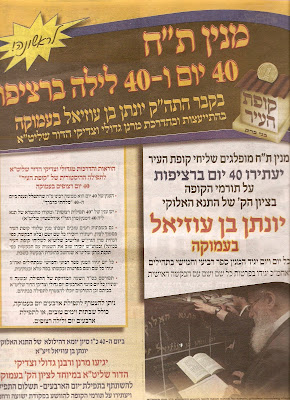
You have to wonder how much this costs and is it worth it. Why are they spending money on sending people there for Shabbos?

You have to wonder how much this costs and is it worth it. Why are they spending money on sending people there for Shabbos?
Sunday, May 03, 2009
Is mixed seating on buses our biggest concern?
According to Yehuda Meshi Zahav the founder and head of Zaka (and a former Edah Chareidis activist) the answer is no. There are many more important issues that need to be dealt with. According to him this is a way of running away from the real problems. It is easier to address something like this then the more serious issues in the Charedi world.
The road to purity
Yehuda Meshi-Zahav, the founder and head of Zaka, was once himself coordinator of the Eda Haredit. Today, he says that this focus on the fear of being in contact with women sounds a little obsessive to him. "When I was a child, I used to take the bus from Mea She'arim to Mahaneh Yehuda, and I don't recall that anything wrong happened to me. I think this whole matter of buses has become totally disproportionate - as if there are no real problems elsewhere. So what if they see a woman on a bus? What can happen to them? When I think of the terrible things happening in some families - like the sort of thing we have been witnessing recently - I really think it's a way of running away from the real problems. Mixed buses seem to me the least of our concern," he says.
The road to purity
Yehuda Meshi-Zahav, the founder and head of Zaka, was once himself coordinator of the Eda Haredit. Today, he says that this focus on the fear of being in contact with women sounds a little obsessive to him. "When I was a child, I used to take the bus from Mea She'arim to Mahaneh Yehuda, and I don't recall that anything wrong happened to me. I think this whole matter of buses has become totally disproportionate - as if there are no real problems elsewhere. So what if they see a woman on a bus? What can happen to them? When I think of the terrible things happening in some families - like the sort of thing we have been witnessing recently - I really think it's a way of running away from the real problems. Mixed buses seem to me the least of our concern," he says.
Thursday, April 30, 2009
I don't need prizes to give צדקה
Hamodia published a great letter this week from someone who is annoyed that he is being inundated with all kinds of useless free stuff from צדקה organizations. As he says "I don't need prizes to give צדקה".
I wholeheartedly agree and would extend this to all of the historic events as well. I don't need prizes and I don't need historic events to give צדקה. Give people a little credit that they give צדקה for the right reasons.
Here is the full text of the letter.
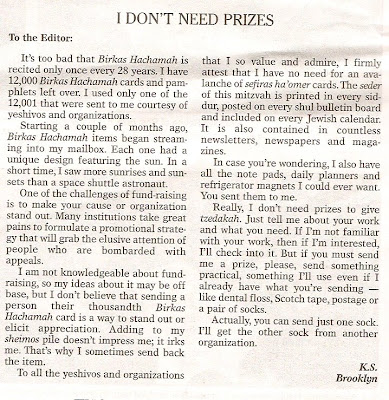
I wholeheartedly agree and would extend this to all of the historic events as well. I don't need prizes and I don't need historic events to give צדקה. Give people a little credit that they give צדקה for the right reasons.
Here is the full text of the letter.

Wednesday, April 29, 2009
הזמה of an עד אחד (Bava Metzia 4a)
The Gemara has a long discussion on how we learn out that עדים are מחייב a שבועה. At one point the Gemara says that עד א יוכיח שישנו בהכחשה. Tosfaos there is גורס the הזמה as well. Tosafos explains that the fact that he doesn't pay money is just because he is not מחייב money. The (קצות (סימן ל"ח ס"ק ה says that the נפקא מינא would be in a case where he is מחייב money such as where he is מחייב a שבועה that the person can't take and the person then has to pay. In that case if he is מוזם the עד would need to pay. The קצות ends off that he is not sure that there is הזמה by an עד אחד.
The Minchas Chinuch (מצוה ל"ז), brings an expicit Rambam (הל' עדות פרק כ"א הל' ה) that there is הזמה by an עד אחד by a Sota:
"בא עד אחד והעיד שזינת אחר הקינוי והסתירה, ונמצא אותו העד זומם--משלם כתובתה ..."
Based on the Rambam the Michas Chinuch is surprised why the קצות said he is not sure that there is הזמה by an עד אחד.
However if you look in the Frankel Rambam you see that there are different נוסחאות in the Rambam whether it should say עד א or not and therefore the proof from the Rambam is not so clear cut. Also see the חזו"א there.
The Minchas Chinuch (מצוה ל"ז), brings an expicit Rambam (הל' עדות פרק כ"א הל' ה) that there is הזמה by an עד אחד by a Sota:
"בא עד אחד והעיד שזינת אחר הקינוי והסתירה, ונמצא אותו העד זומם--משלם כתובתה ..."
Based on the Rambam the Michas Chinuch is surprised why the קצות said he is not sure that there is הזמה by an עד אחד.
However if you look in the Frankel Rambam you see that there are different נוסחאות in the Rambam whether it should say עד א or not and therefore the proof from the Rambam is not so clear cut. Also see the חזו"א there.
Tuesday, April 28, 2009
Not eating chametz that was sold to a גוי - Is it possible? Part 2
The situation is actually even worse then I described. According to R' Yossi Shteinberger a Kashrus expert it is impossible not to eat chametz that was sold to a גוי.
Flour in Israel is very low in gluten and therefore won't rise well unless gluten is added. All bakeries add gluten to the flour in all baked goods.
There is no gluten produced in Israel, it is all imported mostly from Germany, France, and China. Gluten by definition is חמץ גמור. Because it needs to be imported gluten must be SOLD to a Goy over Pessach; unless the bakeries want to close shop for a few weeks waiting for a new shipment. Since they start making bread literally a few hours after Pesach is over they must be using gluten that they sold to a גוי.
Therefore, even if the bread says baked after Pesach from flour that was ground after Pesach, the gluten was most definitley sold and therefore you are relying on the sale to a גוי.
In other words they are pulling the wool over your eyes. They say that it was baked after Pesach from flour that was ground after Pesach but conveniently leave out the bit about gluten that was sold.
Source: בלון ושמו אחר הפסח
Flour in Israel is very low in gluten and therefore won't rise well unless gluten is added. All bakeries add gluten to the flour in all baked goods.
There is no gluten produced in Israel, it is all imported mostly from Germany, France, and China. Gluten by definition is חמץ גמור. Because it needs to be imported gluten must be SOLD to a Goy over Pessach; unless the bakeries want to close shop for a few weeks waiting for a new shipment. Since they start making bread literally a few hours after Pesach is over they must be using gluten that they sold to a גוי.
Therefore, even if the bread says baked after Pesach from flour that was ground after Pesach, the gluten was most definitley sold and therefore you are relying on the sale to a גוי.
In other words they are pulling the wool over your eyes. They say that it was baked after Pesach from flour that was ground after Pesach but conveniently leave out the bit about gluten that was sold.
Source: בלון ושמו אחר הפסח
ודאי רמאי (Bava Metzia 2a-3a)
The gemara on 3a applies the principle of ודאי רמאי to the idea of יחלוקו that if someone is definitely lying you would not say יחלוקו. The simple reading of the Gemara is that even the רבנן hold that you don't say יחלוקו if there is a ודאי רמאי because the Gemara asks on both ר' יוסי and the רבנן from חנוני על פנקסו that in that case there is a ודאי רמאי.
However, in fact, this is a מח' ראשונים. The last Rashi on 2a states that whenever you have a ודאי רמאי you say יהא מונח, implying that according to Rashi this is even according to the רבנן. Tosafos (2b ד"ה אי תנא מציאה) as well as the Rosh in סימן א both disagree and say that even in the case of זה אומר אני ארגתיה וזה אומר אני where there is a ודאי רמאי, you say יחלוקו. They hold that the סברה of ודאי רמאי was only said for ר' יוסי.
A נפקא מינה is the case of זה אומר אני ארגתיה וזה אומר אני ארגתיה. Rashi says the din is יהא מונח because there is a ודאי רמאי. However, Tosafos (2b ד"ה אי תנא מציאה) as well as the Rosh in סימן א both disagree and say that even in the case of זה אומר אני ארגתיה וזה אומר אני ארגתיה where there is a ודאי רמאי, you say יחלוקו. They bring a proof from the Gemara later (7a) from the case of שנים אדוקים בשטר where there is a ודאי רמאי and still the din is יחלוקו. Tosafos and the Rosh explain that according to the רבנן there is a different סברה, that the חלוקה יכולה להיות אמת. What this means is that we don't look at the 2 people to see if one is definitely lying but rather we look at the psak din, can the psak din be correct. In the case of זה אומר אני ארגתיה וזה אומר אני ארגתיה the answer is yes, it is possible that both of them own it and the correct psak is יחלוקו.
What do Tosafos and the Rosh do with the Gemara (3a) of חנוני על פנקסו where the Gemara seems to assume the סברה of ודאי רמאי even according to the רבנן? The answer is that although the Gemara uses the language of ודאי רמאי that is לפי ר' יוסי, according to the רבנן the question really is that by חנוני על פנקסו the psak din cannot be correct. Reuven owes his worker Levi $100 and tells him to collect from Shimon. Both Levi and Shimon now come to collect from Reuven. Reuven only owes $100 yet the psak din is to make him pay $200, $100 to Levi and $100 to Shimon. Even according to the רבנן that is a problem because the חלוקה cannot be אמת.
However, in fact, this is a מח' ראשונים. The last Rashi on 2a states that whenever you have a ודאי רמאי you say יהא מונח, implying that according to Rashi this is even according to the רבנן. Tosafos (2b ד"ה אי תנא מציאה) as well as the Rosh in סימן א both disagree and say that even in the case of זה אומר אני ארגתיה וזה אומר אני where there is a ודאי רמאי, you say יחלוקו. They hold that the סברה of ודאי רמאי was only said for ר' יוסי.
A נפקא מינה is the case of זה אומר אני ארגתיה וזה אומר אני ארגתיה. Rashi says the din is יהא מונח because there is a ודאי רמאי. However, Tosafos (2b ד"ה אי תנא מציאה) as well as the Rosh in סימן א both disagree and say that even in the case of זה אומר אני ארגתיה וזה אומר אני ארגתיה where there is a ודאי רמאי, you say יחלוקו. They bring a proof from the Gemara later (7a) from the case of שנים אדוקים בשטר where there is a ודאי רמאי and still the din is יחלוקו. Tosafos and the Rosh explain that according to the רבנן there is a different סברה, that the חלוקה יכולה להיות אמת. What this means is that we don't look at the 2 people to see if one is definitely lying but rather we look at the psak din, can the psak din be correct. In the case of זה אומר אני ארגתיה וזה אומר אני ארגתיה the answer is yes, it is possible that both of them own it and the correct psak is יחלוקו.
What do Tosafos and the Rosh do with the Gemara (3a) of חנוני על פנקסו where the Gemara seems to assume the סברה of ודאי רמאי even according to the רבנן? The answer is that although the Gemara uses the language of ודאי רמאי that is לפי ר' יוסי, according to the רבנן the question really is that by חנוני על פנקסו the psak din cannot be correct. Reuven owes his worker Levi $100 and tells him to collect from Shimon. Both Levi and Shimon now come to collect from Reuven. Reuven only owes $100 yet the psak din is to make him pay $200, $100 to Levi and $100 to Shimon. Even according to the רבנן that is a problem because the חלוקה cannot be אמת.
Daf Yomi related posts
Daf Yomi just started learning Bava Metzia so I m going to start posting on Bava Metzia related topics.
Thursday, April 23, 2009
Not eating chametz that was sold to a גוי - Is it possible? - Updated
As I pointed out a few years ago (Not eating chametz that was sold to a גוי ) this has become a very popular chumra.
However, Hamodia is reporting this week that it is all a fake. It is practically impossible to keep this chumra as manufacturers can put whatever they want on the label and no one checks whether it is actually true.
Kashrus organizations do not see a difference between cake sold halachically to a gentile and beer ... For that reason there are no grounds for relying on the manufactures declarations.
...
Halachically there is no problem with eating chamtez that was sold to a gentile in accordance withthe law. ... So the kashrus organizations stance is usually to permit the manufacturers to write on the package whatever they want
In other words the Kashrus organizations like the Eidah Hacharedis, R' Landau, R' Rubin and others hold that this is a chumra with no basis and therefore have no issue with the manufacturers writing whatever they want.
In short, this is a chumra that makes people feel frum but has no basis in halacha and is in fact not really possible to keep.
Some people rely on checking product codes which tells them when the product was made. This year for example, a code higher then 9106 (9 - 2009, 106 the 106th day of the year) means it was made after Pesach. However, this is not that useful. All it says is that the product was made after Pesach. However, every Chometz product has chometz ingredients in it (at least flour which is most probably chometz because it was washed) and the consumer has no way of knowing when the chometz ingredients were made. For example even if you only buy cookies that were made after Pesach you have no idea what flour was used. It is very possible/probable that the flour used to make the cookies was chometz and was sold for Pesach.
However, Hamodia is reporting this week that it is all a fake. It is practically impossible to keep this chumra as manufacturers can put whatever they want on the label and no one checks whether it is actually true.
Kashrus organizations do not see a difference between cake sold halachically to a gentile and beer ... For that reason there are no grounds for relying on the manufactures declarations.
...
Halachically there is no problem with eating chamtez that was sold to a gentile in accordance withthe law. ... So the kashrus organizations stance is usually to permit the manufacturers to write on the package whatever they want
In other words the Kashrus organizations like the Eidah Hacharedis, R' Landau, R' Rubin and others hold that this is a chumra with no basis and therefore have no issue with the manufacturers writing whatever they want.
In short, this is a chumra that makes people feel frum but has no basis in halacha and is in fact not really possible to keep.
Update
Some people rely on checking product codes which tells them when the product was made. This year for example, a code higher then 9106 (9 - 2009, 106 the 106th day of the year) means it was made after Pesach. However, this is not that useful. All it says is that the product was made after Pesach. However, every Chometz product has chometz ingredients in it (at least flour which is most probably chometz because it was washed) and the consumer has no way of knowing when the chometz ingredients were made. For example even if you only buy cookies that were made after Pesach you have no idea what flour was used. It is very possible/probable that the flour used to make the cookies was chometz and was sold for Pesach.
Wednesday, April 22, 2009
Shaving this Friday
This Friday is an opportunity to shave even for those who don't normally shave during sefira. Because it is both Rosh Chodesh and Erev Shabbos, the Mishna Berura (סימן תצ"ג ס"ק ה) writes that since there is additional simcha of both Shabbos and Rosh Chodesh, even those who are noheg not to shave from Pesach until Lag Baomer are allowed to shave on this Erev Shabbos which is also Rosh Chodesh.
In previous years I have always forgotten and when I came to shul Friday night and saw the shaven faces I kicked myself. This year I don't plan on forgetting and am either going to trim my beard nicely or shave it off completely (I don't know if it is worth the effort to shave it all off).
Of course this only applies to those people who don't hold from the צוואה of R' Yehuda Hachasid. The Mishna Berura in סימן ר"ס quotes from the the צוואה of R' Yehuda Hachassid that some have the minhag not to take a haircut on Friday that is Rosh Chodesh because it is dangerous.
However, the fact is that according to the calendar Rosh Chodesh Iyyar is always 2 days and cannot fall out on Shabbos and Sunday (because Pesach can't start on Friday). Therefore if Shabbos is Rosh Chodesh Iyar, then that Erev Shabbos is always Rosh Chodesh as well and even so the MB allowed haircuts. In other words the MB here allowed haircuts on Rosh Chodesh against the צוואה of R' Yehuda Hachassid.
Interestingly enough the שונה הלכות quotes (סימן תצ"ג) the Mishna Berura that you can shave on Friday if Rosh Chodesh is Shabbos but then he adds, if Friday is also Rosh Chodesh then look at what I wrote in סימן ר"ס where he quotes the minhag of R' Yehuda Hachassid. This is very difficult because when Rosh Chodesh Iyyar is Shabbos, Friday is always Rosh Chodesh as well in our calendar.
In previous years I have always forgotten and when I came to shul Friday night and saw the shaven faces I kicked myself. This year I don't plan on forgetting and am either going to trim my beard nicely or shave it off completely (I don't know if it is worth the effort to shave it all off).
Of course this only applies to those people who don't hold from the צוואה of R' Yehuda Hachasid. The Mishna Berura in סימן ר"ס quotes from the the צוואה of R' Yehuda Hachassid that some have the minhag not to take a haircut on Friday that is Rosh Chodesh because it is dangerous.
However, the fact is that according to the calendar Rosh Chodesh Iyyar is always 2 days and cannot fall out on Shabbos and Sunday (because Pesach can't start on Friday). Therefore if Shabbos is Rosh Chodesh Iyar, then that Erev Shabbos is always Rosh Chodesh as well and even so the MB allowed haircuts. In other words the MB here allowed haircuts on Rosh Chodesh against the צוואה of R' Yehuda Hachassid.
Interestingly enough the שונה הלכות quotes (סימן תצ"ג) the Mishna Berura that you can shave on Friday if Rosh Chodesh is Shabbos but then he adds, if Friday is also Rosh Chodesh then look at what I wrote in סימן ר"ס where he quotes the minhag of R' Yehuda Hachassid. This is very difficult because when Rosh Chodesh Iyyar is Shabbos, Friday is always Rosh Chodesh as well in our calendar.
Tuesday, April 21, 2009
Is mixed seating on public transportation the cause of all our problems?
According to these Kol Korei's in todays Yated, the answer would seem to be yes. The cause of our problems is התרופפות (weakening) in צניעות specifically mixed seating on public transportation.
Is a lack of tznius really the biggest problem in the Charedi community? Are there no bigger issues that need to be fixed? A generation ago everyone went on public transportation with mixed seating and no one said a word about it. According to this Kol Korei separate seating on public transportation is required by halacha. I guess they disagree with R' Moshe's famous teshuva allowing people to ride the NY subway even in the rush hour.

Is a lack of tznius really the biggest problem in the Charedi community? Are there no bigger issues that need to be fixed? A generation ago everyone went on public transportation with mixed seating and no one said a word about it. According to this Kol Korei separate seating on public transportation is required by halacha. I guess they disagree with R' Moshe's famous teshuva allowing people to ride the NY subway even in the rush hour.

Another historic event from Kupat Hair Bnei Brak
Last year it was a historic event in Vilna

Now they are sponsoring another historic event in the house of the אשה השונמית (from the Haftara of וירא).

What will they think of next?

Now they are sponsoring another historic event in the house of the אשה השונמית (from the Haftara of וירא).

What will they think of next?
Why in Sefira do we count up and not down?
See this post from a few years ago for a beautiful explanation in the name of R' Aharon Kotler.
Monday, April 20, 2009
Early Shabbos Primer
With the advent of DST and many people again making early Shabbos, these posts from a few years ago are very relevant.
An Early Shabbos Primer
Early Shabbos primer continued
Even more on Early Shabbos
An Early Shabbos Primer
Early Shabbos primer continued
Even more on Early Shabbos
Sunday, April 19, 2009
Why can't we eat non-kosher food?
In last week's parsha (שמיני), the torah told us what animals are kosher and what are not.
The mefarshim try to understand this mitzva and why we are not allowed to eat certain animals.
One approach taken (based on the Gemara in Yoma) is that non kosher food is intrinsically harmful, it is spiritual poison. Eating non-kosher food prevents a person from connecting to hashem, clogs up your spiritual arteries, just like eating fatty foods clogs up your physical arteries.
This approach is brought down להלכה both in Shulchan Aruch and by the later Poskim.
The Shulchan Aruch in Yoreh Deah Siman 81 paskens that a Jewish baby is allowed to have a non-Jewish wet nurse, however the Shulchan Aruch says that you shouldn't do it because the non-kosher food will harm the baby spiritually. Likewise the Rama there states that a Jewish woman who needs to eat non-kosher food for health reasons should not nurse her baby because the non-kosher food will harm him. The Gra comments that 1 of the sources of this din is the Medrash in Parshas Shemos. The pasuk says they brought a nursing woman from the Jews, the Medrash brought down by Rashi comments that Moshe refused to nurse from an Egyptian woman because he was going to grow up and be a Navi so how could he eat non-kosher food. In other words, the non-kosher food would have affected his soul and made it impossible for him to be the Navi that he became.
The Ran in his Drashos also takes this approach. In the 11th drasha he discusses why Halacha is decided by Chachamim and not Neviim. He asks the following question. He says that if a Chacham makes a mistake and permits a forbidden food it is like a doctor who makes a mistake and gives a patient poison instead of medicine. In both cases the person is harmed. If so, why don't we have Neviim decide halacha with nevua and there would be no mistakes? He answers that nevua is not always available (see the drasha for more details). He then explains that even though eating non-kosher food is harmful the mitzva of listening to Chachamim may counterbalance the harmful effects. In any case, we see clearly from the Ran that non-kosher is objectively poison and harmful.
The Abarbanel (Devarim 17,4) disagress with the Ran. He holds that a person is never harmed by following the Chachamim. If it is mutar then it cannot be harmful. It would seem that the Abarbanel holds that non-kosher is not objectively harmful, rather it is harmful because it is prohibited. If for you there is no prohibition then it is not harmful.
Rashi in Chullin(5a) seems to agree with the Abarbanel. The gemara there is discussing whether a mumar l'avoda zara can do shechita. The gemara tries to bring a proof from Eliyahu Hanavi. At 1 point Hashem tells Eliyahu to go live by himself and the Orvim (birds) brought him meat to eat from Achav's place and (almost)everyone in Achav's palace worshipped Avoda Zara. How could Eliyahu eat the meat if meat slaughtered by a mumar is not kosher? It must be that a mumar is allowed to slaughter. The Gemara answers that על פי דיבור שאני. Rashi explains that Hashem permitted him to eat non-kosher meat (a Navi is allowed to violate the Torah based on his nevua). The obvious question is how could Eliyahu Hanavi eat non-kosher food if it is spiritually harmful? It didn't seem to affect him as he continued being a Navi. The answer would seem to be like the Abarbanel that because he ate it b'heter it was not spiritually harmful.
In fact, the Ritva in Chullin as well as the Maharsha understand the gemara's answer differently. They understand that the Gemara answered that Eliyahu Hanavi knew b'nevua that the meat was kosher, that it had been slaughtered by Ovadia who did not worship Avoda Zara. According to them, Eliyahu Hanavi did not end up eating non-kosher food.
R' Moshe (Orach Chaim 2:88) quotes a teshuva of the Chasam Sofer where he discusses a handicapped girl in the following situation. If she stayed at home she would never develop and remain an ayno bar daas. However, if the parents sent her to a special school they claimed that she would reach the potential of a 13-14 year old. However, the school was in a non-Jewish area and there was no possibility of providing kosher food. The Chassam Sofer said that al pi din it is muttar, however he recommends against sending her for the following reason. If they send her she will become a bar daas and be chayav in mitzvos. However, the non-kosher food will affect her lev and she will probably violate torah and mitzvos and therefore it is better for her to remain an ayno bar daas.
We see clearly that this idea that any non-kosher food is metamtem halev, even if eaten b'heter (the girl was a ketan and an ayno bar daas so there was no issur), is brought down halacha l'maase and is a serious concern.
The mefarshim try to understand this mitzva and why we are not allowed to eat certain animals.
One approach taken (based on the Gemara in Yoma) is that non kosher food is intrinsically harmful, it is spiritual poison. Eating non-kosher food prevents a person from connecting to hashem, clogs up your spiritual arteries, just like eating fatty foods clogs up your physical arteries.
This approach is brought down להלכה both in Shulchan Aruch and by the later Poskim.
The Shulchan Aruch in Yoreh Deah Siman 81 paskens that a Jewish baby is allowed to have a non-Jewish wet nurse, however the Shulchan Aruch says that you shouldn't do it because the non-kosher food will harm the baby spiritually. Likewise the Rama there states that a Jewish woman who needs to eat non-kosher food for health reasons should not nurse her baby because the non-kosher food will harm him. The Gra comments that 1 of the sources of this din is the Medrash in Parshas Shemos. The pasuk says they brought a nursing woman from the Jews, the Medrash brought down by Rashi comments that Moshe refused to nurse from an Egyptian woman because he was going to grow up and be a Navi so how could he eat non-kosher food. In other words, the non-kosher food would have affected his soul and made it impossible for him to be the Navi that he became.
The Ran in his Drashos also takes this approach. In the 11th drasha he discusses why Halacha is decided by Chachamim and not Neviim. He asks the following question. He says that if a Chacham makes a mistake and permits a forbidden food it is like a doctor who makes a mistake and gives a patient poison instead of medicine. In both cases the person is harmed. If so, why don't we have Neviim decide halacha with nevua and there would be no mistakes? He answers that nevua is not always available (see the drasha for more details). He then explains that even though eating non-kosher food is harmful the mitzva of listening to Chachamim may counterbalance the harmful effects. In any case, we see clearly from the Ran that non-kosher is objectively poison and harmful.
The Abarbanel (Devarim 17,4) disagress with the Ran. He holds that a person is never harmed by following the Chachamim. If it is mutar then it cannot be harmful. It would seem that the Abarbanel holds that non-kosher is not objectively harmful, rather it is harmful because it is prohibited. If for you there is no prohibition then it is not harmful.
Rashi in Chullin(5a) seems to agree with the Abarbanel. The gemara there is discussing whether a mumar l'avoda zara can do shechita. The gemara tries to bring a proof from Eliyahu Hanavi. At 1 point Hashem tells Eliyahu to go live by himself and the Orvim (birds) brought him meat to eat from Achav's place and (almost)everyone in Achav's palace worshipped Avoda Zara. How could Eliyahu eat the meat if meat slaughtered by a mumar is not kosher? It must be that a mumar is allowed to slaughter. The Gemara answers that על פי דיבור שאני. Rashi explains that Hashem permitted him to eat non-kosher meat (a Navi is allowed to violate the Torah based on his nevua). The obvious question is how could Eliyahu Hanavi eat non-kosher food if it is spiritually harmful? It didn't seem to affect him as he continued being a Navi. The answer would seem to be like the Abarbanel that because he ate it b'heter it was not spiritually harmful.
In fact, the Ritva in Chullin as well as the Maharsha understand the gemara's answer differently. They understand that the Gemara answered that Eliyahu Hanavi knew b'nevua that the meat was kosher, that it had been slaughtered by Ovadia who did not worship Avoda Zara. According to them, Eliyahu Hanavi did not end up eating non-kosher food.
R' Moshe (Orach Chaim 2:88) quotes a teshuva of the Chasam Sofer where he discusses a handicapped girl in the following situation. If she stayed at home she would never develop and remain an ayno bar daas. However, if the parents sent her to a special school they claimed that she would reach the potential of a 13-14 year old. However, the school was in a non-Jewish area and there was no possibility of providing kosher food. The Chassam Sofer said that al pi din it is muttar, however he recommends against sending her for the following reason. If they send her she will become a bar daas and be chayav in mitzvos. However, the non-kosher food will affect her lev and she will probably violate torah and mitzvos and therefore it is better for her to remain an ayno bar daas.
We see clearly that this idea that any non-kosher food is metamtem halev, even if eaten b'heter (the girl was a ketan and an ayno bar daas so there was no issur), is brought down halacha l'maase and is a serious concern.
Saturday, April 04, 2009
Bris milah or Bircas Hachama which comes first?
R' Elyashiv was asked this question by one of his grandchildren who had a baby last Wednesday. R' Elyashiv's psak was that first you do Bircas Hachama and then the mila. The reason for the pask is not given but I would guess that it has to with the fact that Bircas Hachama is a mitzva that has a very short time (only the first 3 hours) while milah is all day.
Tuesday, March 31, 2009
Now really the largest government ever
3 years ago I posted The largest government ever in Israel 27+ ministers. Politics moves on and Netanyahu's new government will eclipse Olmert's overblown government.
As I pointed out in that post out of 10 other democracies that I surveyed (most of them Parliamentary democracies) the average number of ministers is 16, Sweden having the smallest with 10 and the UK the largest with 22.
Given the small population and size of Israel in comparison to most of these other countries, we can see that 30 ministers is absolutely ridiculous.
In truth, I don't blame Netanyahu, he is doing what he needs to do to create a government that will be stable. The election system is at fault and needs to be changed. Unfortunately, I don't think there is much chance of that happening.
As I pointed out in that post out of 10 other democracies that I surveyed (most of them Parliamentary democracies) the average number of ministers is 16, Sweden having the smallest with 10 and the UK the largest with 22.
Given the small population and size of Israel in comparison to most of these other countries, we can see that 30 ministers is absolutely ridiculous.
In truth, I don't blame Netanyahu, he is doing what he needs to do to create a government that will be stable. The election system is at fault and needs to be changed. Unfortunately, I don't think there is much chance of that happening.
Subscribe to:
Posts (Atom)