I heard a fascinating story on the radio last night. It seems that Hamodia (run by Gerrer Chasidim) and Ger in general were behind the cherem on Shefa Shuk. After the elections in Yerushalayim where Gerrer Chasidim voted for Nir Barkat a chiloni and not Meir Porush, many have come to the conclusion that Ger is acting in their own interest and not לשם שמים. They are saying that if they can vote for a chiloni because of a fight over Chinuch Atzmai, land etc. then why should we believe them about Shefa Shuk. Therefore, they have decided to start shopping in Shefa Shuk again. In addition, many people have canceled their subscription to Hamodia.
It is going to be very interesting to see how this plays out over the next few months. This could really hurt UTJ in the upcoming elections. Many Chareidim will have a very difficult time voting for UTJ if Litzman is number 1 on the list.
Monday, November 17, 2008


Thursday, November 13, 2008
Biased Media
We always think of the mainstream media as biased against Israel, Jews etc. What is fascinating is that the Charedi press has it's own biases.
I get both the weekly Hamodia in English as well as Mishpacha in Hebrew and it is always interesting to see what news is in one and not the other and vice versa.
This week the difference is dramatic. Mishpacha devotes a huge number of articles to the municipal elections focusing on Porush's loss in Yerushalayim. Hamodia on the other hand almost completely ignores the elections. They have one small article and that is it. Why the big difference?
The answer is simple. Hamodia is run by Gerrer Chasidim and Ger right now is feuding with much of the Charedi world. Ger refused to support Porush in Yerushalayim and in fact, may have actually told some of their Chasidim to vote for a chiloni candidate. Similarly in Bet Shemesh, Ger did not endorse the Charedi candidate from Shas supported by Degel Hatorah, rather they supported Shalom Lerner who is religious but not Charedi.
Here is a fascinating article from VosIzNeias
Meanwhile, the rebbe of Ger, Ya'acov Aryeh Alter, aware of the threat that Porush presents, has called on his hassidim not to vote for him, even though he's the city's only haredi candidate. Ger enjoys the support of the Boyan Hassidic sect, which is still angry at Porush for bucking its authority in the Betar municipal elections.
In Friday's Hamodia, a weekly controlled by the hassidic sect, Alter placed a front page notice calling to vote for Agudath Yisrael. Conspicuously absent was the rebbe's electoral command regarding the mayoral race. Porush's name simply was not mentioned.
The rebbe's omission was particularly striking since it was accompanied by an ad publicizing the opinions of a list of leading haredi rabbis who specifically called to vote not only for Agudath Yisrael and for Porush.
Here is another interesting article from VosIzNeias
Outside a polling place in Jerusalem's Geula neighborhood yesterday, young Hasidic followers of mayoral candidate Meir Porush gathered. On the other side of the street, youngsters in the distinctive dress of the Gerrer Hasidic community set up their own post. The tension between the two camps was palpable.
After a few minutes, the Gerrers crossed the street and entered the station. On the orders of their rebbe, due to a longstanding grievance between their group and Porush's camp, they were threatening to vote for secular candidate Nir Barkat. All eyes were now on the Gerrer voters to see whether they would indeed "betray" the ultra-Orthodox sector by voting for Barkat.
Advertisement:
A young Gerrer walked into the station slowly with his grandfather and assisted the old man in inserting his ballot into the box. On leaving, he encountered an acquaintance from his community and the two began a lively discussion, from which it emerged that both voted for Barkat. "Like everyone," he told his friend jokingly.
Was his hand shaking, his friend asked. "No way," was the response. "The rebbe said so, and so we're happy to vote for Barkat." Hearing the tale, Moshe Friedman, the head of Porush's campaign, let out a sigh, saying, "it breaks your heart."
Wednesday, November 12, 2008
What should we make of the success of Tov in Bet Shemesh?
Tov in Bet Shemesh, despite being attacked non-stop by the local Rabbonim, who even brought R' Shteinman to RBS to speak, got over 1200 votes and a seat on the city council.
I think that a lot of the rank and file Charedim feel like the guy quoted below. When you couple that with the fact that the Torah world is broke this might be a serious change.
Israel - Haredi Voting Signals Weakening of Sector's Political Establishment
The 2008 municipal elections will go down in history as a watershed event for haredi politics that will likely have far-reaching implications on the national level.
For the first time in Israeli political history, the normally obedient haredi voters showed signs of rebellion.
In two haredi centers - Jerusalem and Beit Shemesh - there is a significant haredi contingent that has come out openly against the haredi political establishment.
...
Many have begun to question their obligations to a rabbinic leadership that rejects them and offers them no future. Many also are being to question rabbinic opinion on mundane matters such municipal elections.
As one haredi put it, "What do rabbis know about politics? Do I ask a rabbi what kind of floor cleaner I should use? We need a separation between religion and politics. I don't want rabbis to tell me what kind of cellular phone to use or where to sit on the bus.
Tuesday, November 11, 2008
Municipal elections in Israel today
Today is election day for all of the local elections, mayor and city council.
I would like to focus on 1 city, Bet Shemesh, that is not getting much attention from the national press but is actually very important.
One of the candidates running for mayor is Moshe Abutbul from Shas. Abutbul made deals with a number of non-religious parties and from his ads in the secular press you would never know that he is Charedi or from Shas. Every ad has him surrounded by his bare headed coalition partners who are featured prominently. There is only 1 party that he made a deal with, that does not feature in any of his ads at all, UTJ. The reason is obvious, he is trying to to run as the stealth Charedi candidate.
This is a very important race for Shas and the Charedi world as a whole. For Shas, if Abutbul wins he would be this would be the first mayor ever elected from Shas. For the Charedi world as a whole this race is very important. The Charedi world looks at Bet Shemesh as the next big Charedi city and a place that can alleviate the housing issues.
Another interesting development in Bet Shemesh is the party Tov. Tov is a party started by Charedi baal habatim who feel that UTJ doesn't really represent them. UTJ has ran a very nasty campaign against Tov and has basically tried everything possible to get them to withdraw. They even sponsored an assembly in one of the shuls in which the focus how they (Tov) are going against the gedolim, and how people who vote for TOV cannot be called frum etc.
What UTJ hasn't done is explain why someone should vote for them, aside from the fact that the gedolim say so. This is part of the reason for Tov's success.
Wednesday, November 05, 2008
Barack Hussein Obama, the next President of America
Now that the election is over I would like to make a few comments.
No one really knows. After 2 years of campaigning there are still huge holes in his life story. It is hard to know what he really stands for and who he really trusts.
In any case he is by far the least experienced President ever. He has been in the Senate for a grand total of2 years 4 years. His biggest job before the campaign was as a community activist.
In Israel we like to complain about how the press is left wing and how the press protected Sharon when he decided on the disengagement and how the press loves Livni and is in favor of her. However, believe it or not, the American press was as bad or worse in the last election. How is it that we still don't know where Obama was born? How is it that the LA Times refuses to release a video of Obama with a Palestinian radical? Last January, in an interview to the San Francisco Chronicle Obama said that he would bankrupt the coal industry. This statement only came out this past Sunday too late to effect anything. The list could go on for a long time. Basically the press gave Obama a free pass.
The American system produces winners and losers. Obama won Mcain lost. Listening to the radio in Israel this morning, they were talking about how Obama won by 5 points (52% - 47%) and how that is a big victory. Lets shift gears a second and think about the election in Israel. Imagine Netanyahu and Likud win 5% more votes then Livni and Kadima. Will the press think that it is a big victory? I think not. 5% of the vote is 6 seats. In other words if the Likud would win 35 seats Kadima would win 29. It would not be a decisive victory at all.
The difference is that the US has a winner take all system. Someone wins and someone loses. Here everyone wins. Because of that, there are so many parties and it is impossible to govern.
I. Who is Barack Obama?
No one really knows. After 2 years of campaigning there are still huge holes in his life story. It is hard to know what he really stands for and who he really trusts.
In any case he is by far the least experienced President ever. He has been in the Senate for a grand total of
II. The press was completely biased in favor of Obama
In Israel we like to complain about how the press is left wing and how the press protected Sharon when he decided on the disengagement and how the press loves Livni and is in favor of her. However, believe it or not, the American press was as bad or worse in the last election. How is it that we still don't know where Obama was born? How is it that the LA Times refuses to release a video of Obama with a Palestinian radical? Last January, in an interview to the San Francisco Chronicle Obama said that he would bankrupt the coal industry. This statement only came out this past Sunday too late to effect anything. The list could go on for a long time. Basically the press gave Obama a free pass.
III. Obama is the clear winner
The American system produces winners and losers. Obama won Mcain lost. Listening to the radio in Israel this morning, they were talking about how Obama won by 5 points (52% - 47%) and how that is a big victory. Lets shift gears a second and think about the election in Israel. Imagine Netanyahu and Likud win 5% more votes then Livni and Kadima. Will the press think that it is a big victory? I think not. 5% of the vote is 6 seats. In other words if the Likud would win 35 seats Kadima would win 29. It would not be a decisive victory at all.
The difference is that the US has a winner take all system. Someone wins and someone loses. Here everyone wins. Because of that, there are so many parties and it is impossible to govern.
Sunday, November 02, 2008
Only in Israel: A transitional government can't appoint Judges but can negotiate to give away the Golan
The Attorney General was asked if it is legal for Olmert to negotiate with Syria even though he has resigned and is running a transitional government. The answer, yes. However, the Justice Minister wants to have a meeting of the committee to appoint judges and appoint new Supreme Court justices but the President of the Supreme Court (who herself was appointed by a transitional government) has refused claiming that a transitional government has no authority to appoint new judges.
Think of how absurd this is. The transitional government can negotiate away the country, that is not important, but it can't appoint Supremem Court justices, that is too important for a transitional government. Does this make any sense???
Of course given the Judicial Dictatorship we live in Beinish may be right. Appointing Supreme Court justices is the most important thing because in the end they rule the country.
Wednesday, October 29, 2008
Leiberman tells it like is regarding Mubarak
Here is what Lieberman said:
[Ze'evi] would never agree to the self effacing attitude of Israel vis-à-vis Egypt. Time after time we went to see Mubarak in Egypt - he never agreed to come here in an official capacity as president.
Every self-respecting [Israeli] leader, would expect a reciprocal visit when making one on his own. He wants to talk with us? Let him come here; he doesn't want to talk with us - let him go to hell,
Lieberman is absolutely right and tells it like it is. Mubarak has been in power for over 27 years and he has never made an official diplomatic visit to Israel. In addition, the official State run press is viciously anti-Semitic. There has never been more then a very cold peace with Egypt. It really is embarrassing how our leaders grovel before Mubarak who is the dictator of a third world country of little real significance.
Of course our wonderful leaders Peres and Olmert couldn't let this insult stand even for a few hours. They telephoned Mubarak right away to apologize and grovel before his excellency. Where is their self respect?
ז' מצות בני נח
Do these apply today?
The simple reading of the Gemara in Bava Kama 38a seems to say no. The Gemara says:
מה ראה ראה שבע מצות שקיבלו עליהם בני נח ולא קיימום עמד והיתירן
The Gemara then asks how could that be, the sinner is profiting? The Gemara answers that even if they are מקיים them they only get שכר כאינו מצווה ועושה.
Rashi there seems to take the Gemara literally that they are no longer חייבים. Others understand the Gemara that they still are חייבים however, even so, they don't get שכר like a מצווה ועושה.
According to Rashi, if they are not חייבים how can they be punished for not keeping them? The Netziv answers that the ז' מצות בני נח are really mitzvos for the good of society. Without these miztvos society cannot survive. Therefore, if people violate these mitzvos they are not being punished for violating them, rather society will fall apart and they will suffer because of their actions. The Meshech Chochma (beginning of וזאת הברכה) says a similar idea that the ז' מצות בני נח are for societal order. Since Hashem built the world based on the Torah, whenever the ז' מצות בני נח are not observed things don't work well.
Tuesday, October 28, 2008
Peres: Israel is closer to peace than ever before
What planet is he living on? He is really in a dream world.
As Professor Robert Auman said The very act of running crazedly after the longed-for peace is precisely that which distances it from us.
Professor Auman knows what he is talking about as his Nobel Prize was for "enhancing our understanding of conflict and cooperation through game-theory analysis."
He said the following as well, which is well worth reading:
I will allow myself to say a few unpopular, unfashionable words: our panicked longing for peace is working against us. It brings us farther away from peace, and endangers our very existence.
...
Roadmaps, capitulation, gestures, disengagements, convergences, deportations, and so forth do not bring peace. On the contrary, they bring war, just as we saw last summer. These things send a clear signal to our 'cousins' [the Arabs -ed.] that we are tired, that we no longer have spiritual strength, that we have no time, that we are calling for a time-out. They only whet their appetites. It only encourages them to pressure us more, to demand more, and not to give up on anything. These things stem from simple theoretical considerations and also from straight thinking. But it's not just theory: it has been proven and re-proven in the field over thousands of years. I returned today from a trip to India, where we heard about historical stories that illustrate the same. Capitulations bring about war; determination and readiness bring about peace.
Until the Arabs accept Israel as a Jewish state there is nothing to talk about. Nothing that has happened recently has changed in terms of their accepting Israel, rather the tactics have changed. Why is it so hard for the leaders of Israel to see this?
This is why organizations like Peace Now are so misguided. They claim that if Israel really wanted to make peace then peace would happen. Unfortunately, they are sadly mistaken. As Bernard Lewis said, If the issue is not the size of Israel, but its existence, negotiations are foredoomed, if the other side doesn't want to make peace then peace will not happen.
Only decisive, unambiguous victory for one side or the other can end a long, bitter conflict. Until Israel learns this there will never be peace. Organizations like Peace Now not only don't bring peace now, but like Neville Chamberlain, actually encourage the other side to continue the battle.
Monday, October 27, 2008
The polls show Kadima with 29-31 seats - unbelievable!!!
I cannot understand how after almost 3 years of a disastrous Kadima government people actually want more. Let's remember that Tzipi Livni's biggest achievement is UN Resolution 1701 which has proven to be an unmitigated fiasco.
Why would anyone vote for Kadima? What do they see? What I see is a party of opportunists that failed miserably at running the country, lost a war and have done nothing. Can anyone think of a single achievement of the current Kadima led government? Why would you want more of Shaul Mofaz, Ruchama Avraham, Eli Aflalo, etc.?
It is clear that the mainstream press greatly prefers Livni and will do everything to help her. I have a feeling that the polls are going to prove just as inaccurate as they were in the Kadima primary with Kadima getting much fewer seats.
Sunday, October 26, 2008
The moon and the stars
The Rambam in Hilchos Yesodei Hatorah (3:9) writes:
כל הכוכבים והגלגלים, כולם בעלי נפש ודעה והשכל הם; והם חיים ועומדים ומכירים את מי שאמר והיה העולם, כל אחד ואחד לפי גודלו ולפי מעלתו משבחים ומפארים ליוצרם כמו המלאכים. וכשם שמכירים את הקדוש ברוך הוא, כך מכירים את עצמן ומכירים את המלאכים שלמעלה מהן. ודעת הכוכבים והגלגלים, מעוטה מדעת המלאכים וגדולה מדעת בני האדם
The Rambam writes that the stars and the galgalim (which includes the moon) are spiritual beings like angels. This Rambam was proven wrong when Neil Armstrong walked on the moon showing that the moon was a physical entity.
The Rambam (ibid 3:8) also writes:
כל הכוכבים הנראים--יש מהן כוכבים קטנים שהארץ גדולה מאחד מהן, ויש מהן כוכבים שכל אחד מהן גדול מן הארץ כמה פעמים. והארץ גדולה מן הירח כמו ארבעים פעמים, והשמש גדולה מן הארץ כמו מאה ושבעים פעמים; נמצא הירח אחד מששת אלפים ושמונה מאות מן השמש בקירוב. ואין בכל הכוכבים, כוכב גדול מן השמש ולא קטן מכוכב שבגלגל שני.
He states that the Earth is 4 times bigger then the moon and the sun is 170 times bigger then the Earth. These numbers are clearly wrong based on modern astronomy.
Interestingly enough, R' Shach wanted to use this Rambam to show that Torah includes everything. R' Aharon Lichtenstein responded to R' Shach as follows:
R. Aharon Lichtenstein, "Legitimization of Modernity: Classical and Contemporary" in Leaves of Faith (Ktav: 2004), vol. 2:
...Moreover, I freely concede that one's faith in the concept is periodically put to a severe test. As but one instance, the doyen of [then-]current rashei yeshiva, R. [Elazar Mann] Schach, proves the value of Torah as the self-sufficient repository of all knowledge by asking, rhetorically: "Whence did Hazal know that the earth was forty-two times larger than the moon, and that the sun was approximately one-hundred-and-seventy times larger than the earth (as explained in the Rambam, Hilkhot Yesodei Hatorah 3:8), if not from the power of the Torah?"[24] In raising this question, he is wholly oblivious not only to the rudiments of astronomy but also of the fact that the selfsame Rambam explicitly states, with respect to these very issues, that they are beyond the pale of Hazal's authority.
Elections in Israel!!!
Livni failed in creating a coalition. Here are the big winners and losers:
Winners
1. Netanyahu and the Likud - Netanyahu will most probably be the next PM unless he makes a big mistake or something dramatic happens here.
2. Olmert - If Livni had managed to create a coalition today would have been his last day as PM. Now he has another 3-5 months as PM
3. Eli Yishai - He proved that no one can create a government without Shas
Losers
1. Livni - She promised a different politics but what we saw from her over the last month was the same old politics done poorly. Mrs. Clean is no longer Mrs. Clean.She will now go into the elections as Foreign Minister with little ability to do anything to affect her political fortunes. The worst possible scenario for her was for her to negotiate make concessions and not create a government.
2. Barak - His actions and the coalition agreement that he negotiated buried him.
IMHO the Likud should ignore Barak and focus on Livni and Kadima. They can attack her and Kadima on 3 fronts:
1. The war in Lebanon - Kadima was in power and the war was a fiasco. All they need to do is read the relevenat quotes from the Winograd reports
2. UN Resolution 1701 - This is touted as Livni's big achievement. The only problem is that it has been an absolute disaster according to everyone.
3. Leadership ability - the past month has only strengthened the claim that Livni is not a leader.
Thursday, October 23, 2008
How could אדם הראשון eat from the עץ הדעת?
After all if אדם הראשון had no יצר הרע how could he do a חטא? We can ask an even more basic question. Did he even have בחירה?
R' Dessler explains based on many sources as follows. Before the חטא he was certainly a בעל בחירה however on a different level. The יצר הרע was outside him. There was no "I need, I want". Instead it was "you need, you want". The Rambam explains that before the חטא everything was אמת or שקר, everything was black and white. To do a חטא was like to walk into a fire, it was crystal clear that it was the wrong thing to do. There was no way to rationalize or justify. After the חטא however, things are now טוב ורע, a much more subjective reality where an עבירה can turn into טוב and we can rationalize our actions.
If so, how could אדם be חוטא? The answer is that he willingly walked into the fire. He felt that his status made things too easy. If everything is crystal clear where is the נסיון? If רע is so clearly false then there is no challenge in staying away from it. He felt that he could create a bigger קידוש השם by eating from the עץ הדעת and having a greater נסיון to follow the commandments from Hashem. He wanted to be able to understand רע and stay away from it. Unfortunately, he miscalculated. He did not understand that eating from the עץ הדעת would bring such confusion on the world. Someone at his level could not fathom the world after the עץ הדעת, he could not fathom the חשך of טוב ורע.
Wednesday, October 22, 2008
Pride goes before a fall
On Simchas Torah I davened vasikin at a different shul then I normally daven in. The בעל קורא who read וזאת הברכה was a well known talmid chochom from the neighborhood who is the best בעל קורא that I have ever heard, someone who knows all of Tanach literally by heart and never makes a mistake. After he read חתן תורה a different person from the shul came over and insisted that he lain בראשית and the haftara. The first בעל קורא did not object. Unfortunately the second בעל קורא is not on the same level. He made many mistakes in the trup as well as a few mistakes in the words. The haftara was similar.
The question is why did he insist on laining? He knows the first בעל קורא and therefore had to know that the first בעל קורא was going to do a better job. The only answer that I can think of is כבוד/pride. However, the fact is that instead of bringing him כבוד his actions made him look foolish.
The question is why did he insist on laining? He knows the first בעל קורא and therefore had to know that the first בעל קורא was going to do a better job. The only answer that I can think of is כבוד/pride. However, the fact is that instead of bringing him כבוד his actions made him look foolish.
Tuesday, October 14, 2008
Sitting in the succa in the rain
Generally speaking it doesn't rain in Israel on Succos. However the forecast is for rain late tonight and early tomorrow and therefore we will not be able to sit in the succa.
At first glance, we would say that the פטור of Succah when it is raining is the regular פטור of מצטער. However, if you look at both the Gemara and the Rambam it doesn't seem like that.
The Gemara in Succah on 26a in discussing the din of a חולה and his attendents posits the idea in the name of רבא of מצטער פטור מן הסוכה. However, the Mishna later (28b) discusses rain and gives a completely different reason, it gives a parable of a servant spilling water on his master (or vice versa see the Gemara 29a). The Gemara at no point brings this Mishna (discussing rain) as proof for רבא.
The Rambam also seems to split these 2 up. The Rambam (סוכה ו:ב) writes the halacha of a חולה and a מצטער that both are פטור מן הסוכה in halacha 2. However, he doesn't bring the halacha of rain until halacha 10 unconnected to מצטער. It seems clear from the placement that the 2 are unconnected.
Based on this we could say that the din of rain is an independent din and not based on מצטער. It could be that when it rains the succah loses the din succah because it is not a דירה with rain coming in. It is not related to the person's discomfort but the succah itself.
Sunday, October 12, 2008
Buying an Esrog this year
This year buying an Esrog is different then other years because of shemitta. Shemitta raises a number of different problems. Esrogim according to the consensus of poskim have קדושת שביעית. Here are some of the issues:
1. שמור - shemitta fruits need to be made hefker, if they are not they may be assur and may not be able to be used for the mitzva
2. נעבד - you are not allowed to do various melachos related to the esrog tree during שמיטה. Again if these are done the esrog may not be able to be used for the mitzva
3. סחורה - you are not allowed to buy/sell shemitta produce.
To get around all of these issues many people are buying אוצר בית דין esrogim. The אוצר בית דין watched the orchards and made sure that there was no forbidden melacha going on. they also were מפקיר כדין. The esrogim are also sold in sealed boxes so you can't go and pick out a specific esrog.
The big issue is what about סחורה? The answer is that the אוצר בית דין is allowed to charge in order to cover their costs. Therefore when you buy an אוצר בית דין esrog, all you are paying for is the actual cost in producing the esrog, there is no profit to anyone.
There is 1 major problem. All of the אוצר בית דין are selling esrogim in 3 different price ranges:
1. כשר - these sell for 40-60 shekel depending on the אוצר בית דין
2. mehudar - these sell for 80-100 shekel depending on the אוצר בית דין
3. mehudar א - these sell for 130-150 shekel depending on the אוצר בית דין
If as we said all the אוצר בית דין is doing is recovering costs, how can they charge more for a better esrog? The answer given is as follows.
The אוצר בית דין has for arguments sake 1000 esrogim and needs to get back 75,000 shekel for their costs. If they tried to sell every esrog for 75 shekel people would not want to buy, there are always people who want a more mehudar esrog and are willing to pay more and there other people who can't afford to pay 75 shekel for an esrog. Therefore what the אוצר בית דין does is split the cost differently. They still get back only the 75,000 shekel however, the more mehudar esrogim subsidize the less mehudar ones. This enables them to sell the esrogim and get their costs back while enabling the more affluent buyer to spend a little more and the poorer buyer to spend a little less. Since no one is actually picking a specific esrog, you just get a sealed box, it still doesn't look like סחורה.
By the way, I bought 3 sealed אוצר בית דין esrogim this year and ended up with 3 beautiful esrogim that in a regular year I probably could not get.
Some halachos of building a succah
This post (Some halachic points regarding building a succah ) covers a number of the main issues.
Tuesday, October 07, 2008

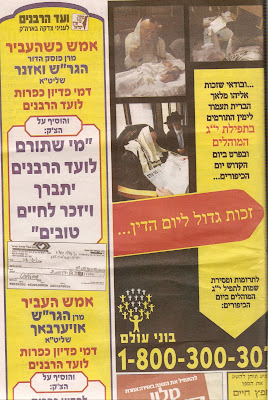
The Tzedaka campaigns are working overtime
Here are some of the ads that appeared in today's Yated Neeman. As you can see R' Chaim Kanievsky is featured prominently in many of them:



Thursday, October 02, 2008
What does המלך הקדוש mean?
This post, What does המלך הקדוש mean? , from 3 years ago is very relevant now during the עשרת ימי תשובה
Subscribe to:
Posts (Atom)