The Israeli governments of the past 15 years (since Oslo) have been great at making threats and not carrying them out. Remember Rabin's threat about what would happen to the Palestinians if they used the rifles against us? Was the threat carried out? Do you remember Barak's threat right before we pulled out of Lebanon? Do you remember Sharon and Mofaz's threat right before the disengagement?
Israel has become the boy who cried wolf. The governments have made so many threats and not carried them out that threats now have zero credibility.
Thursday, May 15, 2008


Wednesday, May 07, 2008
Peres: I didn't imagine Qassams would be fired from Gaza after pullout
Here is a list of things that Peres didn't think were going to happen:
1. He believed the separation between the West Bank and Gaza would make things easier not harder.
2. He did not imagine that we would leave Gaza and they would fire Qassams from there.
3. He did not imagine that Hamas would show so strongly in the elections.
(taken from here)
In other words on some of the most important issues of the past decade he was absolutely wrong. The thing is he is not embarrassed at all for being wrong on every single one of these. It isn't just Peres, everyone on the left made the same mistakes. The problem is that they don't learn from their mistakes rather they repeat them over and over again.
1. He believed the separation between the West Bank and Gaza would make things easier not harder.
2. He did not imagine that we would leave Gaza and they would fire Qassams from there.
3. He did not imagine that Hamas would show so strongly in the elections.
(taken from here)
In other words on some of the most important issues of the past decade he was absolutely wrong. The thing is he is not embarrassed at all for being wrong on every single one of these. It isn't just Peres, everyone on the left made the same mistakes. The problem is that they don't learn from their mistakes rather they repeat them over and over again.
Monday, May 05, 2008
Some facts about the Palestinians
Dov Bear is spouting his stupidity again about the Palestinians.
Here are some facts. These are in no particular order.
1. There has never ever in history been a state of Palestine Here is a great quote about Palestine and Palestinians Myths of the Middle East
The truth is that Palestine is no more real than Never-Never Land. The first time the name was used was in 70 A.D. when the Romans committed genocide against the Jews, smashed the Temple and declared the land of Israel would be no more. From then on, the Romans promised, it would be known as Palestine.
...
Palestine has never existed -- before or since -- as an autonomous entity. It was ruled alternately by Rome, by Islamic and Christian crusaders, by the Ottoman Empire and, briefly, by the British after World War I. The British agreed to restore at least part of the land to the Jewish people as their homeland.
There is no language known as Palestinian. There is no distinct Palestinian culture. There has never been a land known as Palestine governed by Palestinians. Palestinians are Arabs, indistinguishable from Jordanians (another recent invention), Syrians, Lebanese, Iraqis, etc. Keep in mind that the Arabs control 99.9 percent of the Middle East lands. Israel represents one-tenth of 1 percent of the landmass.
2. In the late 1800's every travelogue written about the area (the most famous being Mark Twain's) invariably said that the country was desolate and void of inhabitants, where were all the millions of Palestinians? For instance, a travel guide to Palestine and Syria, published in 1906 by Karl Baedeker, illustrates the fact that, even when the Islamic Ottoman Empire ruled the region, the Muslim population in Jerusalem was minimal. The book estimates the total population of the city at 60,000, of whom 7,000 were Muslims, 13,000 were Christians and 40,000 were Jews. So much for the myth of Arab East Jerusalem.
3. In the Middle East there are 22 Arab countries occupying 99% of the land. Israel occupies less then 1% of the Middle East
4. There is no distinctive Palestinian culture, language, etc. Palestinians are Arabs, they speak Arabic, they are mostly Moslem. The leader of the Palestinians, Yasir Arafat was born in Cairo. What makes Arafat more of a Palestinian then me?
5. From 1948-1967 Israel did not occupy the West Bank and Gaza, where was the call for a Palestinian state?
6. There actually is a Palestinian state already, Jordan. The mandate of Palestine included what is now Jordan, in 1922, the British created an Arab state from 80% of mandatory Palestine called Jordan
7. The 20th century has seen tremendous movement of population. When India and Pakistan were created more then 20 million people moved one way of the other. Yet, no one is calling for a right of return.
8. About 800,000 Palestinians became refugees in 1948 (mostly on the urgings of Arab leaders), from 1948-1953 about 800,000 Jews living in Arab countries became refugees. Contrary to the Palestinians, these Jews were absorbed by Israel and are now productive citizens
9. In 1948 the Palestinians were offered a state they rejected it, the same happened in July 2000.
Let's double click on the 1800's.
When the Jews first started coming back in numbers in the 1800's, the land was desolate, this is not me talking but Mark Twain and every other traveler to Palestine in the late 1800's. And I quote from Twain:
"Desolate country whose soil is rich enough but is given over wholly to weeds—a silent mournful expanse…A desolation is here that not even imagination can grace with the pomp of life and action. We reached Tabor safely…We never saw a human being on the whole route…
"There was hardly a tree or a shrub anywhere. Even the olive and the cactus, those fast friends of a worthless soil, had almost deserted the country…
Stirring scenes ... occur in the valley [Jezreel] no more. There is not a solitary village throughout its whole extent-not for thirty miles in either direction. There are two or three small clusters of Bedouin tents, but not a single permanent habitation. One may ride ten miles hereabouts and not see ten human beings
"Palestine sits in sackcloth and ashes. Over it broods the spell of a curse that has withered its fields and fettered its energies. Palestine is desolate and unlovely."
Lamartine wrote:
"Outside the gates of Jerusalem we saw Indeed no living object, heard no living object, heard no living sound, we found the same void the same silence…as we should have expected before the entombed gates of Pompeli or Herculaneam…a complete eternal silence reigns in the town, on the highways in the country…the tomb of a whole people."(Recollections of the East, vol. 1, pp. 268, 308, London, 1815).
The British Consul in Palestine reported in 1857 that
The country is in a considerable degree empty of inhabitants and therefore its greatest need is that of a body of population.... 18 In the 1860s, it was reported that "depopulation is even now advancing."19 At the same time, H. B. Tristram noted in his journal that
The north and south [of the Sharon plain] land is going out of cultivation and whole villages are rapidly disappearing from the face of the earth. Since the year 1838, no less than 20 villages there have been thus erased from the map [by the Bedouin] and the stationary population extirpated. 20
Where were all those indigenous Palestinians???????
The fact is that the Jews purchased land from absentee owners started to work the land and revived the economy. Because of that Arabs from all over the region migrated to Palestine.
This old post Is Gaza "captured" territory? is very relevant as well.
Here are some facts. These are in no particular order.
1. There has never ever in history been a state of Palestine Here is a great quote about Palestine and Palestinians Myths of the Middle East
The truth is that Palestine is no more real than Never-Never Land. The first time the name was used was in 70 A.D. when the Romans committed genocide against the Jews, smashed the Temple and declared the land of Israel would be no more. From then on, the Romans promised, it would be known as Palestine.
...
Palestine has never existed -- before or since -- as an autonomous entity. It was ruled alternately by Rome, by Islamic and Christian crusaders, by the Ottoman Empire and, briefly, by the British after World War I. The British agreed to restore at least part of the land to the Jewish people as their homeland.
There is no language known as Palestinian. There is no distinct Palestinian culture. There has never been a land known as Palestine governed by Palestinians. Palestinians are Arabs, indistinguishable from Jordanians (another recent invention), Syrians, Lebanese, Iraqis, etc. Keep in mind that the Arabs control 99.9 percent of the Middle East lands. Israel represents one-tenth of 1 percent of the landmass.
2. In the late 1800's every travelogue written about the area (the most famous being Mark Twain's) invariably said that the country was desolate and void of inhabitants, where were all the millions of Palestinians? For instance, a travel guide to Palestine and Syria, published in 1906 by Karl Baedeker, illustrates the fact that, even when the Islamic Ottoman Empire ruled the region, the Muslim population in Jerusalem was minimal. The book estimates the total population of the city at 60,000, of whom 7,000 were Muslims, 13,000 were Christians and 40,000 were Jews. So much for the myth of Arab East Jerusalem.
3. In the Middle East there are 22 Arab countries occupying 99% of the land. Israel occupies less then 1% of the Middle East
4. There is no distinctive Palestinian culture, language, etc. Palestinians are Arabs, they speak Arabic, they are mostly Moslem. The leader of the Palestinians, Yasir Arafat was born in Cairo. What makes Arafat more of a Palestinian then me?
5. From 1948-1967 Israel did not occupy the West Bank and Gaza, where was the call for a Palestinian state?
6. There actually is a Palestinian state already, Jordan. The mandate of Palestine included what is now Jordan, in 1922, the British created an Arab state from 80% of mandatory Palestine called Jordan
7. The 20th century has seen tremendous movement of population. When India and Pakistan were created more then 20 million people moved one way of the other. Yet, no one is calling for a right of return.
8. About 800,000 Palestinians became refugees in 1948 (mostly on the urgings of Arab leaders), from 1948-1953 about 800,000 Jews living in Arab countries became refugees. Contrary to the Palestinians, these Jews were absorbed by Israel and are now productive citizens
9. In 1948 the Palestinians were offered a state they rejected it, the same happened in July 2000.
Let's double click on the 1800's.
When the Jews first started coming back in numbers in the 1800's, the land was desolate, this is not me talking but Mark Twain and every other traveler to Palestine in the late 1800's. And I quote from Twain:
"Desolate country whose soil is rich enough but is given over wholly to weeds—a silent mournful expanse…A desolation is here that not even imagination can grace with the pomp of life and action. We reached Tabor safely…We never saw a human being on the whole route…
"There was hardly a tree or a shrub anywhere. Even the olive and the cactus, those fast friends of a worthless soil, had almost deserted the country…
Stirring scenes ... occur in the valley [Jezreel] no more. There is not a solitary village throughout its whole extent-not for thirty miles in either direction. There are two or three small clusters of Bedouin tents, but not a single permanent habitation. One may ride ten miles hereabouts and not see ten human beings
"Palestine sits in sackcloth and ashes. Over it broods the spell of a curse that has withered its fields and fettered its energies. Palestine is desolate and unlovely."
Lamartine wrote:
"Outside the gates of Jerusalem we saw Indeed no living object, heard no living object, heard no living sound, we found the same void the same silence…as we should have expected before the entombed gates of Pompeli or Herculaneam…a complete eternal silence reigns in the town, on the highways in the country…the tomb of a whole people."(Recollections of the East, vol. 1, pp. 268, 308, London, 1815).
The British Consul in Palestine reported in 1857 that
The country is in a considerable degree empty of inhabitants and therefore its greatest need is that of a body of population.... 18 In the 1860s, it was reported that "depopulation is even now advancing."19 At the same time, H. B. Tristram noted in his journal that
The north and south [of the Sharon plain] land is going out of cultivation and whole villages are rapidly disappearing from the face of the earth. Since the year 1838, no less than 20 villages there have been thus erased from the map [by the Bedouin] and the stationary population extirpated. 20
Where were all those indigenous Palestinians???????
The fact is that the Jews purchased land from absentee owners started to work the land and revived the economy. Because of that Arabs from all over the region migrated to Palestine.
This old post Is Gaza "captured" territory? is very relevant as well.
Tuesday, April 29, 2008
Ben Gurion Airport ranked as the best airport in the Middle East
The World's Best Airports
South Korea's Incheon tops the list for the third year, Porto leads Europe, Dallas-Fort Worth wins first place stateside, and Ben Gurion is best in the Mideast
Some good news for a change.
South Korea's Incheon tops the list for the third year, Porto leads Europe, Dallas-Fort Worth wins first place stateside, and Ben Gurion is best in the Mideast
Some good news for a change.
Here we go again: Another Knesset split
The Pensioners party is splitting up and it looks like 3 of the 7 are forming a new party.
Israel has a list based election system. You don't vote for any individual person but you vote for a party list. Given that, it makes no sense to allow any Knesset member to leave his party and and form a new one. He was not elected and it is not his seat. The party was elected and the party should control the seat. If an MK doesn't like it let him resign. The current system is the worst of both worlds. There is no personal accountability, you cannot vote anyone out of office, if they are high on the list they will be in the Knesset. On the other hand the MK's can do whatever they want with the seat once they get it. This is a formula for disaster and is anti-democratic (remember Sharon and Kadima).
Israel has a list based election system. You don't vote for any individual person but you vote for a party list. Given that, it makes no sense to allow any Knesset member to leave his party and and form a new one. He was not elected and it is not his seat. The party was elected and the party should control the seat. If an MK doesn't like it let him resign. The current system is the worst of both worlds. There is no personal accountability, you cannot vote anyone out of office, if they are high on the list they will be in the Knesset. On the other hand the MK's can do whatever they want with the seat once they get it. This is a formula for disaster and is anti-democratic (remember Sharon and Kadima).
Friday, April 25, 2008
Starting Shacharis at 11:30AM
I went to the Kotel on Chol Hamoed late in the morning. We go there about 11:30 and it was really hot so we went inside. We saw a number of Chasidim with taleisim and then I heard them saying kaddish after korbanos and then starting הודו. It is hard to believe that people are starting to daven shacharis at 11:30AM.


Note the timestamps on the pictures.


Note the timestamps on the pictures.
Wednesday, April 16, 2008
בדיקת חמץ nowadays, what do you need to check?
Nowadays that we clean for Pesach for weeks before, what do you need to check when you do בדיקת חמץ?
RSZA is quoted in הליכות שלמה פרק ה as saying that nowadays you do not need to go and check every little nook and cranny. What a person needs to do is check every place to make sure that it was cleaned for Pesach, that is the בדיקה. This means that the בדיקה does not need to take all night but rather a short time where you check each room, closet, etc. to make sure that it was cleaned for Pesach.
I heard a similar idea from R' Willig as well that the cleaning that you do before Pesach is מצטרף to your בדיקה and on the night of the 14th you do not need to spend hours checking every spot. All you need to do is make sure that you cleaned everything. The בדיקה is like the final check of all the cleaning that you did.
RSZA is quoted in הליכות שלמה פרק ה as saying that nowadays you do not need to go and check every little nook and cranny. What a person needs to do is check every place to make sure that it was cleaned for Pesach, that is the בדיקה. This means that the בדיקה does not need to take all night but rather a short time where you check each room, closet, etc. to make sure that it was cleaned for Pesach.
I heard a similar idea from R' Willig as well that the cleaning that you do before Pesach is מצטרף to your בדיקה and on the night of the 14th you do not need to spend hours checking every spot. All you need to do is make sure that you cleaned everything. The בדיקה is like the final check of all the cleaning that you did.
Monday, April 14, 2008
When to bake the matzah when Erev Pesach falls out on Shabbos?
There is a famous שיטת Rashi that the Matzas mitzva needs to be baked erev Pesach after חצות, otherwise you are not יוצא. Rashi gets this from the Gemara on Pesachim 120b where Rava has a היקש between מצה and קרבן פסח, that the זמן of eating מצה is the same as the זמן of eating קרבן פסח. Rashi understands that the היקש would likewise apply to the preparations, just like the קרבן פסח has to be prepared on erev Pesach after חצות, so too does the מצה. This is quoted as a יש אומרים in Shulchan Aruch. The Gra disagrees, one of his proofs is the following. What happens when erev Pesach is on Shabbos like this year? קרבן פסח is דוחה Shabbos and is therefore brought on Shabbos afternoon, however baking מצה is not דוחה Shabbos and therefore cannot be done on Shabbos afternoon. If so, how is anyone יוצא the mitzva of מצה, the מצה was not prepared in the זמן of the קרבן פסח? In truth, those rishonim who hold like Rashi say that when erev pesach is Shabbos, you bake the מצה on the seder night. However, the Gra's question stil holds. If the מצה needs to be baked in the זמן of the קרבן פסח, the seder night is too late, you cannot bring the קרבן פסח at that time.
A number of later acharonim answer as follows. The Gemara earlier states that the קרבן פסח is brought on Shabbos (and not that night after Shabbos) because it is זמנו קבוע. Rashi explains because there is a general din that korbanos cannot be brought at night. The acharonim ask, why didn't Rashi simply answer because the Torah says that the קרבן פסח needs to be brought on the 14th of Nisan and that night is already the 15th? They answer as follows. In halacha day follows night. However, by קרבנות the din is that night follows day. Therefore they say as follows. Although the seder night is the 15th in the calendar, with regards to קרבנות it is still the 14th as night follows day. Therefore, Rashi can't answer that the seder night is too late because that night is considered the 14th for קרבנות so Rashi needs to answer that קרבנות in general cannot be brought at night.
Based on this, we can answer the Gra's question as well. From the perspective of the קרבן פסח the night of the 15th is still the זמן, there is just a technical problem that you can't bring קרבנות at night, but from the pure קרבן פסח perspective it is the זמן and therefore you can bake the מצה that night. The היקש between מצה and קרבן פסח only relates to those special dinim of קרבן פסח, not to the regular dinim of קרבנות. Therefore from that perspective the seder night is still considered to be the זמן of the קרבן פסח and therefore you can bake the מצה then.
Some rishonim have a different version of Rashi. They understand that according to Rashi you need to bake the מצה on erev Pesach but even in the morning. This is clearly not connected to קרבן פסח as the קרבן פסח cannot be brought in the morning. The question is if so, why do you need to bake the מצה on erev Pesach?
RYBS explained as follows. The Yerushalmi has a din that it is prohibited to eat מצה on erev Pesach. The Ramban explains this as follows (why is the prohibition limited to erev Pesach). מצה is defined as being not חמץ. Without חמץ there can be no מצה. Before erev Pesach there is no halachic significance to חמץ, it doesn't really exist, therefore there can be no issur to eat מצה as if there is no חמץ there is no מצה. On erev Pesach when the mitzva of תשביתו destroying חמץ starts, then you can have מצה and therefore there is an issur to eat מצה.
Based on this RYBS explained Rashi. We know that מצת מצוה needs to be made לשמה. Rashi holds like this Ramban, that מצה is defined as being not חמץ and that without חמץ there can be no מצה. Therefore, before erev Pesach you cannot bake מצת מצוה because it can't be made לשמה as there is no שם מצה yet. Only on erev Pesach where there is halachic significance to חמץ can there be מצה made לשמה. Therefore Rashi says that the מצה needs to be baked on erev Pesach, even in the morning, to create the לשמה of מצת מצוה, and מצה baked earlier is no good because it lacks לשמה.
This also explains why they would bake the מצה on the seder night if erev Pesach was Shabbos.
A number of later acharonim answer as follows. The Gemara earlier states that the קרבן פסח is brought on Shabbos (and not that night after Shabbos) because it is זמנו קבוע. Rashi explains because there is a general din that korbanos cannot be brought at night. The acharonim ask, why didn't Rashi simply answer because the Torah says that the קרבן פסח needs to be brought on the 14th of Nisan and that night is already the 15th? They answer as follows. In halacha day follows night. However, by קרבנות the din is that night follows day. Therefore they say as follows. Although the seder night is the 15th in the calendar, with regards to קרבנות it is still the 14th as night follows day. Therefore, Rashi can't answer that the seder night is too late because that night is considered the 14th for קרבנות so Rashi needs to answer that קרבנות in general cannot be brought at night.
Based on this, we can answer the Gra's question as well. From the perspective of the קרבן פסח the night of the 15th is still the זמן, there is just a technical problem that you can't bring קרבנות at night, but from the pure קרבן פסח perspective it is the זמן and therefore you can bake the מצה that night. The היקש between מצה and קרבן פסח only relates to those special dinim of קרבן פסח, not to the regular dinim of קרבנות. Therefore from that perspective the seder night is still considered to be the זמן of the קרבן פסח and therefore you can bake the מצה then.
Some rishonim have a different version of Rashi. They understand that according to Rashi you need to bake the מצה on erev Pesach but even in the morning. This is clearly not connected to קרבן פסח as the קרבן פסח cannot be brought in the morning. The question is if so, why do you need to bake the מצה on erev Pesach?
RYBS explained as follows. The Yerushalmi has a din that it is prohibited to eat מצה on erev Pesach. The Ramban explains this as follows (why is the prohibition limited to erev Pesach). מצה is defined as being not חמץ. Without חמץ there can be no מצה. Before erev Pesach there is no halachic significance to חמץ, it doesn't really exist, therefore there can be no issur to eat מצה as if there is no חמץ there is no מצה. On erev Pesach when the mitzva of תשביתו destroying חמץ starts, then you can have מצה and therefore there is an issur to eat מצה.
Based on this RYBS explained Rashi. We know that מצת מצוה needs to be made לשמה. Rashi holds like this Ramban, that מצה is defined as being not חמץ and that without חמץ there can be no מצה. Therefore, before erev Pesach you cannot bake מצת מצוה because it can't be made לשמה as there is no שם מצה yet. Only on erev Pesach where there is halachic significance to חמץ can there be מצה made לשמה. Therefore Rashi says that the מצה needs to be baked on erev Pesach, even in the morning, to create the לשמה of מצת מצוה, and מצה baked earlier is no good because it lacks לשמה.
This also explains why they would bake the מצה on the seder night if erev Pesach was Shabbos.
Tuesday, April 08, 2008
Selling Chametz on pesach in Israel
There has been an unenforced law on the books for a long time that permits the public selling of Chametz in Israel. Last week a judge reinterpretated the law that it doesn't apply to stores rather it only applies to open markets. In other words, stores, restaurants, etc. are now free to sell chametz this Pesach.
The charedi and religious parties jumped on this and are trying to change the law so that it prohibits the sale of Chametz period.
IMHO, this is a big mistake. Religious coercion does not work in Israel. It just makes things worse. The real chiloni who wants his bread will get it even if he needs to break the law. The traditional person who doesn't eat chametz on pesach will still not eat chametz on pesach. So what is the point? This law will not make a single person not eat chametz. Religious even Charedi Jews manage to walk around Boro Park where all the stores are selling Chametz on Pesach and survive. All these kinds of laws do is make the chiloni population anti-religious. This is populism at it's worst.
The charedi and religious parties jumped on this and are trying to change the law so that it prohibits the sale of Chametz period.
IMHO, this is a big mistake. Religious coercion does not work in Israel. It just makes things worse. The real chiloni who wants his bread will get it even if he needs to break the law. The traditional person who doesn't eat chametz on pesach will still not eat chametz on pesach. So what is the point? This law will not make a single person not eat chametz. Religious even Charedi Jews manage to walk around Boro Park where all the stores are selling Chametz on Pesach and survive. All these kinds of laws do is make the chiloni population anti-religious. This is populism at it's worst.
Tuesday, April 01, 2008
The dollar is still worth 4 shekels according to the Gedolim
The dollar today, April 1, 2008, is worth 3.54809 Israeli New Shekel. I posted last month, The dollar is still worth 4 shekels according to the Gedolim, that the Gedolim decided that for the Areivim project the $18 monthly contribution is to be calculated at 4 shekel to the dollar. This month again both Areivim and the Gemach Hamercazi reiterated that the dollar is still 4 shekels.
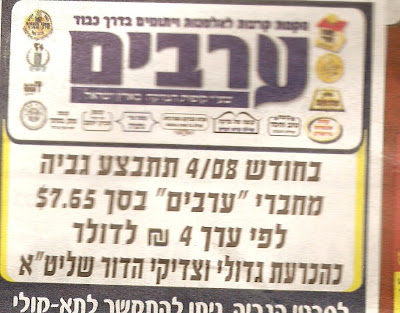

It will be interesting to see how long they continue with this as opposed to just switching to the shekel.


It will be interesting to see how long they continue with this as opposed to just switching to the shekel.
Sunday, March 30, 2008
Misleading statements in the name of Kiruv
Aish Hatorah published an article Women at Work which claims that Orthodox women can work at any job that they want.
Let's get something perfectly clear: Jewish women work. One of my neighbors is a nuclear physicist. I'm a zoo veterinarian.
...
And nowadays, like women all over the Western world, they work in every field. Some run their own businesses or are part of a larger corporation. Here in Israel one of my neighbors is a nuclear physicist. Another is a school principal. Several good friends are lawyers. One's a pediatrician. Two are successful artists. I'm a zoo veterinarian.
...
My point is, little is forbidden to us. We work in the fields we want. We have open choices. We can choose to work part-time or full-time.
If Aish Hatorah was a Modern or Centrist Orthodox institution then these statements would be perfectly true and not misleading. However, Aish Hatorah is a Charedi institution and it's goal for it's students is that they join Israeli Charedi society. The fact is that if Elizabeth had been born to a Charedi family she would not have had a choice to be a veterinarian, a nuclear physicist or anything other then a school teacher. University study is strictly prohibited. In Yerushalayim and Bnei Brak even getting a high school diploma is prohibited (see this post No Bagrut for Beis Yaakov girls?). All the women that she brings as examples fall into one of 2 categories:
1. Baalei teshuva
2. They grew up in modern homes
None of the women cited grew up in a Charedi home in Israel, because if they had they would not be where they are today.
In addition to the issue with secular education and university, there is an issue of tznius. In many parts of the Israeli Charedi world women are not allowed to drive a car because it is not tzanua. There are many seforim published in the last few years on tznius which prohibit women from working in any non-religious workplace. Therefore to state little is forbidden to us is misleading if not an outright lie according to Aish Hatorah's hashkafa.
I find it very offensive when Charedi kiruv institutions use examples of Baalei Teshiva or people who were brought up in a more Modern home. Using these people as examples of how well religious Jews can fit into society is very misleading when the institutions themselves don't believe in that hashkafa. According to Charedi hashkafa, Modern Orthodoxy is pasul and University study is prohibited, yet those are the examples they site when trying to be mekarev people. None of the faculty at Aish Hatorah in Yerushalayim send their daughters to university and their daughters do not have the ability to do what they want. They will be kollel wives who support their husbands by teaching or being a secretary, cashier etc. They have absolutely no choice to be Veterinarians, Nuclear Physicists, Lawyers, etc. To say otherwise is simply a lie.
Let's get something perfectly clear: Jewish women work. One of my neighbors is a nuclear physicist. I'm a zoo veterinarian.
...
And nowadays, like women all over the Western world, they work in every field. Some run their own businesses or are part of a larger corporation. Here in Israel one of my neighbors is a nuclear physicist. Another is a school principal. Several good friends are lawyers. One's a pediatrician. Two are successful artists. I'm a zoo veterinarian.
...
My point is, little is forbidden to us. We work in the fields we want. We have open choices. We can choose to work part-time or full-time.
If Aish Hatorah was a Modern or Centrist Orthodox institution then these statements would be perfectly true and not misleading. However, Aish Hatorah is a Charedi institution and it's goal for it's students is that they join Israeli Charedi society. The fact is that if Elizabeth had been born to a Charedi family she would not have had a choice to be a veterinarian, a nuclear physicist or anything other then a school teacher. University study is strictly prohibited. In Yerushalayim and Bnei Brak even getting a high school diploma is prohibited (see this post No Bagrut for Beis Yaakov girls?). All the women that she brings as examples fall into one of 2 categories:
1. Baalei teshuva
2. They grew up in modern homes
None of the women cited grew up in a Charedi home in Israel, because if they had they would not be where they are today.
In addition to the issue with secular education and university, there is an issue of tznius. In many parts of the Israeli Charedi world women are not allowed to drive a car because it is not tzanua. There are many seforim published in the last few years on tznius which prohibit women from working in any non-religious workplace. Therefore to state little is forbidden to us is misleading if not an outright lie according to Aish Hatorah's hashkafa.
I find it very offensive when Charedi kiruv institutions use examples of Baalei Teshiva or people who were brought up in a more Modern home. Using these people as examples of how well religious Jews can fit into society is very misleading when the institutions themselves don't believe in that hashkafa. According to Charedi hashkafa, Modern Orthodoxy is pasul and University study is prohibited, yet those are the examples they site when trying to be mekarev people. None of the faculty at Aish Hatorah in Yerushalayim send their daughters to university and their daughters do not have the ability to do what they want. They will be kollel wives who support their husbands by teaching or being a secretary, cashier etc. They have absolutely no choice to be Veterinarians, Nuclear Physicists, Lawyers, etc. To say otherwise is simply a lie.
Thursday, March 27, 2008
The Torah world in Israel by the numbers
Here are the number from this week's Mishpacha.

30,150 yeshiva students in 400 Yeshivos
61,243 married men learning in Kollel in 1239 different Kollelim (an average of 50 people per Kollel).
These are unprecedented numbers, over 90,000 people sitting and learning full time, (and this excludes all the kids in Yeshiva Ketana who learn full time).

30,150 yeshiva students in 400 Yeshivos
61,243 married men learning in Kollel in 1239 different Kollelim (an average of 50 people per Kollel).
These are unprecedented numbers, over 90,000 people sitting and learning full time, (and this excludes all the kids in Yeshiva Ketana who learn full time).
Saturday, March 22, 2008
The Torah world in Israel is on the verge of financial collapse
This was on the front page of this weeks Mishpacha magazine.

"We don't have from where to pay the kollel stipends"
There is panic in the administrative ranks of the torah institutions because of the economic crisis in the US, the fall of the dollar, the deep problems in the real estate sector in the US, and the rise in prices of basic products (e.g. flour, bread, etc.). For the first time, the administers of the Torah institutions who control huge budgets are talking in terms of a financial crisis that we haven't seen in many years in the Torah world. A number of the large Kollel chains did not pay stipends this past month and don't know how they are going to pay the Pesach stipends. Donors in the US who are affected by the crisis have shut off the flow of money to the Torah world. The heads of Tzedaka funds: The poor will have to make do with less this year.
This is not a surprise to me, the Torah world in Israel has for many years been on a non-sustainable economic path. The sub-prime crisis in the US has just speeded up the timetable a bit. Given what is going on in the US, this is not going to end soon and the damage will be great.

"We don't have from where to pay the kollel stipends"
Financial terror attack on the Torah world
There is panic in the administrative ranks of the torah institutions because of the economic crisis in the US, the fall of the dollar, the deep problems in the real estate sector in the US, and the rise in prices of basic products (e.g. flour, bread, etc.). For the first time, the administers of the Torah institutions who control huge budgets are talking in terms of a financial crisis that we haven't seen in many years in the Torah world. A number of the large Kollel chains did not pay stipends this past month and don't know how they are going to pay the Pesach stipends. Donors in the US who are affected by the crisis have shut off the flow of money to the Torah world. The heads of Tzedaka funds: The poor will have to make do with less this year.
This is not a surprise to me, the Torah world in Israel has for many years been on a non-sustainable economic path. The sub-prime crisis in the US has just speeded up the timetable a bit. Given what is going on in the US, this is not going to end soon and the damage will be great.
Thursday, March 20, 2008
Avos U'Banim time changes get the approval of the Gedolei Hador
Avos U'Banim is a big deal on Purim with special prizes etc. This year with Purim being on Friday it is difficult to find time for the hour of Avos U'Banim. Therefore a number of shuls decided to have Avos U'Banim on Taanis Esther between Mincha and Maariv.
One of the shuls put up a sign which stated that Avos Ubanim is Thursday between Mincha and Maariv and then at the bottom it stated the following:
This sign was shown to R' Chaim Kanievsky and he said Bracha V'Hatzlacha
In other words something as trivial as changing Avos U'Banim to Taanis Esther now needs the haskama of the Gedolei Hador. The shul in question has a Rabbi who is a big Talimd Chacham yet they felt the need to say that they had the approval of R' Chaim Kanievsky. What have we come to? Can no one other then the "Gedolei Hador" have an opinion anymore? Do we really need to bother someone like R' Chaim Kanievsky about what time we should make Avos Ubanim on Purim?
Rafi G has another example of this phenomenon. The Kupa shel tzdeka in RBS felt the need to go to put out the following flyer:
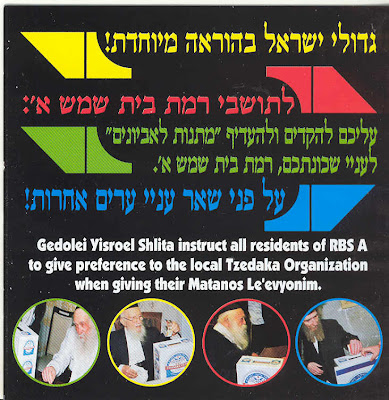
Again, this is a basic halacha of עניי עירך קודמים. Why do we need to hear this in the name of the "Gedolim"? Why wouldn't people ask their local Rav what to do?
One of the shuls put up a sign which stated that Avos Ubanim is Thursday between Mincha and Maariv and then at the bottom it stated the following:
This sign was shown to R' Chaim Kanievsky and he said Bracha V'Hatzlacha
In other words something as trivial as changing Avos U'Banim to Taanis Esther now needs the haskama of the Gedolei Hador. The shul in question has a Rabbi who is a big Talimd Chacham yet they felt the need to say that they had the approval of R' Chaim Kanievsky. What have we come to? Can no one other then the "Gedolei Hador" have an opinion anymore? Do we really need to bother someone like R' Chaim Kanievsky about what time we should make Avos Ubanim on Purim?
Rafi G has another example of this phenomenon. The Kupa shel tzdeka in RBS felt the need to go to put out the following flyer:

Again, this is a basic halacha of עניי עירך קודמים. Why do we need to hear this in the name of the "Gedolim"? Why wouldn't people ask their local Rav what to do?
Wednesday, March 19, 2008
Matanos L'evyonim a מחלוקת הקופות? II
Rafi G (Local RBS Tzedaka: corrupting the words of Rav Kanievsky) has another flyer which purports to tell people in the name of R' Chaim Kanievsky to whom to give Matanos L'Evyonim. Of course it contradicts all the flyers that I posted yesterday.
Here is the flyer courtesy of Rafi G:


Here is the flyer courtesy of Rafi G:


חייב איניש לבסומי בפוריא עד דלא ידע
The idea of Purim is that we are supposed to see the hand of God in everything. Purim was a נס נסתר, it could easily have been explained away as coincidence etc., yet the Jews realized that it was all from Hashem. A person who has true בטחון is a happy person. he doesn't let things bother him because he knows that everything is from Hashem even what seem to be problems/difficulties. It is like the old story about the guy who is rushing to catch a plane and just misses it, he gets really upset. An hour later he hears that the plane crashed. At that point he realizes that it was for the best that he missed the plane. We are supposed to view everything in life that way. Someone who is drunk isn't bothered by anything and therefore we get drunk on Purim to reach this state (even artificially) of not being bothered by lifes problems.
There are a number of caveats to the mitzva of getting drunk:
1. The mitzva is only during the day, there is NO mitzva whatsoever to get drunk on Purim night and therefore it is no different then getting drunk on any other night, e.g. assur.
2. According to many Rishonim the mitzva is only with wine (see the Rambam, Rashi in Megilla and others). Therefore anyone who drinks hard liquor is not mekayem the mitzva
3. The mitzva may only be in the seuda. The Rambam clearly holds this way as he puts this din with the halachos of the seuda. The Shulchan Aruch follows in the Rambam's footsteps and put this din in סי' תרצ"ה דיני סעודת פורים
4. The Mishna Berura writes that if you are going to be מזלזל in even the smallest mitva by getting drunk you shouldn't.
There are a number of caveats to the mitzva of getting drunk:
1. The mitzva is only during the day, there is NO mitzva whatsoever to get drunk on Purim night and therefore it is no different then getting drunk on any other night, e.g. assur.
2. According to many Rishonim the mitzva is only with wine (see the Rambam, Rashi in Megilla and others). Therefore anyone who drinks hard liquor is not mekayem the mitzva
3. The mitzva may only be in the seuda. The Rambam clearly holds this way as he puts this din with the halachos of the seuda. The Shulchan Aruch follows in the Rambam's footsteps and put this din in סי' תרצ"ה דיני סעודת פורים
4. The Mishna Berura writes that if you are going to be מזלזל in even the smallest mitva by getting drunk you shouldn't.
When to eat the Purim Seuda on Friday
See this post from the last time it happened, 3 years ago, When to eat the Purim Seuda this year?
Tuesday, March 18, 2008
Matanos L'evyonim a מחלוקת הקופות?
The קופת העיר ב"ב had the following ad in today's Yated Neeman.

The Gedolei Hador decided that you should give Matonos L'Evyonim to the Kupas Hair Bnei Brak the cleanest and best of tzedakos
It would seem that the Gedolim paskened that everyone should give their מתנות לאביונים to the קופת העיר ב"ב.
But wait. The ועד הרבנים לעניני צדקה בארה"ק seems to disagree. Their ad says:

The Hidur: the poskim of the generation said that the fulfillment of the mitzva of Matonos L'Evyonim in it's greatest form (hidur) is through the Vaad Harabanim
Here is a third ad from a Kupa in Kiryas Sefer:

The Kupa of the Gedolei Hador
If this is the Kupa of the Gedolei Hador then what about the Vaad Harabanim and the Kupas Hair Bnei Brak? Is the biggest hidur giving to the Vaad Harabanim or Kupas Hair Bnei Brak? I could go on but the questions are glaring.
What is my point here? The point is very simple. The use of the words "Gedolim" and "פסקו" or "הכריעו" is misleading and turns the gedolim and psak into a joke. Can there really be a psak that a certain tzedaka organization is "cleaner" then others?
Unfortunately, this is a trend where psak is being used on non-halachic issues (see this post פסקי הלכה on non-halachik issues for more) and it is a very dangerous and disturbing trend.

The Gedolei Hador decided that you should give Matonos L'Evyonim to the Kupas Hair Bnei Brak the cleanest and best of tzedakos
It would seem that the Gedolim paskened that everyone should give their מתנות לאביונים to the קופת העיר ב"ב.
But wait. The ועד הרבנים לעניני צדקה בארה"ק seems to disagree. Their ad says:

The Hidur: the poskim of the generation said that the fulfillment of the mitzva of Matonos L'Evyonim in it's greatest form (hidur) is through the Vaad Harabanim
Here is a third ad from a Kupa in Kiryas Sefer:

The Kupa of the Gedolei Hador
If this is the Kupa of the Gedolei Hador then what about the Vaad Harabanim and the Kupas Hair Bnei Brak? Is the biggest hidur giving to the Vaad Harabanim or Kupas Hair Bnei Brak? I could go on but the questions are glaring.
What is my point here? The point is very simple. The use of the words "Gedolim" and "פסקו" or "הכריעו" is misleading and turns the gedolim and psak into a joke. Can there really be a psak that a certain tzedaka organization is "cleaner" then others?
Unfortunately, this is a trend where psak is being used on non-halachic issues (see this post פסקי הלכה on non-halachik issues for more) and it is a very dangerous and disturbing trend.
Sunday, March 16, 2008
R' Chaim Kanievsky: It is prohibited to employ Arabs
YNET has a fascinating article, הרב קנייבסקי: לפטר עובדים ערבים בישיבות, which quotes R' Chaim Kanievsky on this issue.
After the attack on Mercaz Harav, several Yeshiva administrators asked R' Kanievsky if they should fire their Arab workers. He replied:
אסור בשום אופן להעסיק ערבים, חס ושלום. זו סכנת נפשות
It is absolutely prohibited to employ Arabs, it is life threatening
He also said that in any case we should hire Jews to give them a livelihood:
וכי אין יהודים שיעבדו ויתפרנסו?
are there no Jews who will work and make a living?
What is very encouraging is that almost all the talkbacks (including many non-religious Jews) are very supportive of what R' Kanievsky said.
I can't wait to hear what the left wing Knesset members say. It wouldn't surprise me if they had him investigated for incitement.
After the attack on Mercaz Harav, several Yeshiva administrators asked R' Kanievsky if they should fire their Arab workers. He replied:
אסור בשום אופן להעסיק ערבים, חס ושלום. זו סכנת נפשות
It is absolutely prohibited to employ Arabs, it is life threatening
He also said that in any case we should hire Jews to give them a livelihood:
וכי אין יהודים שיעבדו ויתפרנסו?
are there no Jews who will work and make a living?
What is very encouraging is that almost all the talkbacks (including many non-religious Jews) are very supportive of what R' Kanievsky said.
I can't wait to hear what the left wing Knesset members say. It wouldn't surprise me if they had him investigated for incitement.
Wednesday, March 12, 2008
Olmert to Ashkelon: Get used to rockets
ולמרט באשקלון: אין דרך למנוע ירי גראד
Unbelievable. He is failing in his most basic responsibility, to provide security to the citizens of Israel. How can the government just accept the fact that missiles are falling on a major city? If he and his government refuse to provide security then they should go home and let someone else try. The disengagement which he was an ardent supporter of is a good part of why this is happening.
There are over 500 talkbacks on this article and the overwhelming majority are very critical. I can't see how Olmert can stay in power much longer.
Unbelievable. He is failing in his most basic responsibility, to provide security to the citizens of Israel. How can the government just accept the fact that missiles are falling on a major city? If he and his government refuse to provide security then they should go home and let someone else try. The disengagement which he was an ardent supporter of is a good part of why this is happening.
There are over 500 talkbacks on this article and the overwhelming majority are very critical. I can't see how Olmert can stay in power much longer.
Subscribe to:
Posts (Atom)