Much of this is taken from last years posts, however, I added some additional material.
As now is succah building time I would like to post some common halachic issues that come up when building a succah.
When I was growing up, canvas succahs were very prevalent and in fact, are still widely used. These kinds of Succahs (as well as other non-wood succahs) have a number of halachic problems which I would like to address. For those who aren't familiar, a canvas succah is made of a frame of metal (or fiberglass, etc.) pipes on which canvas is hung to create the walls.
There are 2 issues with this kind of succah:
1. The walls move which may invalidate the wall completely which would invalidate the succah. The gemara, shulchan aruch etc. write that if a wall moves 3 tefachim (about a foot) in the wind then the wall is considered invalid. Every canvas succah that I have seen has walls that move 3 tefachim in the wind and therefore many poskim are not happy with them.
There is an easy solution to the problem which I used for many years. The solution is based on 2 halachos related to walls.
1. לבוד - this means that if you have 2 objects within 3 tefachim of each other the halacha considers it as if the intervening space is filled in.
2. A wall only needs to be 10 tefachim (40 inches) high. Once it is 10 tefachim high we look on it as if it extends up to the sky.
Given these 2 halachos we can construct walls of string for a canvas succah. What we do is tie string/rope from 1 pole to another. We space the string around 8.5 inches apart so that they are within 3 tefachim of each other. With 5 or 6 strings like this we have a wall of greater then 10 tefachim. It works because starting from the bottom, the bottom string is within 3 tefachim of the ground and therefore the intervening space is considered to be filled in. Each subsequent string is placed less then 3 tefachim above the previous one again using לבוד so that we look upon the space as solid. We repeat this until the top string is above 10 tefachim. We have created a wall that is halachically kosher and in actuality serves as the wall of the succah. We repeat this for all the walls.
There is 1 very big caveat that needs to be mentioned. The acharonim (Magen Avraham סי' תר"ל ס"ק א) say that a wall created just by לבוד one way (e.g. strings across the wall like I suggested) is called a מחיצה גרועה a weak (for lack of a better translation) wall. Therefore they say that if you are creating walls like this you need to have 4 walls even though normally, a succa does not require 4 walls (like for a reshus hayachid on Shabbos), rather it only requires 3, and really only 2 plus a tefach.
This means that if you want to be machshir your canvas succah using string and לבוד you have 2 choices:
1.you must do this on all 4 walls.
2.In addition to the strings across, you put string going up and down less then every 3 tefachim the length of the wall, you end up with a real mechitza. The reason being that the strings go both ways (you end up with squares less then 3 tefachim in length and width, שתי וערב) and there is no big gap of space. Therefore you no longer need 4 walls.
There is 1 other point to keep in mind. the סכך has to be placed after you create the walls of strings, otherwise it is a problem of תעשה ולא מן העשוי. If the סכך was already put down, then you need to move the scach around to avoid this problem.
I did this for years and it worked well.
2. מעמיד הסכך על דבר טמא - the gemara has 1 opinion that you are not allowed to support the סכך on something that cannot be used for סכך. There is a machlokes harishonim whether we pasken like this opinion. The Mishna Berura mentions that l'chatchela a person should try to be machmir and the contemporary poskim also say that a person should try to be machmir. This problem applies to any non-wood succah (canvas, fiberglass, etc.) as well.
I saw that RSZA said that this din does not apply to walls that are permanent. In Israel it is very common for people to build a succah on a porch, 1 wall is the wall of the building and the other 3 walls are the walls off the porch. The walls of the porch are usually either stone or a metal type railing and the scach rests on top of the walls. In either case RSZA said that since it is permanently connected to the building the gezera of מעמיד הסכך על דבר טמא would not apply in that case.
To get around this the minhag evolved to place wood poles on top of the metal walls and then rest the סכך on top of the wood poles. This makes the wood the מעמיד of the scach and the metal a מעמיד דמעמיד. There are 2 problems with this approach:
1. If the סכך would not fall without the wood then the wood is not considered a מעמיד. In other words if your succah is 6 feet wide and your סכך is 6.5 feet wide, if you just rest the סכך on wood poles it doesn't help, if you took away the wood the סכך would not fall it would rest on the metal. Therefore the metal is called the מעמיד of the סכך. The way to get around this is to make sure that the סכך would fall if you remove the wood, namely, move the סכך to one side so that it doesn't overlap the other wall (it is just very close). In that case, the סכך is truly being held up by the wood.
2. A number of acharonim point out the following. The wood that is used to hold up the סכך is in and of itself kosher סכך. therefore, why should we consider the wood a מעמיד of the סכך, rather it should just be considered סכך which is resting on the metal. I have not seen a good answer for this claim. I saw that RSZA argues on this sevara, I didn't have a chance yet to see why.
The Chazon Ish has an unbelievable chumra. The Chazon Ish understands (based on the Ramban in the milchamos) that even if you have a wooden succah, if the walls are held up by metal screws, that metal is considered to be a מעמיד of the סכך because if you took that metal out the walls would fall down and so would the סכך. In other words, if you have something that is mekabel tumah holding up any part of your succah such that without this piece the סכך would fall down (e.g. the walls would fall down causing the scach to fall) the Chazon Ish considers this to be מעמיד the סכך with a davar hamekabel tumah and no good. Basically according to the Chazon Ish you cannot use any metal to build your succah.
Almost no one holds like this Chazon Ish, it makes building a succah an absolute nightmare, you need to use wooden screws, etc. I remember in KBY everyone was amazed that the posek held from this Chazon Ish.
The bottom line is that with a wooden succah you avoid almost all of these problems and are yotze the mitzva. It is not difficult to build and therefore I highly recommend it.
The מקראי קדש raises the following issue which is halacha l'maase for me. He quotes an opinion that if you use the wall of a tall building as one of your walls (taller then 20 amos), even if the scach is below 20 amos (supported by something else) the wall is פסול because it is taller then 20 amos. The מקראי קדש disagrees and brings a number of sevaros.
1. The fact that the wall continues up is irrelevant, for your purposes you could take it away and your succah will not be affected.
2. The gemara (succa 2a) comments that you can build your succah out of metal (e.g. a permanent structure) even though a succa has to be a דירת עראי. If so why is taller then 20 amos no good? The answer is that taller then 20 amos can only be built as a דירת קבע, the halacha requires that you build the succah in a way that it could be built as a דירת עראי. therefore, the building wall even though it is above 20 amos, since the schach is below is kosher because it could be built as a דירת עראי.
The acharonim point out that you only say דופן עקומה when the wall reaches the scach. However, if the wall does not reach the schach you don't say דופן עקומה and you don't have a wall. This is very relevant especially in the situation I described above, if you are using לבוד to make walls and you have an overhang, you can't use דופן עקומה if the wall doesn't reach the scach and therefore you won't have a wall.
Tuesday, September 25, 2007


Wednesday, September 19, 2007
Picking your battles
This is something that the Charedi world has not yet learned. The Charedi world makes everything into a big issue and fight. A perfect example is the switch from Daylight time to Standard time. In the Western world this happens at the end of October beginning of November. In Israel, it already happened, why? So that Yom Kippur would end an hour earlier. This provoked some tremendous battles between the Charedi MK's and secular ones. The question we need to ask is, is it worth it? Is this really that important that we need to provoke a fight with the secular public?
I was very happy to see that Rabbi Horowitz Is Everything a 10? makes the same point.
I was very happy to see that Rabbi Horowitz Is Everything a 10? makes the same point.
Monday, September 17, 2007
Why is Rosh Hashana before Yom Kippur?
See my post from 2 years ago Why is Rosh Hashana before Yom Kippur?
Tuesday, September 11, 2007
What sound is a תרועה?
The Gemara in Rosh Hashana (34a) seems to offer 3 possibilities.
1. What we call a תרועה
2. What we call a שברים
3. What we call שברים-תרועה
The Gemara there quotes an interesting statement from ר' אבהו that he instituted the practice of blowing all 3 because of a ספק which is the correct תרועה.
The Rishonim ask a very fundamental question. What happened before ר' אבהו? Before ר' אבהו, some communities only blew שברים and some only תרועה. Were they not יוצא? How did this ספק come about? Everyone hears shofar every year so how did they forget what it was?
R' Hai Gaon has a fascinating answer. He says that really all 3 are called a תרועה and you are יוצא the mitzva by blowing any one of the 3. תרועה means a crying type of sound and all 3 fit the bill. ר' אבהו was bothered by the fact that since different communities blew differently people would not understand and think that the other person is not יוצא, he also felt that it made it look like there are different Torah's. Therefore, he instituted a common practice of blowing all 3 different possibilities. This is how the Ritva and others explained that in Musaf the minhag was to blow תשרת for מלכיות and תשת for זכרונות and תרת for שופרות. If there really was a safek then you should need to blow all 3 after each section of the שמונה עשרה. However, according to R' Hai it makes perfect sense, since you are יוצא with any of them we are not מטריח the people to blow so many קולות.
Tosafos and the Rambam however disagree. They hold that ר' אבהו had a real safek and you are only יוצא with one of the 3, the other 2 are wrong. It comes out, that before ר' אבהו it would seem that many people were simply not יוצא the mitzvah. The obvious question is how could this have happened? In truth, we can ask this on many cases. For example, everyone wears tefillin every day and yet there is a machlokes what is the order or the parshiyos. You have to say that over teh years the mesora was lost or got corrupted and there was a genuine doubt as to what is called a תרועה.
1. What we call a תרועה
2. What we call a שברים
3. What we call שברים-תרועה
The Gemara there quotes an interesting statement from ר' אבהו that he instituted the practice of blowing all 3 because of a ספק which is the correct תרועה.
The Rishonim ask a very fundamental question. What happened before ר' אבהו? Before ר' אבהו, some communities only blew שברים and some only תרועה. Were they not יוצא? How did this ספק come about? Everyone hears shofar every year so how did they forget what it was?
R' Hai Gaon has a fascinating answer. He says that really all 3 are called a תרועה and you are יוצא the mitzva by blowing any one of the 3. תרועה means a crying type of sound and all 3 fit the bill. ר' אבהו was bothered by the fact that since different communities blew differently people would not understand and think that the other person is not יוצא, he also felt that it made it look like there are different Torah's. Therefore, he instituted a common practice of blowing all 3 different possibilities. This is how the Ritva and others explained that in Musaf the minhag was to blow תשרת for מלכיות and תשת for זכרונות and תרת for שופרות. If there really was a safek then you should need to blow all 3 after each section of the שמונה עשרה. However, according to R' Hai it makes perfect sense, since you are יוצא with any of them we are not מטריח the people to blow so many קולות.
Tosafos and the Rambam however disagree. They hold that ר' אבהו had a real safek and you are only יוצא with one of the 3, the other 2 are wrong. It comes out, that before ר' אבהו it would seem that many people were simply not יוצא the mitzvah. The obvious question is how could this have happened? In truth, we can ask this on many cases. For example, everyone wears tefillin every day and yet there is a machlokes what is the order or the parshiyos. You have to say that over teh years the mesora was lost or got corrupted and there was a genuine doubt as to what is called a תרועה.
What does המלך הקדוש mean?
Wednesday night we are all going to start saying המלך הקדוש, what does it really mean? I refer you to an old post What does המלך הקדוש mean? which addresses this issue.
Thursday, September 06, 2007

Tuesday, September 04, 2007
The שיר של יום
Every day we say the שיר של יום which is what the לויים said in the Beis Hamikdash. The Gemara in Rosh Hashana (31a) details the שיר של יום for every day of the week and for Shabbos. The simple understanding of the Gemara on (30b) is that in addition there was a special שיר של יום for Yom Tov as well.
The Minhag Ashkenaz for the שיר של יום on Shabbos and Yom Tov is very difficult. We say מזמור שיר ליום השבת after musaf. However, the Gemara says that מזמור שיר ליום השבת was the שיר for the תמיד של שחר, for the תמיד of musaf they said the שירה of האזינו (split into the six aliyos one aliaya a week). Therefore, really we should say מזמור שיר ליום השבת after shacharis like nusach sefard as that is it's place. To ay it after musaf and say that this is what the Leviim said is simply not true. The Aruch Hashulchan makes this point and says he doesn't understand the minhag. It's also interesting that we don't say the שיר mentioned in the gemara for shabbos musaf or mincha.
On Yom Tov it is not clear whether there was a different שיר at shacharis, there definately was one for musaf. Therefore, again our minhag of saying the regular שיר של יום on Yom Tov is difficult because that was not what was said at musaf.
The Minhag Ashkenaz for the שיר של יום on Shabbos and Yom Tov is very difficult. We say מזמור שיר ליום השבת after musaf. However, the Gemara says that מזמור שיר ליום השבת was the שיר for the תמיד של שחר, for the תמיד of musaf they said the שירה of האזינו (split into the six aliyos one aliaya a week). Therefore, really we should say מזמור שיר ליום השבת after shacharis like nusach sefard as that is it's place. To ay it after musaf and say that this is what the Leviim said is simply not true. The Aruch Hashulchan makes this point and says he doesn't understand the minhag. It's also interesting that we don't say the שיר mentioned in the gemara for shabbos musaf or mincha.
On Yom Tov it is not clear whether there was a different שיר at shacharis, there definately was one for musaf. Therefore, again our minhag of saying the regular שיר של יום on Yom Tov is difficult because that was not what was said at musaf.
Sunday, September 02, 2007
Shofar on Shabbos
The Mishna in Rosh Hashana (29b) states that they blew shofar in the mikdash but not בגבולין (for our purposes outside of Yerushalayim, there is a big machlokes rishonim what it means exactly). The Gemara asks why don't we blow on Shabbos? The Gemara first brings R' Levi Bar Chama that it is a דין דאורייתא based on pesukim, the Torah says in one place יום תרועה and in another place זכרון תרועה. One is on a weekday one is on Shabbos. The Gemara rejects this and says it is because of Rabbah's gezerah that he will carry. Interestingly enough the Yerushalmi does not reject the hava amina and the simple understanding of the Yerushalmi is that not blowing shofar on Shabbos is a דין דאורייתא. What is even more interesting is that when Rosh Hashana does fall out on Shabbos, in davening we say זכרון תרועה.
Tosafos asks why is it that after the churban habayis the חכמים allowed blowing the shofar on Shabbos in a place where there is a בית דין, while by לולב after the churban we simply don't take it on Shabbos even where there is a בית דין? They answer that the shofar's purpose is to bring our זכרונות up to שמים and therefore Chazal felt that they could not completely abolish the practice of blowing shofar on Shabbos, there had to be somewhere where the shofar was blown. Based on this, what about today? We don't blow shofar anywhere when Rosh Hashana falls out on Shabbos.
As I mentioned above the Gemara explains that we don't blow on Shabbos because of גזירה דרבה. However, it is clear from the Mishna that this was a much earlier גזירה as רבה is one of the late amoraim and the Mishna states that in the time of the Beis Hamikdash they did not blow shofar on Shabbos outside of Yerushalayim. We see that the גזירה was in existence for a long time before רבה, it is a little strange that the Gemara attributes it to רבה.
Tosafos asks why is it that after the churban habayis the חכמים allowed blowing the shofar on Shabbos in a place where there is a בית דין, while by לולב after the churban we simply don't take it on Shabbos even where there is a בית דין? They answer that the shofar's purpose is to bring our זכרונות up to שמים and therefore Chazal felt that they could not completely abolish the practice of blowing shofar on Shabbos, there had to be somewhere where the shofar was blown. Based on this, what about today? We don't blow shofar anywhere when Rosh Hashana falls out on Shabbos.
As I mentioned above the Gemara explains that we don't blow on Shabbos because of גזירה דרבה. However, it is clear from the Mishna that this was a much earlier גזירה as רבה is one of the late amoraim and the Mishna states that in the time of the Beis Hamikdash they did not blow shofar on Shabbos outside of Yerushalayim. We see that the גזירה was in existence for a long time before רבה, it is a little strange that the Gemara attributes it to רבה.
Wednesday, August 29, 2007
What is the מצוה of שופר?
At first glance there are 2 possibilities, שמיעה or ,תקיעה. The mitzva is either to hear the shofar or blow it.
This seems to be a machlokes harishonim. The Rambam and others emphasize that the mitzva is שמיעה and therefore the beracha is לשמוע קול שופר. The Rosh on the other hand quotes Rabbenu Tam that the beracha is על תקיעת שופר strongly implying that the mitzva is the תקיעה.
The acharonim point out that both opinions are quite difficult.
The acharonim ask a number of questions on each opinion. If the mitzva is שמיעה then why does the תוקע have to be מכון to be מוציא you? After all, you heard the shofar, who cares what the blower's kavana was. On the other hand if the mitzva is the תקיעה then how can somene else blow for you? We know that by a מצוה שבגופו you can't appoint a שליח. For example, someone else cannot put on tefillin for you or sit in the succah for you or shake a lulav for you. If so, how can they blow shofar for you? Also, according to R' Tam why does the mishna say that if you blow in a בר and you hear an echo you are not יוצא, why not? After all you blew the shofar.
Based on the above and more the acharonim say that shofar is a hybrid, both the תקיעה and the שמיעה are part of the mitzva. Therefore, you need both aspects to be יוצא.
We are left with 1 question how can someone blow for you it is a מצוה שבגופו?
The answer may be as follows. Sofar is considered by the gemara to be avodas pnim and is considered to be tefila. The Gemara says that we say מלכויות to crown hashem, זכרונות so that he remembers ובמה בשופר. The shofar is a vehicle of tefilla and therefore maybe just like I can be מוציא you in tefilla through שומע כעונה, so too I can be מוציא you in תקיעת שופר because it is tefilla.
The machlokes about the beracha would then seem to be which of the 2 parts of the mitzva is the עיקר , more important. Although both are needed, the beracha needs to focus on one and the machlokes is which one should we pick.
This seems to be a machlokes harishonim. The Rambam and others emphasize that the mitzva is שמיעה and therefore the beracha is לשמוע קול שופר. The Rosh on the other hand quotes Rabbenu Tam that the beracha is על תקיעת שופר strongly implying that the mitzva is the תקיעה.
The acharonim point out that both opinions are quite difficult.
The acharonim ask a number of questions on each opinion. If the mitzva is שמיעה then why does the תוקע have to be מכון to be מוציא you? After all, you heard the shofar, who cares what the blower's kavana was. On the other hand if the mitzva is the תקיעה then how can somene else blow for you? We know that by a מצוה שבגופו you can't appoint a שליח. For example, someone else cannot put on tefillin for you or sit in the succah for you or shake a lulav for you. If so, how can they blow shofar for you? Also, according to R' Tam why does the mishna say that if you blow in a בר and you hear an echo you are not יוצא, why not? After all you blew the shofar.
Based on the above and more the acharonim say that shofar is a hybrid, both the תקיעה and the שמיעה are part of the mitzva. Therefore, you need both aspects to be יוצא.
We are left with 1 question how can someone blow for you it is a מצוה שבגופו?
The answer may be as follows. Sofar is considered by the gemara to be avodas pnim and is considered to be tefila. The Gemara says that we say מלכויות to crown hashem, זכרונות so that he remembers ובמה בשופר. The shofar is a vehicle of tefilla and therefore maybe just like I can be מוציא you in tefilla through שומע כעונה, so too I can be מוציא you in תקיעת שופר because it is tefilla.
The machlokes about the beracha would then seem to be which of the 2 parts of the mitzva is the עיקר , more important. Although both are needed, the beracha needs to focus on one and the machlokes is which one should we pick.
Thursday, August 23, 2007
Cremation in Israel
The only crematorium in Israel went up in flames last night sparking a debate about cremation. Shas is introducing legislation which will ban cremation completely.
IMHO this is a very bad idea. Religious coercion doesn't work in Israel in fact many times it hurts more then it helps. We need to pick our battles and I don't see how cremation is that big of an issue. It is an issur but so is shaving with a razor. It is not an issue that has ramifications for the Jewish people at large and in fact, the estimate is that a few hundred people a most would be cremated a year. These kinds of laws just antagonize the non-religious population and don't contribute anything.
IMHO this is a very bad idea. Religious coercion doesn't work in Israel in fact many times it hurts more then it helps. We need to pick our battles and I don't see how cremation is that big of an issue. It is an issur but so is shaving with a razor. It is not an issue that has ramifications for the Jewish people at large and in fact, the estimate is that a few hundred people a most would be cremated a year. These kinds of laws just antagonize the non-religious population and don't contribute anything.
יפת תאר and כהנים
In this week's parsha we have the din of יפת תאר. The Rambam writes in Hilchos Melachim (8:4)
הכוהן מותר ביפת תואר בביאה ראשונה, שלא דיברה תורה אלא כנגד היצר; אבל אינו יכול לישא
אותה אחר כן, לפי שהיא גיורת.
A Kohen is permitted to have relations with a יפת תאר because the Torah only permitted it to appease the evil inclination, but he can not marry her because she is a convert
We see from here that the din of יפת תאר applies to a כהן. This is very interesting because the din of יפת תאר only applies to soldiers fighting in a war. The clear implication is that Kohanim fought in the army.
In fact, the Rambam earlier implies this as well. In פרק ז where he discusses who leaves the army, he writes the following:
המחזיר את גרושתו, והמארס אישה האסורה לו, כגון אלמנה לכוהן גדול, גרושה וחלוצה לכוהן הדיוט ...
Someone who remarries hios divorced wife or someone who marries a woman he is prohibited from marrying such as a Kohen Gadol and an widow a regular Kohen and a divorcee ...
Again the Rambam discusses Kohanim in the context of the army.
This seems to contradict that Rambam at the end of hilchos shemita where he seems to exempt Shevet Levi.
I looked in the Frankel Rambam and to my great surprise none of the standard commentaries on the Rambam discuss this issue. The only references were to sefarim I never heard of and have no access to.
הכוהן מותר ביפת תואר בביאה ראשונה, שלא דיברה תורה אלא כנגד היצר; אבל אינו יכול לישא
אותה אחר כן, לפי שהיא גיורת.
A Kohen is permitted to have relations with a יפת תאר because the Torah only permitted it to appease the evil inclination, but he can not marry her because she is a convert
We see from here that the din of יפת תאר applies to a כהן. This is very interesting because the din of יפת תאר only applies to soldiers fighting in a war. The clear implication is that Kohanim fought in the army.
In fact, the Rambam earlier implies this as well. In פרק ז where he discusses who leaves the army, he writes the following:
המחזיר את גרושתו, והמארס אישה האסורה לו, כגון אלמנה לכוהן גדול, גרושה וחלוצה לכוהן הדיוט ...
Someone who remarries hios divorced wife or someone who marries a woman he is prohibited from marrying such as a Kohen Gadol and an widow a regular Kohen and a divorcee ...
Again the Rambam discusses Kohanim in the context of the army.
This seems to contradict that Rambam at the end of hilchos shemita where he seems to exempt Shevet Levi.
I looked in the Frankel Rambam and to my great surprise none of the standard commentaries on the Rambam discuss this issue. The only references were to sefarim I never heard of and have no access to.
Monday, August 20, 2007
What is the nature of דינים דרבנן?
In last week's parsha שופטים, we have the din of לא תסור.
There is a well known מחלקת between the Rambam and the Ramban (ספר המצות שורש א) about the nature of דינים דרבנן. The Rambam holds that all דינים דרבנן are based on לא תסור. In other words there is a חיוב דאורייתא to listen to them. The Ramban asks an obvious question, if so why do we say ספק דרבנן לקולא? After all, if you violate a דרבנן you are violating the איסור דאורייתא of לא תסור?
The Meshech Chochma (Devarim 17:11) explains the Rambam as follows. He says that every דין דרבנן is not necessarily a fulfillment of the will of Hashem. The proof is that the Rambam paskens based on the Gemara that a later greater Beis Din can be מבטל a תקנה of an earlier Beis Din. If every תקנה was the will of Hashem how could that be? Therefore, he explains that by דינים דרבנן what is not important is the actual mitzva act, but the fact that you listened to the חכמים and did not rebel against their words. The איסור of לא תסור is an איסור to rebel against the חכמים, to not listen to them. Given that, we understand why ספק דרבנן לקולא because the act of doing the mitzva is not the main point, the point is listening to the חכמים, once it is a ספק, there is no need to do the act because it is not so important (contrast that to a מצוה דאורייתא where the act is clearly an unequivocally the רצון השם).
Based on the above, we can answer another question, do you need to do teshuva for violating an איסור דרבנן. Based on the Mehsech Chochma's understanding of the Rambam the answer would be no. Since the whole idea of דינים דרבנן is to listen the חכמים and not rebel against them as the Meshech Chocham explains, then by definition an עבירה דרבנן בשוגג is not a problem, you did not rebel, you did not know that you were doing an issur and therefore there is no need for teshuva.
The Nesivos סימן רלד סעיף ג also holds that an aveira b'shogeg doesn't need כפרה it would seem for the same reason, that there is no מעשה עבירה.
This idea may also explain those שיטות that hold that a פסיק רישא דלא ניחא ליה is permitted by an איסור דרבנן. Since the whole idea of דינים דרבנן is to listen the חכמים and not rebel against them, a פסיק רישא דלא ניחא ליה is not called rebelling against them, you are not directly doing the action that is prohibited, in fact you don't want it to happen. Therefore, even though it will definitely happen, since you are not doing it directly, it is not an act of rebellion against the חכמים and therefore permitted.
There is a well known מחלקת between the Rambam and the Ramban (ספר המצות שורש א) about the nature of דינים דרבנן. The Rambam holds that all דינים דרבנן are based on לא תסור. In other words there is a חיוב דאורייתא to listen to them. The Ramban asks an obvious question, if so why do we say ספק דרבנן לקולא? After all, if you violate a דרבנן you are violating the איסור דאורייתא of לא תסור?
The Meshech Chochma (Devarim 17:11) explains the Rambam as follows. He says that every דין דרבנן is not necessarily a fulfillment of the will of Hashem. The proof is that the Rambam paskens based on the Gemara that a later greater Beis Din can be מבטל a תקנה of an earlier Beis Din. If every תקנה was the will of Hashem how could that be? Therefore, he explains that by דינים דרבנן what is not important is the actual mitzva act, but the fact that you listened to the חכמים and did not rebel against their words. The איסור of לא תסור is an איסור to rebel against the חכמים, to not listen to them. Given that, we understand why ספק דרבנן לקולא because the act of doing the mitzva is not the main point, the point is listening to the חכמים, once it is a ספק, there is no need to do the act because it is not so important (contrast that to a מצוה דאורייתא where the act is clearly an unequivocally the רצון השם).
Based on the above, we can answer another question, do you need to do teshuva for violating an איסור דרבנן. Based on the Mehsech Chochma's understanding of the Rambam the answer would be no. Since the whole idea of דינים דרבנן is to listen the חכמים and not rebel against them as the Meshech Chocham explains, then by definition an עבירה דרבנן בשוגג is not a problem, you did not rebel, you did not know that you were doing an issur and therefore there is no need for teshuva.
The Nesivos סימן רלד סעיף ג also holds that an aveira b'shogeg doesn't need כפרה it would seem for the same reason, that there is no מעשה עבירה.
This idea may also explain those שיטות that hold that a פסיק רישא דלא ניחא ליה is permitted by an איסור דרבנן. Since the whole idea of דינים דרבנן is to listen the חכמים and not rebel against them, a פסיק רישא דלא ניחא ליה is not called rebelling against them, you are not directly doing the action that is prohibited, in fact you don't want it to happen. Therefore, even though it will definitely happen, since you are not doing it directly, it is not an act of rebellion against the חכמים and therefore permitted.
How many people are learning full time in Israel?
According to last week's Mishpacha magazine the numbers are as follows (approximations):
Yeshiva Ketana (high school age) - 21,000
Yeshiva Gedola - 31,000
Kollelim - 56,000
These numbers are unbelievable. The big question is how much longer can this last.
Yeshiva Ketana (high school age) - 21,000
Yeshiva Gedola - 31,000
Kollelim - 56,000
These numbers are unbelievable. The big question is how much longer can this last.
Thursday, August 16, 2007
What does a מלאך look like?
The Gemara in Rosh Hashana 24b and Avoda Zara 43b learns out from the pasuk לא תעשון אתי that we are not allowed to make representations of many things including מלאכים. This halacha is brought down in Shulchan Aruch in יו"ד סימן קמ"א. Since there is an issur to create a representation of a מלאך we need to know what it looks like so we know what not to do. Interestingly enough none of the commentaries on the Shulchan Aruch on the page explain what a מלאך looks like. However, the Ran in Avoda Zara comments that a representation of a מלאך is a human being with wings because this is how a מלאך is perceived by a נביא.
It comes out that this Ran would seem to be the source for the depictions of מלאכים with wings.
I addressed this gemara in a different context relating to a 7 branched menora in a previous post A 7 branch Menora
It comes out that this Ran would seem to be the source for the depictions of מלאכים with wings.
I addressed this gemara in a different context relating to a 7 branched menora in a previous post A 7 branch Menora
Wednesday, August 15, 2007
Whatever happened to giving צדקה simply because it's a mitzva?
These days every ad that I see in Yated Neeman for צדקה is pushing how the צדקה will help you the giver. Talmidei Chachamim will daven for you, it will help your children in their learning, help you have children, help your parnasa, etc. What ever happened to giving צדקה simply because it is a mitzva? Why does the benefit to the giver need to be promoted so?
Below are all the ads that appeared for צדקה in today's Yated Neeman. You can see that every single one touts the benefits for the giver.



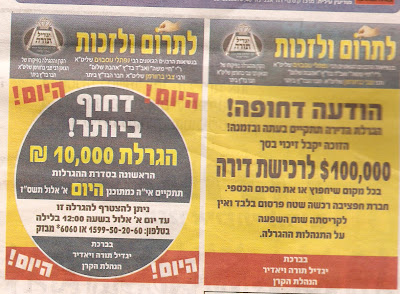

Below are all the ads that appeared for צדקה in today's Yated Neeman. You can see that every single one touts the benefits for the giver.


Monday, August 13, 2007
Rap in Yiddish
Some Charedi musicians/singers took some popular rap songs and transformed them into Yiddish. It has of course been banned in Israel. You can listen to a sampling of some the songs here סערה בעולם החרדי: פיפטי סנט ומדונה ביידיש
Sunday, August 12, 2007
The collapse of Heftziba
Everyone in Israel has been talking about the collapse of the construction company Hetziba especially the Charedi world as Heftziba did a lot of construction for the Charedi world.
This past weeks Mishpacha had 2 opinion pieces about the situation, one by a former MK who is not involved and one by a Kannoi who has a regular column (for example he wrote vehemently against participating in the Israeli elections) who bought an apartment from Heftziba for his children and could very well have lost hundreds of thousands of shekels.
The contrast is startling. The former MK writes about how time after time the Charedi population tries to save/make money and ends up losing everything. He doesn't understand why the Charedi population is so gullible and easily cheated.
The Kannoi on the other hand writes an angry bitter article demanding that someone do something so that he gets his money back. While I understand his pain I would like to make a few comments.
Basically, he brought this on himself. Here are some of the things he did that created the situation.
1. The government passed a law about 15 years ago requiring that buyers of new apartments receive bank guarantees on their payments to cover exactly what happened with Heftziba. If the contractor goes bankrupt the buyer gets all his money back. Heftziba, offered discounts to Charedim if they would forgo the bank guarantees. R' Kannoi writes proudly in the article that he opted to take a discount instead of the bank guarantees. In essence, he wants to have his cake and eat it. He opted to forgo the bank guarantees to save money but now wants the protection of those same bank guarantees.
2. He signed a contract without a lawyer. Many in the Israeli Charedi world don't trust lawyers and after all, a lawyer charges 1.5% of the price. As he himself admitted he doesn't know anything about real estate and has no idea what he actually signed.
3. He bought on paper. While there is nothing wrong with buying on paper, however, he paid 80% of the total price in advance (without bank guarantees). By law, you are not allowed to pay more then 15% in this situation. In addition, it is simply not a very smart thing to do especially without bank guarantees. Why did he do this? Again, for a discount.
What is most interesting is that he expects the government and the Charedi parties/MK's to bail him out. Even though he is vehemently opposed to participating in the elections, he wants the Charedi MK's/political parties to use their clout to get him his money back. Of course, the only reason they have any clout/power is because they did participate in the elections and according to him are violating an aveira of sitting with reshaim. I guess money talks.
Last but not least, I was disappointed by a lack of emuna. When it comes to money people seem to lose their emuna. After all הכל בידי שמים חוץ מיראת שמים and כל מזונותיו של אדם קצובים לו מראש השנה. Whatever happened was a גזירה משמים, he was meant to lose this money, if so, why such anger, frustration and pain? Why didn't instead he write a column about this explaining the lesson he should learn from this?
This past weeks Mishpacha had 2 opinion pieces about the situation, one by a former MK who is not involved and one by a Kannoi who has a regular column (for example he wrote vehemently against participating in the Israeli elections) who bought an apartment from Heftziba for his children and could very well have lost hundreds of thousands of shekels.
The contrast is startling. The former MK writes about how time after time the Charedi population tries to save/make money and ends up losing everything. He doesn't understand why the Charedi population is so gullible and easily cheated.
The Kannoi on the other hand writes an angry bitter article demanding that someone do something so that he gets his money back. While I understand his pain I would like to make a few comments.
Basically, he brought this on himself. Here are some of the things he did that created the situation.
1. The government passed a law about 15 years ago requiring that buyers of new apartments receive bank guarantees on their payments to cover exactly what happened with Heftziba. If the contractor goes bankrupt the buyer gets all his money back. Heftziba, offered discounts to Charedim if they would forgo the bank guarantees. R' Kannoi writes proudly in the article that he opted to take a discount instead of the bank guarantees. In essence, he wants to have his cake and eat it. He opted to forgo the bank guarantees to save money but now wants the protection of those same bank guarantees.
2. He signed a contract without a lawyer. Many in the Israeli Charedi world don't trust lawyers and after all, a lawyer charges 1.5% of the price. As he himself admitted he doesn't know anything about real estate and has no idea what he actually signed.
3. He bought on paper. While there is nothing wrong with buying on paper, however, he paid 80% of the total price in advance (without bank guarantees). By law, you are not allowed to pay more then 15% in this situation. In addition, it is simply not a very smart thing to do especially without bank guarantees. Why did he do this? Again, for a discount.
What is most interesting is that he expects the government and the Charedi parties/MK's to bail him out. Even though he is vehemently opposed to participating in the elections, he wants the Charedi MK's/political parties to use their clout to get him his money back. Of course, the only reason they have any clout/power is because they did participate in the elections and according to him are violating an aveira of sitting with reshaim. I guess money talks.
Last but not least, I was disappointed by a lack of emuna. When it comes to money people seem to lose their emuna. After all הכל בידי שמים חוץ מיראת שמים and כל מזונותיו של אדם קצובים לו מראש השנה. Whatever happened was a גזירה משמים, he was meant to lose this money, if so, why such anger, frustration and pain? Why didn't instead he write a column about this explaining the lesson he should learn from this?
Thursday, August 09, 2007
The Israeli Supreme Court is at it again
Naomi Blumenthal was convicted of bribery and was sentenced to a few months in jail. She appealed to the president for clemency because of her personal situation (her husband died etc.) and the President agreed and canceled her jail term. The organization for good government petitioned the Supreme Court to cancel the clemency.
The law (a Basic law) specifically gives the President the power to grant clemency with no reservations. In other words, there is no absolutely no room for the court's intervention. The law give the President the power of clemency with no reservations. The fact that the court even agreed to hear the case is a travesty.
Bill Clinton before he left office pardoned a whole bunch of people including Marc Rich. There was a lot of criticism but no one would have dreamed of appealing to the Supreme Court and if someone would have they would have been throw it. There is simply no legal issue. The President has the absolute right to pardon who he wants, the same thing applies in Israel. The fact that the court is even hearing the case highlights the judicial tyranny of the Supreme Court in Israel.
The law (a Basic law) specifically gives the President the power to grant clemency with no reservations. In other words, there is no absolutely no room for the court's intervention. The law give the President the power of clemency with no reservations. The fact that the court even agreed to hear the case is a travesty.
Bill Clinton before he left office pardoned a whole bunch of people including Marc Rich. There was a lot of criticism but no one would have dreamed of appealing to the Supreme Court and if someone would have they would have been throw it. There is simply no legal issue. The President has the absolute right to pardon who he wants, the same thing applies in Israel. The fact that the court is even hearing the case highlights the judicial tyranny of the Supreme Court in Israel.
Tuesday, August 07, 2007
Arabs, Jews to be subject to same airport security check
Mofaz: Arabs, Jews to be subject to same airport security check
This is so stupid it would be laughable if it wasn't so serious. The system here has worked for 60 years but let's throw it out the window because it is not politically correct. The bottom line is that Israeli Jews are not terrorists and are not trying to blow up planes while Arabs are. No amount of skating around the issue can change this fundamental fact. Given that, it makes perfect sense to subject Arabs to more stringent security checks.
I have a great idea for Mofaz, let's bring in the TSA.
This is so stupid it would be laughable if it wasn't so serious. The system here has worked for 60 years but let's throw it out the window because it is not politically correct. The bottom line is that Israeli Jews are not terrorists and are not trying to blow up planes while Arabs are. No amount of skating around the issue can change this fundamental fact. Given that, it makes perfect sense to subject Arabs to more stringent security checks.
I have a great idea for Mofaz, let's bring in the TSA.

Subscribe to:
Posts (Atom)